
WKU News
Curiosity in Motion: How Lincoln Potts Found His Path in Physics
- Nina Marijanovic
- Monday, February 16th, 2026
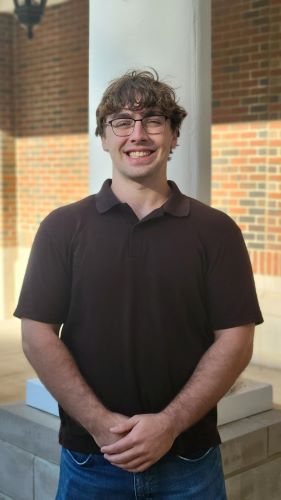
When Lincoln Potts first walked onto WKU’s campus as a Gatton Academy student, research wasn’t part of his plan. “I initially didn’t want to research,” he admitted. “I was like, I don’t know about all that—that’s some really nerdy stuff I would never do.”
But watching his classmates pursue projects that combined creativity and discipline changed his mind. “I saw all these people doing these research projects, and they were actually putting in work and getting stuff out of it. I thought, I should probably at least try it.”
That simple decision set off a chain reaction. Lincoln began with a small physics experiment—rolling cylinders filled with fluids of different viscosities—and by the end of his time at Gatton, he was designing components for a gamma-ray detector array as part of a national collaboration in nuclear physics.
The project, called NOPTREX, investigates a fundamental law of physics known as time-reversal symmetry—the idea that if you could reverse time in an equation, the same rules of physics should still apply. “In some rare cases, that’s not what happens,” Lincoln explained. “We’re studying why.”
To do that, his team designs a circular array of detectors that surround a sample being hit with subatomic particles. When the particles strike the target, they release tiny bursts of gamma radiation. Measuring those bursts from multiple angles allows scientists to detect extremely subtle asymmetries in how energy behaves—clues that could deepen our understanding of how matter and antimatter differ, and how the universe formed.
“It sounds abstract, but I like that it’s hands-on,” Lincoln said. “I got to help design parts of the detector system that make those measurements possible. That’s where the engineering comes in.”
That discovery—bridging the creative problem-solving of engineering with the theoretical wonder of physics—shaped his next major choice: staying at WKU for college. While some Gatton peers chased distant universities, Lincoln saw unique opportunities right where he already was. “At WKU, I could really have time to explore both of my majors—mechanical engineering and physics—and still dive into research easily,” he said. “I already knew everyone, and it’s just easier to get connected here.”
It turned out to be the right call. The summer after graduating Gatton in 2024, Lincoln earned a spot in a Research Experience for Undergraduates (REU) at the University of Kentucky—an experience that gave him the credentials and confidence to apply for the IRES Program in Japan, an international nuclear research exchange.
“Dr. [Ivan] Novikov told me to apply for the REU, but the deadline was the next day,” Lincoln laughed. “I emailed the director anyway, and they extended it so I could send my application. I ended up getting in—and that opportunity completely shaped what came next.”
Through IRES, Lincoln joined Nagoya University’s physics department for ten weeks of research and cross-cultural collaboration. “Nagoya isn’t a tourist city like Tokyo,” he said. “Almost no one spoke English, and that actually made it better—we really immersed ourselves in the culture.”
He described the lab structure as radically different from what he’d known: professors and students working side by side in one shared room, learning through direct collaboration. “It made me more comfortable working with anyone from another culture,” Lincoln reflected. “Even with the language barrier, science is its own language. You draw a diagram on the board, point at an equation, and suddenly you’re both on the same page.”
That experience cemented his passion for the field and expanded his global perspective on research. He now sees his dual majors as stepping stones toward graduate study in nuclear engineering. “When I picked mechanical engineering and physics, I didn’t know they were the perfect combination for nuclear engineering,” he said. “Now I realize how well they fit together.”
Between his heavy course load, ongoing research with Dr. Novikov, and preparation for conferences in Chicago and Virginia, Lincoln’s weeks are packed. “I treat research like a part-time job,” he said. “Then I go to the gym. It keeps me balanced—it keeps everything fun.”
Lincoln’s discipline and humility continue to guide him forward. Though he didn’t receive the Goldwater Scholarship last year, he’s applying again. “That’s all right,” he said with a grin. “I’ll apply again. It’s all part of the process.”
Some of the links on this page may require additional software to view.