

Policies and Guidelines Regarding Student Organization
Supervision of student organizations rests with the Office of Student Activities and Organizations.
The Rights of Student Organizations
- Students forming organizations may secure registration for the organizations, provided they comply with the regulations for student organizations.
- Registered student organizations may use campus facilities, provided the facilities are used for the purpose contracted, subject to the regulations of the University.
- Registered student organizations may invite and hear speakers of their choice subject to the University's speakers policy. The responsibility of assuming the consequences of one's own actions.
- The responsibility to insure that no student organization, constitution, or other organizational document includes discriminatory clauses pertaining to race, creed, religion, color, sex, national origin, disability, or sexual orientation.
- The responsibility to respect the rights and property of others, including other students, the faculty, and the administration.
- The responsibility to recognize that student actions reflect upon the individuals involved and upon the entire university community.
- The responsibility for knowledge of and observance of established University policies presented in official University publications.
Student organizations are categorized into the following types:
- Social Sororities and Fraternities
- Honor, Leadership, and Recognition Societies
- Departmental Organizations and Professional Fraternities
- Political Organizations
- Government Organizations
- Specialty Organizations (religious, athletic, military, etc.)
I. Membership
Membership in student organizations shall be limited to students, faculty, and staff of the University, except honor, leadership, and recognition societies, which may include other persons as provided for in their national constitutions.
II. Registration
Any student organization that wishes to use the Western Kentucky University name, facilities, or property, or to solicit thereon must be registered with the Vice President of Student Experience. Its registration is at the discretion of the Vice President for Student Experience. Students may establish and maintain an organization for any lawful purpose consistent with the University's purposes as outlined in the University catalog. A group seeking University registration must submit a petition to the Office of the Vice President of Student Experience by way of Student Activities containing the following information:
- A constituent document (e.g., charter, constitution, articles, by-laws, or other
specific statement of the organization's structure and rules of procedure). Contained
in that statement or document should be the following:
- A clear statement of purposes.
- Requirements for and obligations of membership.
- A limitation on membership to matriculated students, but without any restrictions based on sex, race, religion and national origin except as expressly permitted by law.
- An affirmation or pledge that the organization is willing to comply with all laws, rules, and regulations of the University as a condition to initial and continued registered status.
- Identification of organization, authorized spokesmen, and a permanent mailing address.
- A statement from a faculty or staff member indicating willingness to serve as a faculty advisor.
The Office of the Vice President of Student Experience shall notify the petitioning organization by letter of the action taken on the petition.
Student organizations must be registered before they may use University facilities or property. The Office of the Vice President of Student Experience shall promulgate regulations governing the use of University facilities by registered student organizations. These regulations shall specify the times when facilities and premises are available for use, the manner in which they may be used, and how they may be reserved.
III. Advisors
Each such organization must comply with the following requirements for advisors upon submission of an application for registration:
- Every social fraternity or sorority shall have a University advisor who shall be appointed by the Vice President of Student Experience and a faculty advisor elected by the membership.
- Every honor, leadership or recognition society shall have a faculty advisor elected by the membership.
- Every departmental organization and professional fraternity shall have a faculty advisor.
- Every political organization shall have a University advisor elected by the membership or, failing that, appointed by the Vice President of Student Experience, as well as a faculty advisor elected by the membership.
- Every government organization shall have a University advisor appointed by the Vice President of Student Experience.
- Every specialty organization shall have a sponsor, who must be approved by the Vice President of Student Experience, and a faculty advisor elected by the membership.
The definition and scope of the various advisors required above is as follows:
- University Advisor: A member of the University staff within the Division of the Vice President of Student Experience or any administrative office under the Vice President's jurisdiction whose duty shall be to counsel and advise the organization and its officers as to their powers and responsibilities. However, the Vice President of Student Experience shall have no authority to prohibit any proposed action by a political organization.
- Faculty Advisor: A member of the faculty or the University connected with or interested in the organization, who shall offer support and advice to the officers in carrying out the purposes of the organization and shall be available to meet with members of the organization.
- Sponsor: A responsible person interested in the organization's purpose(s), who shall provide guidance and counsel to the officers in carrying out the purpose(s) of the organization and shall be available to meet with the members of the organization at their regular meetings.
Organizational Conduct Procedure
Authority and Responsibility for Student Organization Conduct:
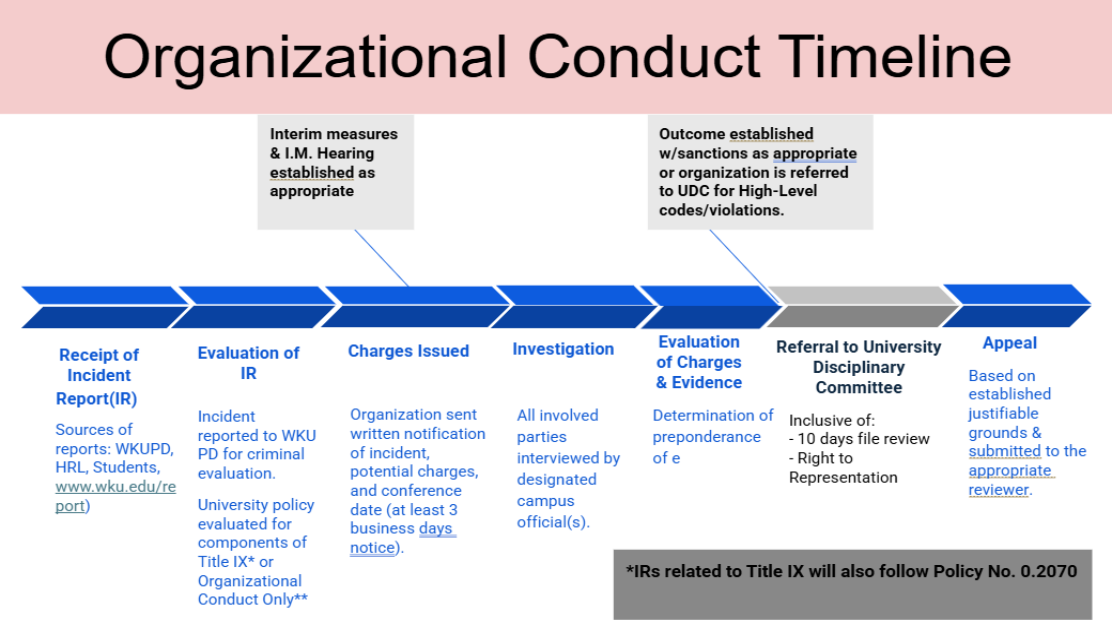
The Department of Student Activities and Organizations, or the appropriate governing bodies typically handle minor student organization violations or conflicts; however, certain violations may be handled by the Office of Student Conduct and/or the Office of Institutional Equity, due to the nature of the violation, including, but not limited to: Hazing, Unruly Conduct, Sexual Misconduct, Major Alcohol violations, and general Student Code of Conduct allegations.
The Office of Student Conduct,in consultation with Student Activities and Organizations, may impose a range of sanctions/actions from restricted participation, probation, interim suspension, and refusal or cancellation of registration.
Roles in Student Organization Conduct:
- Director of Student Activities and Organizations or designee - The Director of Student Activities and Organizations or designee is responsible for the oversight of all student organizations and may handle minor violations related to the policies and procedures for student organizations at WKU.
- The Office of Student Conduct - The Office of Student Conduct is appointed by the Vice President for Student Experience to be primarily responsible for investigating all serious allegations of the Student Code of Conduct. Student organization violations of a serious nature might include, but are not limited to, Hazing, Unruly Conduct, Major Alcohol violations, and general Student Code of Conduct allegations, which are the responsibility of the Office of Student Conduct. The Office of Student Conduct conducts investigations in cooperation with Student Activities and Organizations.
- Vice President for Student Experience - The Vice President for Student Experience is responsible for the overall coordination of rules and regulations regarding student organizations. The Vice President of Student Experience may assign a designee to act in their stead. The Vice President of Student Experience reserves the right to determine if a case should be handled by the Office of Student Conduct rather than Student Activities and Organizations when, in the Vice President's sole discretion, they believe that the circumstances warrant such action or have a conflict of interest.
Preponderance of the Evidence
The standard of proof for a Student Code of Conduct conference will be the preponderance of evidence. For a student or student organization to be found responsible for violation(s) of the Student Code of Conduct, the information presented must indicate that it is more likely than not that the violation occurred
Offenses
Offenses as defined that violate the Student Code of Conduct when committed by student organizations include:
- Hazing
- Interference, coercion or disruption that impedes, impairs, or disrupts University missions, processes, or functions, or interferes with the rights of registered student organizations.
- Conduct that is disorderly, abusive, drunken, violent, or excessively noisy.
- Discrimination against any person due to sex, race, religion, sexual orientation, and national origin, except as expressly permitted by law.
- Knowingly electing, appointing or retaining as an elected or appointed officer or committee chair any student on academic probation, financially delinquent to the University, or under disciplinary sanctions which prohibit the student from holding such office.
- Organizing, sponsoring, implementing or conducting programs or activities that are violations of law or University policy.
- Recurrent financial over-obligation and non-payment of debts.
- Recognized student organizations may use the University's trademarks and/or logos only with the permission of the University, and only in accordance with the University's Trademark and licensing Policies and Procedures.
- Any violation of University rules or policies that apply to registered student organizations or their use of University facilities or property.
- Student organizations or individuals representing student organizations are subject to conduct outcome(s) by the Office of Student Conduct when found responsible for a violation of any standards of the Code of Student Conduct.
Preliminary Procedures
- The University shall have notified the organization or students in writing as to the time and place of the conference to be held by the Director of Student Conduct or the University Disciplinary Committee for the organization or individual student conduct matters and of the nature of the problem or charge and the information against the organization or students.
- Notification to the organization or student (s) shall be made at least three days before the conference is to be held.
- The organization will meet with the Office of Student Activities and Organizations to gain an understanding of the process, discuss the details of the allegations, and to determine if there is a responsibility for the alleged violation.
- The Director of Student Activities and other designated staff shall provide the Office of Student Conduct with a written report of the facts of the case and the determination of responsibility.
- The Office of Student Conduct will meet with the organization or students determined to be involved and assign an outcome if deemed responsible.
- A follow-up letter of outcome or action taken will be sent to the organization.
Student Organization Outcomes
Student Organizations found responsible for violations of the Code of Student Conduct
or University policy will be subject to the following outcomes:
- Educational Outcomes - An outcome that may be used in lieu of or in combination with
other outcomes. Educational Outcomes will be consistent
with the behavior. Educational seminars, classes, and/or workshops can be adopted for use in the outcome. - Restitution - Reimbursement by transfer of property or service to the University,
other organizations, or a member of the University community in an
amount not in excess of the damage or loss incurred. Reimbursement may be accompanied by other outcomes. - Restricted University Participation/Loss of Privileges – Exclusion for a period of
time from participation in extracurricular activities for a designated
period, including University-wide events such as intramural sports and Homecoming (as an organization), as well as Greek-affiliated events such as
Greek Week. This sanction may also include revocation of the Sophomore Housing exemption. - Probation - A period of observation and review of conduct in which the student organization
demonstrates compliance with the provisions of University
regulations. Organizations on probation shall not have any restricted participation or loss of privileges, unless specifically noted. - Deferred Suspension - In some cases, an outcome of suspension may be held in abeyance
for a specified period. This means that, if the student
organization is found responsible of any violation during that period, the organization will be subject to the deferred outcome without further review, in
addition to the conduct action appropriate to the new violation. An organization that is placed on deferred suspension may continue to hold meetings but may
not sponsor any activity or program. - Interim Suspension – Temporary exclusion from all organizational activities may be
imposed prior to and/or during the course of a student organization’s
conduct proceedings. While on interim suspension, the organization is prohibited from holding meetings, sponsoring events, or engaging in any
activity or program. Interim suspension may be enacted under the following circumstances:- To ensure the safety and well-being of members of the university
community. - To ensure organizational compliance with the conduct process.
- To ensure the safety and well-being of members of the university
- Suspension/Loss of Recognition – Exclusion from recognition as a student organization for a period of time, generally from one term to one year.
- Long term Suspension - Exclusion for the student organization for any time that is over one calendar year.
Right of Appeal
The University understands the need to have a corrective process in place to address circumstances should the conduct officer err.
The decision of the original conduct administrator or committee may be appealed as set in theStudent Code of Conduct (WKU Policy No 6.3000)
Some of the links on this page may require additional software to view.