
WKU News
Undergraduate’s Journey in Naylor Workshop
- Melisa Morgan, edited by Brielle Freeman
- Thursday, November 12th, 2026
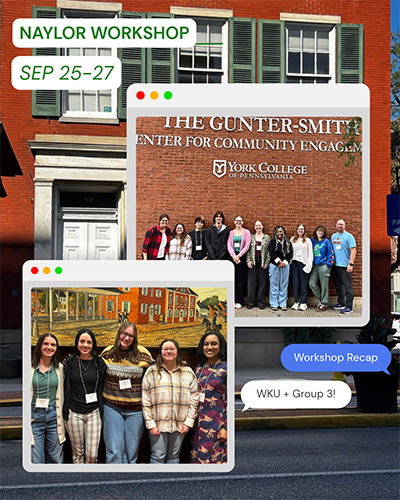
My Naylor Workshop journey started very early Friday morning. By early, I mean 2:50 AM with 3 hours and 30 minutes of sleep. I felt like an anxious zombie ready to be at the Nashville airport. Elene, Emma, and I headed straight for a coffee cafe. After a much-needed recharge, it was time to get on the plane for a 1-hour-and-50-minute flight.
When we arrived at the Yorktowne Hotel, it felt like I stepped into the world of The Suite Life of Zack & Cody. It was fancy, especially with your own personal room and a roommate. For me, it was someone from WKU; her name is Christina. Since Christina and I had already been in a Victorian Lit class together, we were familiar with each other.
After quickly settling into the room, we had time to spare, so the majority of us from WKU and one person from Clayton State University decided to explore the city, especially since Elene and Emma knew of a good coffee shop.
After exploring the Pennsylvania city, we had a little time before we had to go to the banquet. The banquet was inside a hotel in a fancy dining room. You are seated in the group that you are assigned to before arriving at the workshop. Then, we got to hear from the plenary speaker, Dr. Rebecca Babcock, who discussed personal archives like postcards.
On Saturday, Christina and I left our room and headed to the Gunter-Smith Center for Community Engagement for breakfast, which is a separate building from the hotel. When we arrived, we got food and then went to our group for more networking. Conversations ranged from topics of research to enthusiastic emotions leading up to the introduction presentations.
After everyone was eating breakfast, it was time to transition to introductions, which made my heart beat out of my chest with nervousness. The brave person who started the introductions was Tony, who is a WKU student. His research topic was about AI and data centers; he wants to give a voice to members of rural communities to communicate their concerns.
When Tony was done introducing his topic, people slowly followed his lead in introducing their topics. Introducing your topic was voluntary, which means not everyone stood up, but whenever someone was talking, I was thinking, “Okay, I’ll volunteer to be next,” but I waited so long that I literally jumped out of my chair as the last person. Did my chair knock over? Yes, it did… and I will block that moment out of my memory; but before I knew it, it was my turn to speak.
If I were to tell you that my hands and voice weren’t shaking, I’d be lying. With an experience like this, you are pushed to get out of your comfort zone in a rewarding way.
My topic was about “How can content from underrepresented authors be made more visible/pushed to readers on social platforms?” This question is especially important because social media and the algorithms tend to privilege a narrow range of author identities and experiences. And I want my research to provide pathways for readers to seek out diverse genres and authors in order to create change in the industry, because it’s important to learn about different life experiences and identities beyond your own.
When I sat down after my short introduction, I was proud, despite my hands shaking.
Later, during our group sessions, the three of us undergraduates each had the opportunity to present our projects, whether they were early-stage questions or fully defined studies, and share where we needed guidance. As a group, we listened and added input when needed while letting our mentors provide more guidance than we did.
Our group discussion flew by; it was time to switch to Speeding Mentor part one, where each undergraduate researcher moves among stations with a specific mentor to discuss possible next steps and methods for the study and gather advice from methods experts. For me, I met with Hunter, who helped me organize my research methods toward interviewing and community-based work, especially with libraries. We discussed my project goal and how it became community-based because I want to create a welcoming environment for underrepresented authors. We also drafted interview questions that I could ask libraries.
After that conversation ended, I moved to a different mentor group with Rebecca Babcock and Kim Peck, discussing ethical research and navigating the Institutional Review Board (IRB). In this group session, there were six people, including myself, and this time it focused on any ethical questions that you have for your research. For me, I was wondering how to pursue interviewing as a research method in an ethical way, as libraries are my target interviewees. The advice I got was to be respectful when asking questions, and when writing an updated version of my research, I was recommended to write the employees as anonymous to respect their identity. As we considered ethics, it was interesting to hear everyone's topics and what type of research method they would possibly use.
For the second part of Speed Mentoring, I went to two other mentors, who were Faith and Dr. Thomsen. For Faith, she gave me advice for my project in terms of readers, like what genres they read and when they step out of those genres. Or prompted: how do readers break the algorithm?
While for Dr.Thomsen, I talked with her about how this experience is going, and I explained how my mindset for this research is turning towards a community lens, with libraries rather than publishing houses. She also helped me organize my thoughts into one single solution rather than multiple solutions.
We then arrived at the Crispus Attucks History & Culture Center; we were welcomed with a delicious dinner and kind words. There was a guest speaker during dinner who was Tiff Lowe; she shared her story of addressing violence, crime, and education for youth in York. She expressed the importance of literacy as social justice by advocating that people have a voice in expressing their story, as she showed this by explaining how she encourages youth to write in a journal or how she wrote a book called “More Than The Worse Thing,” which is a memoir of honest reflection on survival, accountability, and becoming.
Sunday morning started the same as Saturday, with waking up at 6 AM and leaving with Christina around 7 AM. I got my breakfast and started chatting with my group about their progress on their poster. Everyone seems to have the majority of it finished or was tinkering with adjustments to their satisfaction. I was definitely part of the group that finished up the last-minute details. I got it submitted before the deadline they requested so they could print everyone's poster for the gallery walk.
The gallery walk isn’t something to be nervous about; its intention is to be helpful and showcase the work that you did through the stay at the workshop. It is set into two groups. They will then have everyone's poster taped around the center. When it's your time, you stay by the poster and give a brief introduction to your research or how your research has changed from the workshop. And if it isn’t your time, you are given postcards to give the presenter advice that you wish their project still needed.
For example, my research has shifted toward a more community-focused lens than social media. Admittedly, I would say the feedback I was given was direct and caught me by surprise, which is a good experience as a young scholar who is pursuing research.
After the gallery walk, it was time to say goodbye to the workshop and everyone who was involved, from undergraduates to mentors. It was a bittersweet moment; I truly appreciate my time at Naylor Workshop because I learned how to expand my research project and to network with new people and learn about their passions.
Overall, as a student who recently attended Naylor Workshop for the first time, I highly recommend taking advantage of this opportunity before graduation because it's so unique. It is a good opportunity to network with undergraduates & mentors from different universities across the nation. Also, you get to explore your research style.
On that note, I shall leave you with words from another undergraduate who attended Naylor Workshop recently, and that is Tony Ringle: “For those of you who may be considering applying for the Naylor Workshop and aren’t sure if you should or not; or if you think that you hate research writing and Naylor sounds like it would be boring, here is my advice. Don’t look at Naylor as a strictly research-focused workshop. While it obviously is research-focused, you have so many people with such varied interests and specialties that conversations happen that revolve around creative writing, or environmental issues and politics, or even graduate school successes and failures. I can honestly say that what I learned at Naylor, I can apply to any writing assignment I receive in the future. Do this for you; your professional self will appreciate it.”
If you have any questions about Naylor Workshop, feel free to email Dr. Thomsen at jessi.thomsen@wku.edu. She would be happy to answer any questions that you have. She also plans to host an info meeting about the Naylor Workshop. Watch out for more details about an informational meeting in early February 2027!
Some of the links on this page may require additional software to view.