

WKU News
WKU Geoscience Grad Student Presents AI Weather Research in the UK
- Friday, September 18th, 2026
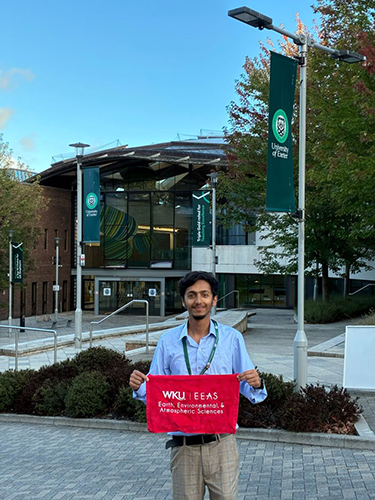
While exploring graduate programs in his home country of Nepal, Somnath Luitel, a WKU graduate student pursuing an M.S. in Geoscience, had a single conversation that changed his academic trajectory.
Luitel spoke with Dr. Manmeet Singh, an Assistant Professor in the WKU Department of Earth, Environmental, and Atmospheric Sciences (EEAS), discussing developing AI models that could turn large-scale weather forecasts into detailed local information.
"What stayed with me was how seriously he engaged with those possibilities," Luitel said. "I could see a place for my interests, my questions, and my ambition at WKU. That conversation helped me imagine what I could build here, and it became a major reason I chose to come."
In September 2026, Luitel presented at Environmental Intelligence 2026, held at the University of Exeter Streatham Campus in the United Kingdom, after attending as one of the MSc Poster Competition winners. His travel was supported in part by the WKU Ogden College of Science & Engineering (OCSE), EEAS, the WKU Disaster Science Operations Center (DSOC), and conference organizers.
Luitel’s research centers on AirCast-SR, an innovative AI weather forecast model.
“AirCast-SR is an AI high-resolution (1 km, 1 hr) three-day lead weather forecast model,” said Dr. Singh, who serves as Luitel's research advisor. “It has been a research direction that has developed through several iterations over the past few years, with the current version coming together during winter break in 2025. Somnath joined the project soon afterward and has done an excellent job helping advance the work and communicate its potential to a broader scientific audience. The model uses state-of-the-art diffusion distillation, an approach that is also driving some of the most exciting advances across artificial intelligence, to generate kilometer-scale atmospheric information from coarser-resolution data.”
The model takes forecasts with a grid spacing of roughly 28 kilometers and produces hourly weather fields at approximately 1 kilometer, covering eight surface variables, including temperature, rainfall, humidity, wind, and solar radiation. Trained using data from the United States, the model demonstrated its ability to transfer to test regions in India and Germany without additional training.
"For me, the larger purpose is to make climate and weather information more useful at the scale where people make decisions," Luitel said. "A farmer, an energy operator, or a local planner needs information relevant to a particular location. I want to help close the distance between advances in AI weather forecasting and those practical needs."
During the conference, Luitel had the opportunity to discuss research and lab interests with scientists from the UK Met Office and NVIDIA.
“Having the work recognized at Environmental Intelligence 2026 was especially meaningful because it gave Somnath the opportunity not only to present the research internationally, but also to build connections with researchers working on AI and weather and climate modeling, including scientists from the UK Met Office, NVIDIA and others,” Dr. Singh said. “Those interactions are an important part of turning a research project into something with a much broader scientific impact.”
This international recognition highlights the growing impact of research happening within OCSE, the Department of EEAS, and DSOC.
“The WKU Disaster Science Operations Center continues to demonstrate its role as a nationally recognized hub of innovation, helping to lead the charge in the commingling intersection of meteorology, emergency management, disaster science, and AI engineering and development,” said Dr. Josh Durkee, Director of DSOC and WKU’s University Meteorologist. “Our center is steadily attracting incredibly talented students like Somnath, who seek opportunities to develop robust AI expertise, specifically in the DSOC Artificial Intelligence Research (AIR) Lab, working directly alongside internationally recognized AI experts such as Dr. Singh. Undoubtedly, Somnath is setting a new standard for graduate student excellence at WKU, and we are quite proud of his achievements.”
Dr. Leslie North, Chair of the Department of EEAS, echoed the significance of these international opportunities for student success.
“We are incredibly proud of Somnath and the way he represented WKU and EEAS on an international stage,” Dr. North said. “Experiences like this are exactly what we want for our students, as it allowed Somnath to take the research happening here at WKU beyond our campus, engage with leading scientists and organizations from around the world, and begin building the professional networks that will shape his future career. Somnath has worked incredibly hard, and seeing him take advantage of this opportunity while helping showcase the innovative AI and meteorology research happening within our department and DSOC is something we are proud to celebrate.”
Funding support through DSOC covers Luitel's living expenses and tuition, while university travel support helped cover his travel to the UK, allowing him to focus entirely on his scientific goals.
"Without travel support, attending this conference would not have been financially possible for me," Luitel said. "Growing up, the cost of education was a real concern, and international travel felt far beyond what I could afford. Now, research is giving me opportunities to explore other countries and share what I am learning. Sometimes I pause during a trip and think about how unlikely this would have seemed to my younger self."
Looking ahead, Luitel aims to complete his master's thesis and spend about two years gaining further research or professional experience before pursuing a PhD. Completing a U.S. degree will be a first in his family, and earning a doctorate would be another. He also maintains strong ties to his home country, having co-founded the research group PANIAI with undergraduate colleagues.
"I hope my story encourages students whose ambitions feel larger than their circumstances," Luitel said. "Financial barriers are real, and having people willing to invest in my potential has made an enormous difference. One day, I hope to help another student find that same chance."
Some of the links on this page may require additional software to view.