
WKU News
From Arizona to the Scottish Highlands: One Hilltopper’s Journey to Find Her Place in the Field
- Nina Marijanovic
- Monday, September 14th, 2026
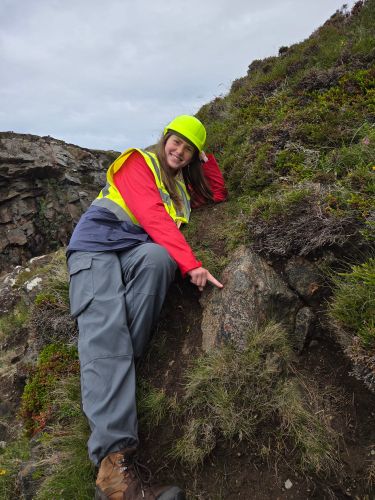
When honors student Natalie Strader applied to a geology field program at the University of St Andrews, she got a no. The program director told her she was missing a prerequisite course. Most students would have moved on.
Strader, a senior geological sciences major at Western Kentucky University, did not.
"I was so determined to go," she said. "I emailed back and said, 'What if I take this class and this class next semester?' And she said, 'If you can send me a new transcript, we'll save a spot for you.'"
She took the courses. She sent the transcript. She went to Scotland.
Strader grew up in Lake Havasu City, Arizona, and came to WKU on something close to a whim. Her father, who works in the racing industry, had done work in Kentucky and nudged her to put Western on her campus tour list. It was the last school she visited.
"There's just this quality about Western that's different than anywhere else," she said. "The community, the atmosphere — nothing else made me feel that way."
She declared geological sciences with an earth and environmental concentration and never looked back. Within her first week of classes, she knew she had landed in the right major. Since then she has built a full undergraduate experience on the Hill: she works in the landscape geodynamics lab under Dr. Nahid Ghani in the Department of Earth, Environment, and Atmospheric Sciences (EEAS), contributing to a project that uses remote sensing technology to map rare earth element potential in California's Mojave Desert. She spent a year as a WKU Global Ambassador, helping run international fairs and study abroad outreach. And she leaned hard on WKU's resources when she needed them — the Office of Scholar Development (OSD) helped fund her international experiences.
Those two experiences are where Strader's story gets unusual. Most undergraduates study abroad once, if at all. Strader has done it twice, and in two completely different experiences.
The first was a semester at the Sant’Anna Institute in Sorrento, Italy, where the earth sciences coursework put her thirty minutes by train from Pompeii and in the shadow of Mount Vesuvius. She studied volcanology. She explored. It was, by her own description, more abroad than study.
The second was something else entirely.
Strader knew she wanted an intensive, hands-on field experience and she started searching on her own, looked at options in the U.S. and abroad, and landed on the St Andrews program: essentially four years of field work compressed into five weeks, offered to students from outside the university.
After negotiating her way off the waitlist, what followed was nine weeks across Scotland — a week of orientation in St Andrews, then nine to five in the field, every day, traveling north through the Highlands to the furthest reaches of the country. The work was physical, methodical, and at times overwhelming.
"I jumped in knowing I'd need it, but I was definitely unprepared," she said. "It was baptism by fire."
The capstone was an independent mapping project on the Isle of Iona, a small island off the west coast. Working in a small group, Strader spent days observing geological formations, collecting data, and building an interpretation of how the landscape came to be — then presenting her findings at the program's end.
"You observe what you can see, and then you interpret later," she said. "Everyone's interpretation is going to look different. I really enjoyed that."
The Scotland experience reoriented her. She came back knowing she loved fieldwork, clearer on where she wants to go, and newly connected to a network of researchers at one of the world's top geology programs — a network she is already thinking about for graduate school down the road.
For now, she is eyeing early career work in environmental and coastal conservation, open to wherever the work takes her, including abroad.
Her advice to anyone watching opportunities pass them by is straightforward.
"Cold email the people you need to email," she said. "Put yourself out there. If you ask for help, there are so many people willing to help you get to the places you want to go."
Some of the links on this page may require additional software to view.