

WKU News
Carrie Updegraff Goes West: WKU Electrical Engineering Student Earns Competitive NSF Research Fellowship
- Nina Marijanovic
- Monday, July 13th, 2026
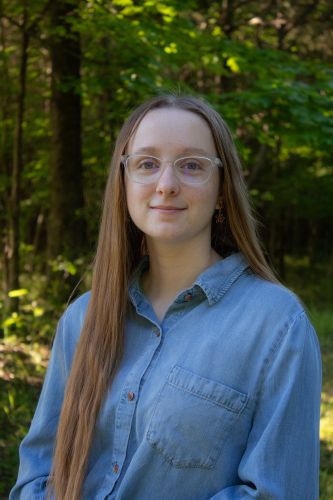
Carrie Updegraff grew up in Bowling Green and had every reason to stay close to home for college. Her mom works at WKU. She'd been on campus for events since she was young. The decision, she said, was never really a question. "I knew since around middle school — that's the smartest choice for me."
What she didn't know, coming in, was just how far "the Hill" would actually take her. This summer, the electrical engineering student is conducting solar energy research at the University of Nevada, Reno's Department of Electrical and Biomedical Engineering, funded by a National Science Foundation Research Experience for Undergraduates (REU) — one of the most competitive undergraduate research awards in STEM.
She is also the first person in her family to attend college.
"My family's very supportive," Updegraff said. "Even though they didn't go to college, my mom works at Western, and she's like, 'you really, really should go,' and I was like, 'don't worry, I plan on doing it.'"
From Geology to Solar Energy
Updegraff arrived at WKU with a general sense that her path would lead somewhere in engineering or science. For a while, geology caught her attention. But conversations with faculty in the engineering department — particularly Dr. Mark Cambron — shifted her direction. "I realized I really, really like the work that I'm doing in these classes," she said, and made the call to pursue electrical engineering.
Within that field, her focus landed on power systems and sustainable energy, specifically solar. What drew her in wasn't the technology itself so much as its unfinished nature. "I thought it was a lot more advanced than it was," she said, "but there's still a lot of hurdles that are being worked out in terms of implementing it large-scale in cities. So I was like, oh, this is an area more research can be done in — that's what made me pursue it in the REU programs."
The REU path opened through an unlikely connection. After a study abroad experience — Updegraff has traveled internationally twice, including a faculty-led WKU trip to Ireland and a semester-long program in South Korea at Hanyang University — she met with WKU's Office of Scholar Development to learn about scholarship opportunities. The conversation started in one direction and ended somewhere else entirely. "During that meeting, it actually spread into another talk about my interest in electrical engineering," she said. "They were like, 'yeah, come back and talk after you're done, we can work something out' — and then that's what led to the REUs." She hadn't even known REU programs existed before that meeting.
Applying for Eight, Landing One
The REU application process requires strategic front-loading. Updegraff began researching programs in the fall — the right time to start, she said, since waiting until spring puts applicants behind. She applied to eight programs in total, with four clustered on the West Coast, partly because she'd never been to that part of the country and wanted to experience it. The application for each included a general personal statement plus one or two program-specific essays.
"They're not killer essays," she said. "They were pretty easy to manage, even for me, and I'm an engineer — I'm not the writing type." Her advice for future applicants: get the basics of who you are and what drives you on paper first, then tailor from there. "You want to lay out what makes you you on a piece of paper, and then look at what that program's asking for and see how it applies." She also flagged a common pitfall — eligibility requirements buried in fine print. "Sometimes it's buried at the bottom of the page and you're like, oh wait, I've been writing an essay for a program I can't even get into."
The program at the University of Nevada, Reno focuses on solar energy research, and Updegraff is working directly in a lab alongside a graduate student mentor, with regular check-ins from her faculty PI. She described the structure as hands-off in the best way. "I was a little concerned I wouldn't know where I was heading with the project, like I would be lost," she said. "But they outlined it really well in the first week — they explained what the problem was I was gonna be working on, and how I could get started." She's also found an unexpected benefit in watching the graduate student's broader workload. "Working with the grad student is helping me a lot, because it's helping me see what he's doing, and then thinking, could I do that?"
That question is taking on more weight. Before the REU, Updegraff described a master's degree as something she felt she "should" pursue. Now it feels like something she actually wants. "I just talked to my mom about that," she said. "I was like, yeah, I think I can really at least do that — maybe not the PhD, but the master's, I think that's something I want to do now." She plans to work in industry for a couple of years after graduation first, with Bowling Green's manufacturing base as a practical starting point, but graduate school is firmly on the horizon.
The First Step Is the Hardest
Looking back from a summer research fellowship at the University of Nevada, Reno, Updegraff is candid about how different this trajectory looks compared to where she started — homeschooled, largely isolated through the COVID years, and self-described as someone who just "didn't understand the workings of college."
Studying abroad helped shift that. "After studying abroad and sort of just seeing a bunch of different perspectives — I met so many people on both of those trips — it really encouraged me to get out of my comfort zone and be like, I want to learn more about this. I might as well apply and see if I get it, because then I'm just gonna learn."
The mechanism she's developed for overcoming hesitation is practical, if a little blunt: "If it doesn't go good the first time, I can just leave and they'll never see me again." The point isn't to minimize the discomfort, she said, but to stop treating it as a reason not to try. "I just gotta do the first step — that was always the hardest part for me. After that first step, it's never as awkward as the first time. If you can just get through that first time, it's fine. It'll be easy, even."
She's currently vice chair of WKU's IEEE chapter and sees the same hesitation in other students around her. Her message to them — and to anyone who reads this article — is direct: "If there's anyone who reads this when it's published, that's the one thing you need to take away: just go try to do it at least once. That's what's gotten me to where I am now. You'll regret it more than you'll cringe about it in the moment."
High school Carrie Updegraff, she said, would not have seen this coming. "She'd be proud of me too, though. Think of it like that."
Some of the links on this page may require additional software to view.