

WKU News
From the Bedside to a Fulbright: WKU Alum's Path from Nursing to Global Health Research
- Nina Marijanovic
- Monday, July 6th, 2026
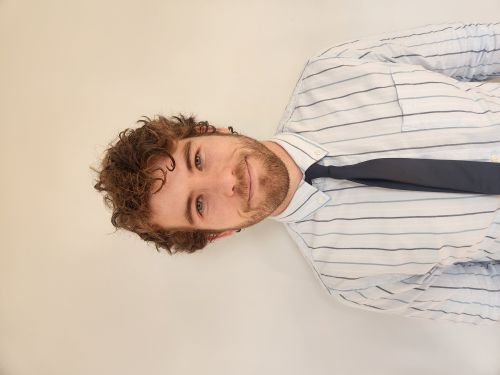
Brent Andrews didn't set out to become a Fulbright Scholar. For most of his career, his world has been the bedside — first as a pediatric ICU nurse in Minnesota during the early days of the COVID-19 pandemic, and more recently in a Louisville emergency room. But this fall, the 2019 WKU and honors nursing graduate will trade the ER for Taipei, Taiwan, where he'll spend two years pursuing a Fulbright-funded master's degree in global health research.
It's a path that started, in a roundabout way, with a completely different major.
"I initially started college studying international affairs, and I was in the Chinese Flagship program," Andrews said. He had imagined pairing language study with a career in diplomacy or foreign service — but as he got further into the coursework, something didn't click. "That… that government-type work, or… business, like, both of those things just didn't quite align with what I was interested in, but that was the initial thought."
What did align, it turned out, was healthcare. After shadowing a few different career paths, Andrews found his way to nursing. "I felt like nursing was a good mix of skills that I have, but also just interests," he said. "It was just a kind of happenstance. I shadowed a nurse, and I was like, this is really cool, and I feel like I could see myself doing it."
He earned his EMT license at WKU, then went on to complete his Bachelor of Science in Nursing in December 2019. Two months later, he started his first nursing job — in a pediatric ICU in Minnesota, just as COVID-19 began to take hold.
"I was a new nurse in Minnesota," Andrews said. "Did that for two and a half years, and then moved down to Louisville, where I'm currently at, and I've been working in the emergency room here since I moved down."
A Long-Held Interest, Reawakened
Even as he built his career in emergency and pediatric critical care, Andrews never let go of the pull toward international work that had drawn him to WKU in the first place. Early on, his original goal was to work with Doctors Without Borders. Over time, that interest evolved into something a little different — a pull toward public health research rather than direct international clinical work.
"As, like, interests and career and stuff has changed, I've sort of gotten more into the idea of doing more public health-type research," he said, "or at least having an ability or knowledge on how to do some of that."
About two years ago, after moving back to Kentucky, Andrews reconnected with a mentor from his undergraduate years, Dr. Melinda Grimsley of the Office of Scholar Development, who had talked with him years earlier about options for nurses interested in further education. That conversation reignited something.
"She kind of had me do a little bit of soul searching, and thinking, and looking up programs," Andrews said. He had actually considered applying the year before, but held off. "I just felt like I wasn't really — I didn't really know what I was applying for, like, what I could do."
What changed things was hands-on experience. Andrews has spent the last several years working with the University of Louisville's Global Health Program, including a stint in Ghana, and found mentors there who encouraged him to think bigger. "They were like, there's, you know, there's ways you can do this," he said, "and kind of pushed me to think about going back to school to do some research."
A Different Kind of Fulbright
Andrews' Fulbright award will fund a two-year master's degree with a thesis research component — a structure he says is a bit different from many traditional Fulbright grants. His initial research proposal focused on dengue screening, though he describes that less as a fixed plan and more as proof of concept.
"That was really almost just proof of concept that I can do some research, or have ideas about [global] health," he said. Once he arrives in Taiwan, he'll have six or seven months to settle on a mentor and a thesis topic — something he sees as an opportunity rather than a source of anxiety, given the research connections the program offers. "There's so many research opportunities, it's just figuring out funding and grants."
Taiwan wasn't a random choice. Andrews spent a summer there as an undergraduate, and that earlier experience — along with friends who have stayed in the country — made the decision easier. He was also drawn to the structure of the specific global health program he applied to, which brings together students from around the world.
"It's a really interesting model for a program," he said. "There's a lot of international students from all over the world in the program... it'll just be a different regional experience of healthcare than what I think a global health program here would be." For Andrews, that's the point — a chance to see how public health challenges are approached from a different vantage point entirely.
He's also candid about the parts of this transition that are hard. "I have a really good community, and I love my life here," he said. "It's gonna be hard to be gone, and be away from family and friends." He had pictured doing something like this before the pandemic, he said, but COVID reordered his priorities for a while. "The important thing to do at that time was just, like, work — be a nurse, do the thing... but now that we're a little bit outside of that," he's ready for something different. "It'll be hard, but I'm excited. I want to make sure that I give a shoutout to all of the people who have lifted me up and supported me during this transition. My friends and family have helped me every step of the way. My roommates, Sarah and Giana, have supported me in innumerable ways. Finally, my partner Jordan, who has been by my side through it all."
Becoming a "Non-Traditional" Candidate
For someone who hadn't written an academic essay in years, the application process itself was a hurdle and one Andrews credits WKU's Office of Scholar Development with helping him clear.
"It's been a long time since I've been in school. It's been a long time since I've written something like that," he said. He worried that his background as a working clinician, rather than a recent graduate or career academic, might count against him. "When I initially reached out, I was like, they might just be like, ah, this isn't really the... I'm not a traditional candidate for this sort of thing."
Instead, he found the opposite. "They made it seem like it was very possible and doable, and helped me kind of dust off some of the writing stuff," he said. The Statement of Grant Purpose — just two pages — required him to demonstrate research potential despite not doing research day-to-day. "They walked me through a lot of how to frame that stuff, and a lot of drafts. [My advisor] read through a bunch of drafts." Looking back, he said simply: "It was great."
As for brushing up on Mandarin before he leaves, Andrews is keeping his expectations realistic. "To be honest, I haven't done as much as I would have liked," he admitted, though he's been working through old language-learning audio and plans to take classes once he arrives. "I've kept it up a little bit, but not enough to be super confident."
A Different Kind of Academic Path
Looking back on his journey — international affairs to nursing to a Fulbright in global health — Andrews sees something worth sharing with other nurses, especially those who, like him, didn't follow a traditional academic track after graduation.
"I love being a nurse, and I love nurses," he said. "Sometimes it's viewed as maybe not necessarily an academic pursuit... but I think there are a lot of really cool opportunities for nurses out there to do different things and try new, outside-the-box opportunities. I'm glad that I've had some nurses at WKU and at U of L that have kind of showed me that."
He's also thinking about what comes next. Andrews said he doesn't view himself as "academic" in a traditional sense, but he does want to use research to make a difference for the people he's spent his career caring for. "I do want to improve the system in some way, and hopefully make things better for either nurses or patients or both," he said. Working in U.S. emergency departments has shown him how often systemic problems get treated as someone else's responsibility. "It gets easy to get kind of lost in the system of it all... this is a system problem, so we're not gonna fix it at the bedside."
His goal, he said, is straightforward: "More people having access to care that they deserve" — without the burden of medical debt. "More health equity, I would say."
For now, that means stepping away from the bedside — at least temporarily. Andrews isn't sure exactly what role he'll return to after his Fulbright ends, and he's at peace with that uncertainty. "One of the cool things about nursing... you can do all sorts of different jobs as a nurse," he said, pointing to friends who've gone into school nursing, legal consulting, travel nursing, and remote work. "We'll see when I get back. I don't really know exactly what it's gonna be. It might be just bedside for a little bit till I can figure it out."
He's also been talking with friends back home who are considering applying for a Fulbright award of their own, despite being years removed from school. His message to them — and to other nurses weighing whether opportunities like this are really for them — is simple: they are. "There's still opportunities once you've gotten a few years of experience," he said. "Not something I initially thought about, but now that I did, I'm like, well, there's really a lot out there."
Some of the links on this page may require additional software to view.