

WKU News
WKU Student Presents AI Education Research at National ASEE Conference
- Tuesday, June 30th, 2026
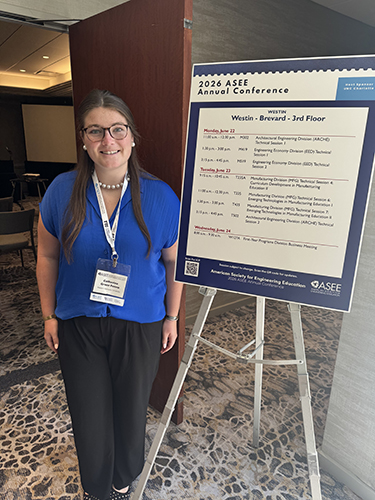
Catherine Grace "Gracie" Fenno, an undergraduate student studying Architectural Science in the WKU School of Engineering & Applied Sciences (SEAS), recently represented WKU on a national stage. Fenno traveled to Charlotte, North Carolina, to present co-authored research at the 2026 American Society for Engineering Education (ASEE) Annual Conference held from June 21–24, 2026.
The paper, titled "Exploring the Potential of AI Conversations in Architecture, Engineering, and Construction Education: Insights from a Building Systems Course," was born directly out of her experience in the classroom. Developed alongside fellow student Gabriel Jerdon and Dr. Osama E. Mansour, an Associate Professor in SEAS, the study highlights how cutting-edge artificial intelligence can transform technical STEM classrooms.
Driving Innovation in the Classroom
The research evaluated the real-world integration of Blackboard’s AI conversation tool during the Spring 2025 semester. The experiment involved 41 WKU students spanning Construction Management, Architectural Science, and Civil Engineering disciplines enrolled in a technically intensive Building Systems course.
By interacting with AI personas tailored to technical fields, students received a highly customized, adaptive learning experience. According to the study's findings:
- Immediate Feedback: 88% of students valued having 24/7 availability to clarify complex building science concepts on demand.
- Enhanced Engagement: 82% of surveyed students reported that conversational AI tools noticeably increased their active engagement in the course.
- Personalized Support: 81% agreed that the adaptive dialogue effectively targeted their individual knowledge gaps, catering perfectly to a multidisciplinary cohort.
The Power of "Human-in-the-Loop" Education
While the study revealed promising potential for scaling up personalized support in large higher-education classrooms, it also addressed critical technical hurdles like AI "hallucinations" and biased prompts.
To overcome this, Dr. Mansour utilized a "human-in-the-loop" approach, ensuring the instructor remained the primary authority. Dr. Mansour reviewed transcript trends to address inconsistencies during live lectures, demonstrating how AI works best as a powerful complement to expert instruction rather than a complete replacement.
"Students arrived at discussions with more refined technical questions, suggesting that real-time interaction with the AI persona helped clarify foundational concepts as they were being introduced," Dr. Mansour noted in his observations. "This allowed in-class dialogue to advance more quickly toward higher-level considerations of structural loading and system integration."
Congratulations to Gracie, Gabriel, and Dr. Mansour for representing WKU's dedication to educational innovation and student-led research on a national level.
Some of the links on this page may require additional software to view.