

WKU News
How One Conversation Changed Samantha Gerdes' College Journey
- Nina Marijanovic
- Monday, June 22nd, 2026
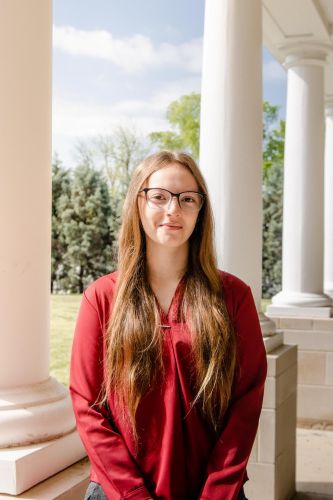
When Samantha Gerdes first toured WKU's campus as a prospective student, she wasn't planning to spend her college career immersed in Mandarin. But a conversation with a tour guide who happened to be a Chinese Flagship alum, followed by a meeting with Mahurin Honors College former director, Dr. Craig T. Cobane, changed the trajectory of her entire WKU experience — and this fall, it will take her to Taiwan for a 10-month stay funded by the prestigious Boren Award.
"I decided to come to WKU because the university is only about an hour away from home," Gerdes said. "So it's far enough away that I can have my own life and close enough that I can come home if necessary." It was during an honors tour that she first learned about the Chinese Flagship Program, from a guide who had gone through it herself. "After I heard about the concept of the program, I was very interested in it."
For Gerdes, the appeal was personal. She had dabbled in Spanish and a little German before college, but neither language had really stuck. "Nothing has really sticked," she said. "When she had proposed this program to me, I thought, wow, this sounds really cool, because I'll actually be able to use the language."
Finding the Click
What made Mandarin different, Gerdes said, came down to the people teaching it. "It was really just the support from all of the professors and also the tutors as well," she said. "They really know what they're doing. They understand when you actually don't know something, and you're just pretending that you understand it — so that they can actually help you out and help you learn." When the textbook explanation didn't land, instructors found another way in. "It was really just their support that helped me move along this progress and actually remember the language that I'm learning, instead of forgetting it after I take the exams."
That support extended beyond the classroom. As part of the Flagship Program's required coursework, Gerdes spent a summer at Indiana University's domestic intensive language program after her first year at WKU — an experience she credits with breaking through one of the biggest barriers in language learning: the fear of speaking.
"I couldn't really respond to people" before the program, she said. "But after that intensive two-month-long program, I was able to better respond to people. I was more confident in speaking." A turning point came early on, when instructors pulled her aside for extra one-on-one tutoring after noticing she was struggling. "At first I was like, oh, I feel now like I'm doing bad," she admitted. But after a month, they told her she no longer needed it. "That really helped my confidence, knowing that they have just told me that I've improved... even when I mess up, that still helps me learn, because you learn through making mistakes."
The following summer, in 2024, Gerdes traveled to Taiwan for her required study abroad component — her first experience using Mandarin in an immersive, everyday environment.
A Capstone Project That Took On a Life of Its Own
For her honors capstone project — a requirement tied to a scholarship she'd received — Gerdes had only a loose set of ideas until she sat down with Dr. Peng, director of the Chinese Flagship Program. "I had this long sit-down meeting with her, just talking about different ideas that I had for it," Gerdes said. "She really helped me piece together a good project that I had, because I love learning Chinese, and that's why I wanted it to be a big part of that project."
The result was a social media account where Gerdes posts videos in Mandarin — both to practice her own language skills and to help others get excited about learning Chinese. She initially expected the project to end once her capstone requirements were met. That's not what happened.
"I actually love posting on there now," she said. "I love being able to practice my Chinese and interact with people in the comments that are like, oh, you said this correct, but maybe you could edit your phrasing here. I love that, because that'll help me when I go to Taiwan." She's kept the account active ever since, continuing to post primarily in Mandarin to preserve "the original identity of the project."
One of her favorite Flagship memories also grew out of an assignment with room to explore. For a final presentation in fall 2024, after returning from her summer in Taiwan, Gerdes chose to research and present — in Chinese — on a major shopping holiday celebrated in Taiwan and China, called Singles’ Day, which she likened to Black Friday. "Going through the process of learning about it and reading all these articles in Chinese to prep for my presentation and then doing the presentation itself — I feel like that was the best oral presentation I've done so far," she said. "It just was so interesting to me that I was able to find all the information I needed in Chinese on these articles... that I wouldn't have been able to read before, years prior. If I hadn't gone through all these steps to get here."
Landing the Boren
Gerdes first heard about the Boren Award at her very first annual Flagship meeting, years before she'd be eligible to apply. "It was a good introduction for me to learn about what this thing is," she said. "I now have three more years to sort of learn about it before I'm at the point where I need to apply for it."
When the time came, she didn't hedge her bets. "I really only focused on Boren. I didn't apply for other scholarships, because I just felt like this was the one for me." Part of the appeal was practical — the award is built around a year of post-program service in a government-related field, which appealed to Gerdes as a way to explore career paths. "I've been thinking about working in some part of the government," she said. "I thought this would be a good way to help me start that work and then see — do I like this? Do I not? — and figure out what I want to do for my future career."
The application, she said, centered on two essays of roughly 700 words each, along with two letters of recommendation — one addressing her language ability, and one addressing her interest in government service.
What's Next
This fall, Gerdes will spend 10 months in Taiwan as part of her award, living in on-campus housing alongside international students from around the world — a choice she made deliberately. "I thought that that would help me be able to speak with my classmates as well as other international students that are living there," she said. "That'll give me a good time to get to know new people."
Her time abroad will be split between coursework and an internship, with her cohort doing classes first and an internship in the spring semester. Beyond the program itself, she's looking forward to having more time to travel during breaks — and to making the most of time with family before a long stretch apart. "I won't see them for about 10 months during the program, so I'm just trying to spend as much time with them as I can before I have to leave."
As for keeping up her Mandarin after Boren wraps up, Gerdes is already thinking ahead. "If I'm not able to use my language skills in my future career, I want to try to keep up my speaking and listening... watching YouTube videos, even in Chinese. Reading articles, maybe keeping a diary where I write in Chinese — all those ways to help me just keep my proficiency up, because I don't want to lose this after putting in all this work for these four years."
When asked what she's learned about herself across four years of flagship coursework, study abroad, content creation, and now a major federal award, Gerdes doesn't credit any singular talent. "I think it's more of, I just love to learn," she said. "I used to love school when I was really young, and I feel like I lost a little bit of that when I was in high school. But when I came to WKU and started learning Chinese, I feel like I re-found that love for learning again... I never thought that I would end up here. Even when I started the program, I knew I would be doing each of the steps, but it wasn't real in my mind that I would be going to Taiwan and doing all these things."
Her advice for students considering something like the Flagship Program — or any opportunity that feels intimidating — is simple: just try it. "Whatever you're thinking about, just go and try it, because you're not going to be stuck doing that thing forever if you end up not liking it," she said. "You don't know how good you'll be until you actually go in and put in the effort and try it out. I didn't know that I would be able to actually have these good fluent conversations with people when I first started... but after I've trusted the process and tried it out and moved through all of these steps, now I can speak with people — and that was because I took the risk of trying this."
Her final word of advice, fittingly, doubles as a tribute to the people who got her here: "Trust the professors. They know what they're doing. They've been doing this for years."
Some of the links on this page may require additional software to view.