

WKU News
Six vs. Eighty-Six: How a WKU Education Major Teaches All Ages
- Monday, June 1st, 2026
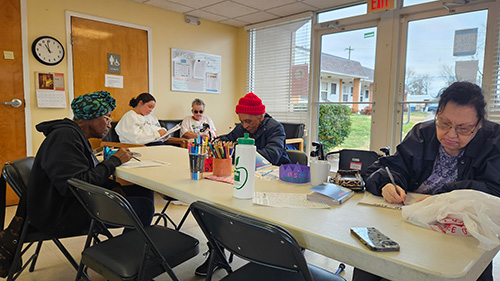
For most Hilltoppers, the path to becoming an educator features student-teaching clinicals in local elementary school classrooms. But for Carly Wright, a Western Kentucky University dual-major from Owensboro, Kentucky, the journey toward her degree looks a little different. On any given week, her students might be six years old or closer to 90.
Expected to graduate in May 2027 with certifications in both Elementary and Special Education, Carly is discovering that the foundational principles of inclusive teaching transcend age, and her work connects WKU’s campus to local senior residents at Bowling Green’s Housing Authority.
Carly’s desire to become a teacher started with her family. "Ever since I was a sophomore in high school, I knew I wanted to be a special educator someday," she shares. "I drew a lot of inspiration from my mom, who is an educator herself, specializing in working with students with disabilities at the early childhood stage."
When looking at programs, WKU’s reputation for hands-on, clinical preparation immediately stood out. By pursuing a dual certification, Carly sought to bridge the gap between standard, general education curriculum and individual student profiles so that "no student falls through the cracks." Little did she know that teaching would soon unlock a completely unexpected learning environment: a literacy program for senior citizens.
Stepping into a classroom of seniors rather than a room full of elementary students highlighted a fascinating truth for Carly; the core of human connection remains the same across a lifetime. "Whether a learner is six or eighty-six, they thrive on validation, social interaction, and the curiosity that comes with discovering something new," Carly notes.
Both groups benefit from structured routines, enthusiastic communication, and a teacher who can adapt complex ideas into digestible concepts. The difference, however, lies in what the students bring to the table. "In an elementary classroom, the focus is often on foundational skill-building where the teacher serves as a primary authority figure," Carly explains. "Conversely, a classroom of seniors is a room full of lived experience; the instructor acts more as a facilitator. While children may require more physical movement to stay on task, seniors bring a self-directed focus and a desire to connect new information to decades of personal history." For Carly, this meant shifting her teaching style from a traditional top-down approach to one of mutual respect and active listening, honoring the maturity of her adult students.
To reach her older learners effectively, Carly leans heavily on core frameworks taught within the School of Teacher Education, such as Scaffolding and Universal Design for Learning (UDL).
By applying scaffolding, she meets residents at their current knowledge base and provides temporary structures to help them master new skills without making the material feel remedial. UDL allows her to design lessons with multiple ways to engage, smoothly adjusting for the diverse sensory or cognitive preferences that come with aging.
A typical session with the residents balances mental exercise with shared literature. The class kicks off with a half-hour of literacy games, word searches, and "brain games.” Then, the group dives into their current book study. Favorites have included So B. It (complete with a celebratory movie viewing after finishing the text) and Because of Winn-Dixie. As Carly reads aloud and the residents follow along in their copies, the text becomes a springboard for personal storytelling.” I enjoy hearing from them about their life experiences, and how they relate to the characters and events from the stories," Carly says.
The validity of applying special education strategies to adult learners was cemented during a powerful "lightbulb moment" in one of Carly's literacy sessions. A resident who had long struggled with the shifting phonetic rules of English encountered the word independence. Normally, the resident would skip the word or try to guess it based entirely on context. This time, Carly stepped in with a visual "chunking" technique straight from her coursework. Together, they systematically isolated each morpheme. As the sounds successfully merged into a familiar word, the resident's expression shifted from intense concentration to pure relief. Looking up, the resident beamed, noting that the word no longer felt like a jumbled "wall of letters" but a series of logical parts they controlled. "That instant transformed their perspective on reading from a source of frustration to a manageable puzzle," Carly recalls, "proving that the same systematic instructional methods used in elementary classrooms are equally transformative for adults rediscovering their own capabilities."
Though Carly's goal is to lead a K-5 elementary classroom, she insists that her time spent working with seniors has made her a profoundly better educator. The experience has taught her to look entirely past age or current ability level, focusing instead on the unique "funds of knowledge" every individual brings into a room. Navigating adult learning dynamics has sharpened her ability to break down high-level concepts into dignified, accessible steps, which a crucial skill when helping a frustrated young student push through a tough academic challenge. "Working with this group of residents has taught me that the most vital element of teaching isn't the perfect delivery of a lesson plan, but the profound patience and resilience required to honor the learner's own pace," says Carly. "It showed me that a teacher’s greatest asset is the ability to listen as much as they speak."
When Carly eventually opens the door to her own elementary classroom, she will step in with a deepened sense of empathy and adaptability, fully prepared to build a low-stakes environment where young students feel safe to take risks. She is proof that you are never too established in life to learn something new, and never too young to provide meaningful guidance.
For more on WKU's education majors, visit wku.edu/ste.
Some of the links on this page may require additional software to view.