

WKU News
WKU grad brings light to connections between art and science through psychological science
- Mary Bidwell
- Wednesday, April 22nd, 2026
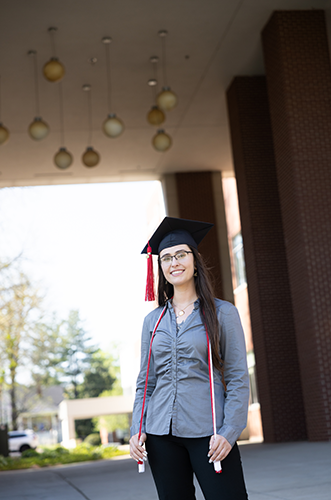
The research laboratory or the art studio? For graduating senior Maria Elena Carmichael, the exploration of science and art created a unique educational pathway for her journey on the Hill.
Carmichael initially planned to pursue a degree in Psychology with a minor in Studio Arts, with a goal of pursuing art therapy as a profession. A chance encounter with Dr. Aaron Wichman, a Professor in the WKU Department of Psychological Sciences, altered her academic trajectory and propelled her into exploring research opportunities.
“During my first semester, I entered a painting in the Kentucky Museum’s Celebration of the Arts exhibition. At the reception, I ran into one of my professors, Dr. Wichman, whose wife also had a painting on display. After a brief conversation, Dr. Wichman encouraged me to look into the psychological science program and gave me his card in case I had any questions. Despite my apprehension about shifting to a science-focused degree, I found myself genuinely enjoying Dr. Wichman’s Social Psychology course, Dr. Qin Zhao’s Research Methods course and Dr. J. Farley Norman’s Sensory and Perceptual Systems course. I ultimately decided to change my major to psychological science, a decision I am incredibly grateful to have made,” Carmichael explained.
Stemming from those positive classroom experiences, Carmichael sought out opportunities to pursue research within the field of vision and became a student research assistant in the Vision and Haptics Lab at WKU. Directed by Dr. Norman, a University Distinguished Professor, the laboratory studies areas including human perception of distance, spatial relationships and the three-dimensional shape of environmental objects. Carmichael credits her time in the lab with leveling up her understanding of the research process and providing hands-on experience in the field.
“Through discussing areas of investigation and experiment designs, recruiting participants, conducting experiments and learning how to write and submit manuscripts, I have gained invaluable insight into the world of scientific research,” Carmichael shared.
Building on that experience, Carmichael presented research at the annual WKU Student Scholar Showcase and published scientific articles in an international weekly research journal.
“I have had the unique privilege to have been co-authored by Dr. Norman on three published articles in Nature. These publications have certainly made me a strong PhD candidate and I would not have this incredible opportunity without my mentor, who has believed in me every step of the way,” Carmichael explained.
Dr. Norman reinforced that these applied learning experiences established a strong foundation for Carmichael’s future aspirations, noting that “Maria is not a student learning how to be a scientist; Maria is already an accomplished scientist.”
Carmichael not only cultivated a strong portfolio of research – she also created unique connections with the arts that intertwined with her scientific endeavors.
“As a primarily visual learner, I have found that illustrating my notes helped me better comprehend and retain course content. Connecting concepts from Dr. Norman’s Sensory and Perceptual Systems class, particularly how we process visual information and perceive the world around us, to principles of art enhanced my approach to drawing, painting and overall draftsmanship,” Carmichael explained.
Considering hands-on applications, she noted that these interdisciplinary concepts influenced the art she created and strengthened her creative skills.
“Applying principles related to the perception of three-dimensional objects has helped me to create more convincing still-life paintings through the use of contrast and relative size. Additionally, learning how our eyes process light and how our brains perceive color helped me better understand the foundation of color theory and clarified why certain color combinations feel harmonious, vibrant, or even jarring,” Carmichael continued.
She continued to find parallels between her work in the lab and in the art classroom, highlighting a comprehensive research paper she wrote in a class led by Dr. Guy Jordan, an Associate Professor of Art History in the WKU Department of Art & Design.
“This paper was my first solo research project and provided me with the opportunity to apply key skills in information gathering evaluation, interpretation and academic writing I have begun developing under Dr. Norman,” Carmichael explained.
Yvonne Petkus, a University Distinguished Professor of Painting in the WKU Department of Art & Design, highlighted Carmichael’s interdisciplinary approach and noted how it served as a lighthouse for fellow Hilltoppers.
“Maria has been an example and inspiration for those choosing to minor in Studio Art, able to both stay open to new approaches or experiences (and take them on quickly), while also pushing deeply from within her own desire to explore and express. She meaningfully bridges her areas of study, including through the scientific method, shared in both the studio and the sciences, and in the visual, physical and content-based questions she asks of herself and of her work,” Petkus shared.
A nontraditional student, Carmichael is no stranger to creating bridges between different fields. After earning an associate’s degree, Carmichael spent time in the workforce before deciding to pursue a bachelor’s degree.
“Having previously worked in the trades, refinishing cabinets and painting in both residential and commercial settings, it felt especially daunting to transition away from this line of work to pursue a college degree,” Carmichael explained.
She credits the support of her family and the WKU community for encouraging her to make the leap.
“To be believed in is a very special experience. I am extremely fortunate to have a loving and supportive family that values education and stood by me during my lowest points. The same can be said for my professors at WKU. At the beginning of my academic journey, I struggled with self-doubt and felt paralyzed by the fear of failure,” Carmichael shared.
In addition to individuals such as Dr. Norman, Dr. Wichman and Professor Petkus, Carmichael credits the late Dr. Pitt Derryberry, a former co-department head of the WKU Department of Psychology, as an early support figure on her journey.
“Dr. Derryberry made me feel welcomed and supported when I was feeling particularly nervous and out of place throughout the admission/registration process. He took the time to express his confidence in me and respect for my decision to strive for higher education,” Carmichael noted.
Carmichael also possessed a strong familiarity with the Hill through her mother, Carmen Herrera.
“My mother was an award-winning graphic designer at Western for approximately 17 years and I loved exploring campus on the days I would accompany her to her office,” Carmichael recalled.
Carmichael’s family provided inspiration and encouragement on her educational journey – even through multiple significant losses.
“I lost my father at twelve years old, my stepfather at twenty, my close friend at twenty-two and my uncle at twenty-six. When my father, who was David’s youngest brother, passed away in 2009, David stepped into a mentorship role alongside my mother, advocating for the importance of education, just as my father had. In their own ways, my father, stepfather and uncle instilled in me the belief that education is not as much power as it is freedom,” Carmichael shared.
Carmichael noted that her life experiences shaped her career goals, highlighting a desire to positively contribute to her community.
“The losses I have experienced do not put me at a disadvantage; rather, they have provided me with the resilience necessary to fully rise to a challenge, both academic and personal. Our past often contains clues to our future and in the depths of my losses, I discovered a deeper connection to others that has motivated me to want to enter a helping profession,” Carmichael explained.
Looking to the future, Carmichael aims to blend research, science and art into a career that can help others rise to their potential as well.
“I hope to further my education and enter a profession that allows me to integrate my knowledge of psychology, my appreciation for the healing, enriching power of art and my ability to conduct meaningful research in ways that provide the tools for self-actualization.”
--
#WKUGrad series: For more stories on graduating students in the #WKUGrad series, visit https://www.wku.edu/news/articles/index.php?view=default&categoryid=799&multinewsid=187
Some of the links on this page may require additional software to view.