

WKU News
Bringing Local History to Life: Beech Bend Park Exhibit Highlights the Power of Primary Sources
- Emily Eden Gabriel
- Monday, March 9th, 2026
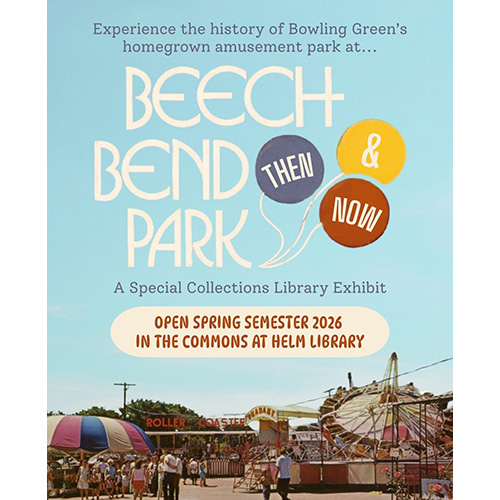
WKU Libraries’ Special Collections Library is inviting the campus and community to explore the rich history of Bowling Green through its newest exhibit, “Beech Bend Park: Then & Now.”
Step through the many eras of Beech Bend Park; it’s like Taylor Swift’s Eras Tour, but for local history! Since opening as picnic grounds in 1898, and especially after Charles Garvin took over in the 1940s, Beech Bend has been a cornerstone of entertainment and employment in Bowling Green. Woven into the collective identity of the community, the park holds memories for generations who have visited, worked, and played there. Its enduring presence and unique past contribute to what sets Bowling Green apart.
Curated by Emma Newton, Special Collections' Exhibits Coordinator, the exhibit has been nearly two years in the making. More than a historical display, the project was designed with a broader purpose: strengthening the connection between WKU students and the Bowling Green community.
Because many WKU students come from outside Warren County, they often remain primarily engaged with campus life and may be unfamiliar with what the city has to offer. Newton believes that a meaningful college experience extends beyond the classroom. Encouraging students to explore the surrounding community can enrich their college years by introducing them to off-campus resources, expanding their social networks and helping them build lasting memories beyond university grounds. The sense of belonging and support found within the local community, she said, is fundamental to a well-rounded and fulfilling higher education experience.
Newton selected Beech Bend Park as the vehicle for this message because of its colorful history, its deep roots in the region and the extensive related materials housed in Special Collections. As one of Bowling Green’s most recognizable attractions, Beech Bend Park provides an engaging entry point into local history while demonstrating how archival collections preserve community stories.
While many of the park’s core attractions have remained consistent since the Garvin era, including rides, games, racing and swimming, one of the most striking changes over time has been the disappearance of the zoo at Beech Bend Park. Although the zoo no longer exists, its history can still be explored through photographs and ephemera preserved in WKU’s Special Collections Library. Ephemera refers to everyday printed items such as tickets, brochures, promotional flyers and souvenirs that were originally created for short-term use. These materials provide valuable insight into how the zoo operated and how visitors experienced it. Though they were never meant to last, they now serve as important primary sources, offering firsthand evidence of the park’s past. Through these photographs and printed artifacts, students and researchers can continue to study and better understand this once-expansive feature of Beech Bend, even though it has disappeared from the physical landscape.
Behind the scenes, the exhibit also reflects WKU Libraries’ commitment to student success and experiential learning. Through hands-on involvement in digitization, preservation, research and exhibit design, student workers gain practical skills that extend far beyond the display cases. From mastering scanning protocols and archival handling procedures to contributing to interpretive writing and visual design decisions, students develop technical expertise, attention to detail and collaborative problem-solving abilities.
These experiences not only strengthen classroom learning but also prepare students for future careers in libraries, museums, archives and other professional fields where research, communication and critical thinking are essential. Through opportunities like this, WKU Libraries supports academic success by turning archival collections into active learning laboratories; spaces where students refine research methods, build digital literacy skills and gain confidence presenting information to diverse audiences.
“I hope visitors learn from Charles Garvin’s story that they can achieve any goal they set their minds to so long as they have perseverance, creative thinking and a willingness to work hard,” Newton said. She also hopes the exhibit encourages students not only to explore Bowling Green more deeply, but to engage with the rich primary sources preserved in Special Collections that document other facets of local and regional history. For example, the National Corvette Museum and Motorsports Park, Lost River Cave, Baker Arboretum and Chaney's Dairy Barn; experiences that, like Beech Bend, are part of the broader story of the community.
Andrew Adler, Chair of the Department of Library Collections & Discovery, said the exhibit “reflects WKU Libraries’ commitment to preserving and sharing the stories that define our region. Thanks to the dedication of Emma and others, it highlights a unique piece of local history while expanding awareness and access to our Special Collections.”
“Beech Bend Park: Then & Now” will be on display through early June in The Commons at Helm Library History Room. Visitors interested in seeing more can explore additional materials through KenCat and TopScholar, which include even more resources related to Beech Bend Park. To learn more visit our WKU Libraries Special Collections Library.
Some of the links on this page may require additional software to view.