

WKU News
WKU releases renderings for the first facility in its multi-year initiative to transform student housing on the Hill
- WKU News
- Friday, February 20th, 2026
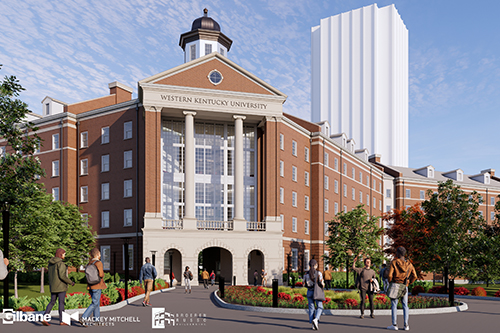
Western Kentucky University released new renderings today (Friday) for the first facility in its multi-year initiative to transform student housing on the Hill, offering the campus community and public a detailed look at the design of a modern, student-centered residential complex that will anchor the next generation of on-campus living at WKU.
The renderings illustrate the planned replacement of Hugh Poland and Douglas Keen Halls with a new, roughly 1,000-bed residential complex to be constructed on the same site. The project represents Phase 1 of WKU’s comprehensive housing transformation plan, which the university has termed Elevate WKU, made possible through a public-private partnership (P3) with Gilbane. The facility marks a visible step forward in the university’s long-term strategy to modernize residential facilities and elevate the student experience.
The new facility is designed around flexibility, community and academic connection. Plans call for a mix of private and semi-private suite-style rooms that give students more choice in how they live, paired with shared spaces intentionally designed to foster interaction and belonging. Each residential area will be supported by community kitchens, collaborative lounges and modern study spaces that promote both social and academic engagement. The design also includes purpose-built environments to support the continued expansion of Living Learning Communities, allowing WKU to more closely integrate where students live with how they learn.
In addition to supporting community and collaboration, the facility will incorporate modern safety, accessibility and security features throughout the building. The design emphasizes energy-efficient systems and sustainable construction practices, aligning with WKU’s broader commitment to responsible stewardship and long-term operational efficiency. Technology-enabled learning and living spaces will be integrated across the complex to support today’s student expectations for connectivity, hybrid learning and digital engagement.
The release of the renderings follows the WKU Board of Regents’ December approval of a pre-development agreement with Gilbane. Since that approval, WKU and Gilbane have continued refining program elements, design features and site planning to ensure the new complex reflects student needs, supports university priorities and delivers long-term value.
The first phase of the housing transformation initiative represents an investment of approximately $350 million. That total includes construction of the new residence hall, defeasance of Student Life Foundation debt and significant repairs and renovations to existing facilities. Future phases of the master plan will address additional residence hall upgrades, explore new living-learning models and further align residential design with WKU’s academic mission and student success goals.
University leaders have emphasized that replacing Douglas Keen and Hugh Poland Halls is a strategic starting point because it targets some of the most dated housing on campus while delivering early, visible improvements to the residential portfolio. The new complex is expected to set a new standard for campus housing at WKU in terms of comfort, flexibility, sustainability and student-centered design.
WKU President Timothy C. Caboni highlighted the important role that residence halls play in building connections among students. “On-campus living is a cornerstone of the WKU Experience,” he said. “Time spent in our residence halls fosters independence while cultivating a strong sense of community and lifelong connections among our Hilltoppers. This investment reflects our commitment to creating modern, competitive environments that meet the evolving expectations of our students and families. By taking this bold step forward, we are ensuring WKU remains a vibrant, student-centered university for generations to come.”
Since 1999, WKU residence halls have been constructed and owned by the WKU Student Life Foundation, a nonprofit organization created to address housing needs during a period of aging facilities and limited state funding. Through that model, the Foundation helped expand housing capacity for a generation of Hilltoppers. As WKU looks to the future, university leadership determined that the next generation of housing development would be best advanced through increased university oversight combined with the expanded financing and delivery tools available through a public-private partnership structure.
Under the P3 model, WKU collaborates with a private development partner that assumes primary responsibility for financing, design and construction, while the university retains control over mission-driven priorities tied to student experience and academic outcomes. The approach allows for more efficient delivery, leverages private capital and reduces institutional financial risk while maintaining a strong focus on affordability and quality for students. Peer institutions across the country have successfully used similar partnerships to accelerate housing modernization and renewal.
Gilbane, founded in 1870 and headquartered in Providence, Rhode Island, brings extensive experience in higher education housing and campus infrastructure projects. The firm has developed and built more than 55,000 student housing beds across more than 100 campuses nationwide and was selected through a competitive RFP process based on its integrated approach to design, finance, construction, sustainability and long-term operations.
The facility is being designed by Mackey Mitchell Architects, a nationally respected architecture and planning firm with deep expertise in higher education, particularly student housing and campus life projects. Known for designs that balance aesthetics, functionality and long-term durability, the firm has worked on a number of campus projects, including at the University of Arkansas, Syracuse University and Penn State. Their work emphasizes sustainability and flexibility, helping institutions create living environments that feel both modern and enduring.
“As a trusted partner for colleges and universities across the country, Gilbane is committed to creating campus environments that truly elevate the student experience,” said Geoff Eisenacher, Vice President of Development at Gilbane Development. “The newest renderings from Mackey Mitchell Architects showcase the remarkable transformation of student living at Western Kentucky University. We’re excited to see this vision come to life and to deliver a state-of-the-art residence hall that will serve generations of Hilltoppers.”
John Burse, Principal, FAIA, LEEP AP with Mackey Mitchell, noted the effect the facility will have on residents. “This is about more than bricks and mortar – WKU’s vision is a strategic investment in the student experience, offering first-year students a launch pad for what lies ahead,” he said. “It is a place to rest and refuel, to connect and collaborate, and to belong – an inspired setting that honors the beauty of WKU while carrying its story forward into the future.”
Additional project updates will continue to be shared as design and partnership terms advance. The project is expected to return to the Board of Regents for final approval and financial close in late Spring or early Summer 2026, with construction anticipated to begin soon thereafter. The new residence hall complex is projected to open in fall 2028.
Renderings of the new facility are located at https://www.wku.edu/elevate.
Contact: Jace Lux at jace.lux@wku.edu
- WKU -
Western Kentucky University prides itself on positioning its students, faculty and staff for long term success. As a student-centered, applied research university, WKU helps students expand on classroom learning by integrating education with real-world applications in the communities we serve. Our hilltop campus is located in Bowling Green, Kentucky, which was recently named by Reader’s Digest as one of the nicest towns in America, just an hour’s drive from Nashville, Tennessee.
Some of the links on this page may require additional software to view.