


State Authorization
State Authorization
Western Kentucky University serves students across the United States through online courses and degree programs and through educational activities such as internships, clinicals, practicums, student teaching, and other supervised field experiences that may occur outside Kentucky. When WKU provides education to a student located in another state or territory, the University must comply with requirements governing interstate education.
Your physical location while enrolled in a WKU program matters from start to finish.
Know Before You Enroll
- Before enrolling in an online or distance education program from outside Kentucky, confirm that WKU can serve students in your location and review any program-specific restrictions that may apply.
- If a program includes professional licensure, clinical education, student teaching, an internship, a practicum, or another required field experience, then additional requirements may apply even when WKU is generally authorized to provide distance education in your location.
Why Your Location is Important
- Enrollment & Compliance: Your physical location, not your legal residence, permanent address, or mailing address, determines whether WKU is authorized to deliver your program or offer educational activities in that jurisdiction.
- Location Confirmation: You are responsible for providing WKU with accurate and current information about where you are physically located while participating in your program.
- Relocation Impact: A move to another state or territory can affect your program continuity and completion possibilities at WKU. Contact your program before relocating!
- Experiential Learning: The location of an internship, clinical, practicum, student-teaching assignment, or other field experience may be subject to requirements different from those governing online coursework. A WKU program may meet applicable educational requirements in a jurisdiction even when WKU is unable to offer or approve a required learning placement there.
- Professional Licensure: If your program is designed or advertised to lead to professional licensure, the requirements of the jurisdiction where you are located and where you intend to seek a credential may affect whether WKU's program can meet your needs.
How WKU Is Authorized to Serve Students Across State Lines
Kentucky participates in the State Authorization Reciprocity Agreement (SARA), and Western Kentucky University is an approved SARA institution.
SARA is a voluntary agreement among participating U.S. states, districts, and territories that establishes a common framework for interstate postsecondary distance education. Through WKU’s participation, the University may provide covered distance education activities to students located in other SARA member jurisdictions without seeking separate institutional authorization in each participating jurisdiction, subject to SARA requirements and applicable limitations.
SARA covers more than online courses. It also provides a framework for certain educational activities conducted across state lines, such as in-person activities like experiential learning placements, certain qualifying field trips, and some meetings of limited duration.
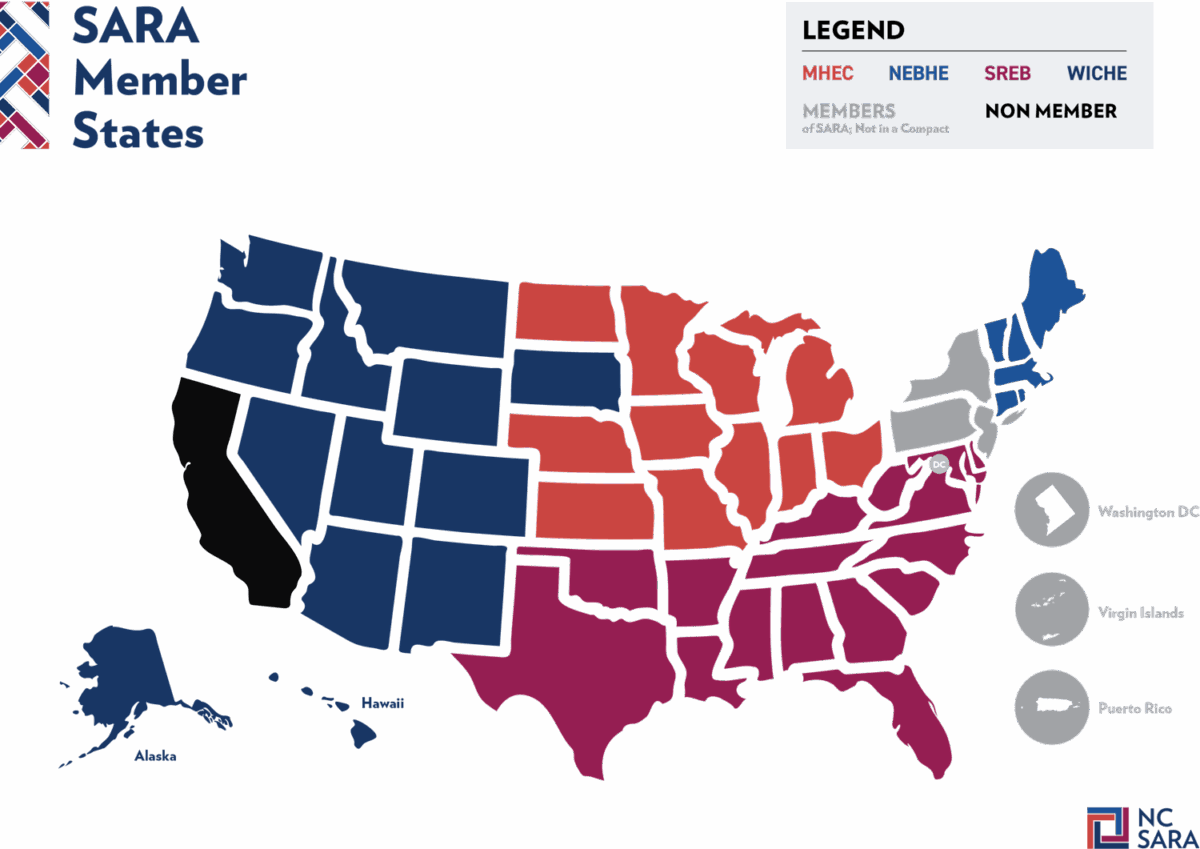
The National Council for State Authorization Reciprocity Agreements (NC-SARA) coordinates SARA in partnership with four regional higher education compacts:
-
-
- Southern Regional Education Board (SREB)
- Midwestern Higher Education Compact (MHEC)
- New England Board of Higher Education (NEBHE)
- Western Interstate Commission for Higher Education (WICHE)
- Some states and territories participate in SARA but are not members of a regional compact.
-
Since 2016, Kentucky has participated through SREB. Western Kentucky University was first approved to participate in SARA in 2017.
California Exception
California does not participate in the State Authorization Reciprocity Agreement, but WKU is permitted to offer online coursework to students located there. Institutional authorization to provide distance education does not guarantee that a specific degree program, professional licensure pathway, or experiential learning activity (such as an internship, externship, or clinical placement) is available or approved in California.
Annual renewal of our participation provides WKU with broad authority to offer online and distance education across state lines, but SARA participation does not mean that every WKU program can necessarily be offered or completed in every state or territory.
State Authorization Limitations
WKU’s authorization to provide distance education in a particular jurisdiction should not be interpreted as confirmation that every WKU program, professional licensure pathway, or experiential learning activity is available in that jurisdiction.
Although SARA provides substantial opportunities for interstate education, state-specific restrictions still apply:
- State Regulations: Individual states may set unique requirements for specific academic programs.
- Licensing Standards: Professional certification boards may require coursework that differs from WKU’s curriculum.
- Modality Restrictions: Certain states may limit online or distance learning activities for particular programs or career paths.
- Placement Authorizations: WKU may be approved to offer online courses in a state but unable to arrange, offer, or allow experiential learning placements in that jurisdiction.
Understanding Out-of-State Learning Placements (OOSLPs)
Some WKU programs require students to complete learning placements at a physical site away from campus. These activities may include internships, clinical rotations, practicums, student teaching, externships, or other supervised field experiences.
Since WKU participates in SARA, many but not all out-of-state learning placements are generally permissible. An out-of-state learning placement is not guaranteed simply because the student or site is located in a SARA member state.
A proposed out-of-state placement may be affected by:
-
- state or territorial requirements governing the activity
- professional licensing or certification board requirements
- SARA limits on placements at an individual site
- additional contractual, approval, or supervisory requirements not met by WKU
- limited availability of an approved placement at the student's desired site
Student Complaints and Consumer Protections
WKU is committed to resolving student concerns through established institutional processes. Students should first use the applicable WKU complaint or grievance procedure.
For qualifying distance education complaints that are not resolved through WKU’s internal process, additional state or SARA complaint procedures may be available. The appropriate process depends on the nature of the complaint and the student’s location.
Some of the links on this page may require additional software to view.