

CHHS Faculty & Staff Wellness Newsletter
Fall 2026
CHHS Faculty & Staff Wellness Newsletter
Fall 2026 Edition
On behalf of the CHHS Wellness Committee, welcome to the Fall 2026 semester! Whether you're returning to a familiar routine or joining our college for the first time, we're glad you're here. A new academic year brings new energy, new students, and new demands on our time which makes it a great moment to recommit to the habits that keep us healthy, focused, and resilient.
This year, the Wellness Committee is organizing our programming around three priority areas: financial wellness, physical wellness, and occupational wellness. Below you'll find what's planned for each area this semester, along with ways to get involved. We hope you'll join us. Your wellbeing matters to us, and to the students and colleagues who depend on you.
Check out the new CHHS Wellness Experience Website
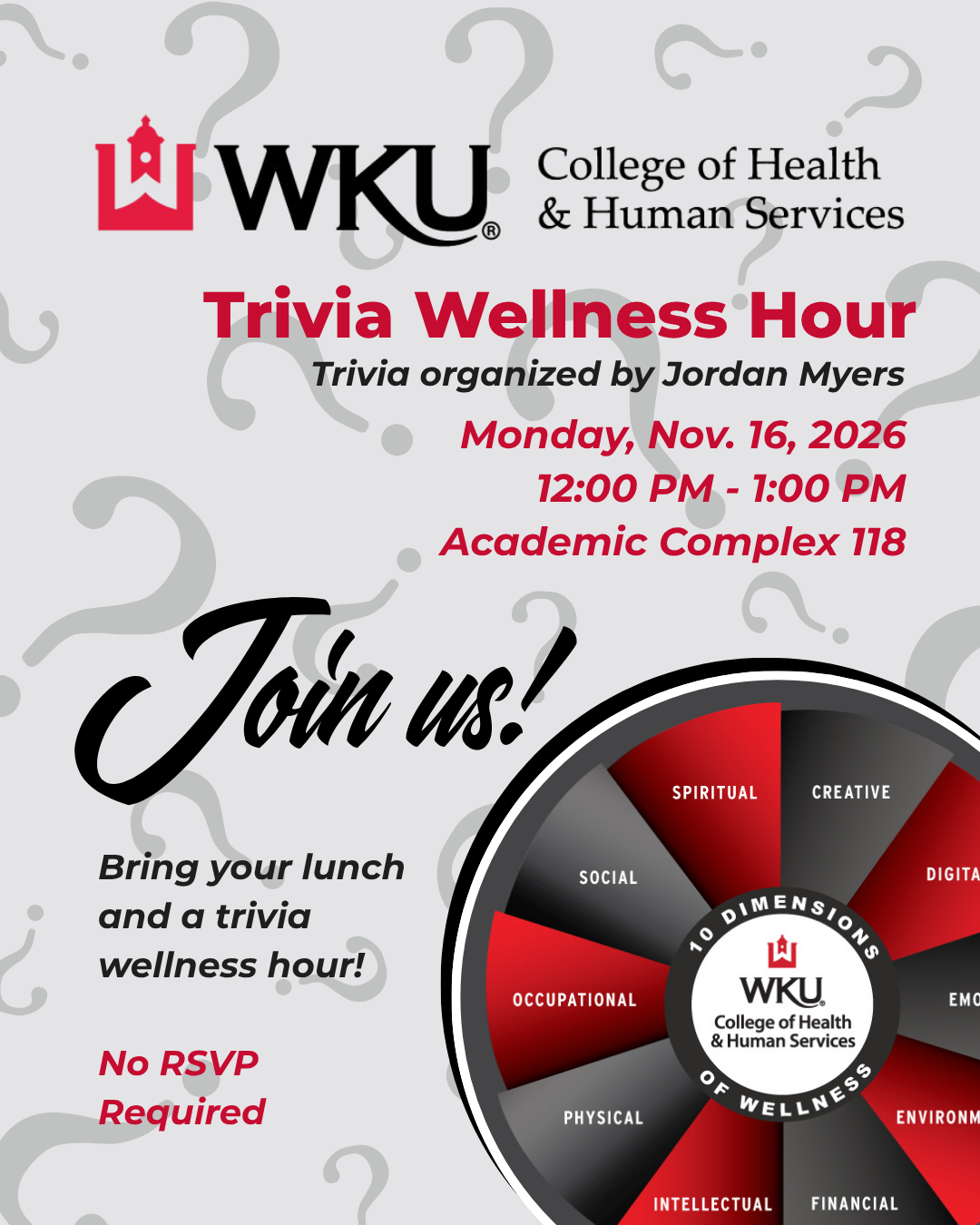
The website brings together resources organized around the ten dimensions of wellness, along with programming built specifically for faculty and staff based on assessment results and feedback, including:
- The Wellness Hour program, linked to higher job satisfaction among CHHS employees. Log your daily Wellness Hour Activity directly from the website.
- Stretch Breaks you can request for your meetings. Submit a request to have a wellness team member lead a break at your upcoming class or meeting.
- A full wellness resource directory, plus links to campus supports for faculty, staff and students.
- A wellness PowerPoint slide to include in your course presentations that directs students to wellness resources and provides contact information for the Student Wellness Navigators.
- Our strategic plan and assessment data, showing where CHHS is thriving and where we're focusing next.
- An event-suggestion form and access to past newsletters and presentation materials.
- Visit: wku.edu/chhs/chhswellness.php
Financial stress is one of the most common and most overlooked sources of strain for faculty and staff. Building simple, sustainable money habits can reduce anxiety and free up mental space for everything else on your plate (Consumer Financial Protection Bureau, 2014).
Regular movement, even in small amounts, improves energy, mood, and long-term health. The Physical Activity Guidelines for Americans recommend adults get at least 150 minutes of moderate aerobic activity and two days of muscle-strengthening activity each week (U.S. Department of Health and Human Services, 2018).
Occupational wellness is about finding satisfaction and balance in your work which includes how well work fits alongside the rest of your life.
Events
Lunch & Learn: Budgeting Basics
Date: October 16th
Time: 11:00 AM - 12 PM
Location: AC 118
Details: Bring your lunch and join us for a practical, no-judgment session on building a budget that actually works. The Center for Financial Success staff will cover tracking expenses, setting realistic savings goals, and planning.
No RSVP Required
This fall, we're offering multiple ways to build more movement into your week. Here are just a few examples:
Core Strengthening Classes
Each Wednesday starting September 9th
12:30 PM - 1:30 PM
Location: Micatrotto Dining Room
Details: A low-impact session focusing on core strength and mobility. Great for easing desk-related tension and building functional strength. Bring a water bottle and yoga mat (or borrow one of ours) and join us.
Walking Study
Enrollment Window: Currently enrolling
Details: A college-wide walking study designed to help faculty and staff build a consistent walking habit while contributing to research on workplace physical activity. Inclusion criteria apply.
More Info Contact: Dr. Mark Schafer at mark.schafer@wku.edu
Exercise is Medicine on Campus
Details: CHHS is bringing the American College of Sports Medicine's Exercise is Medicine on Campus initiative to WKU. EOM-IC is a national program that treats physical activity as a vital sign and connects faculty, staff, and students with resources to get and stay active (American College of Sports Medicine, n.d.).
Get Involved: More information will be released soon!
Below are a few evidence-informed tips.
Balance & Integration
- Set clear start and end points for your workday and protect them the same way you'd protect a meeting (Mayo Clinic, 2024).
- Use your calendar to block time for deep work, breaks, and personal commitments, not just meetings.
- Take the leave and breaks you've earned. Stepping away, even briefly, restores focus rather than draining productivity.
- Utilize and log the CHHS Wellness Hour as a time to prioritize your overall wellbeing.
Stress Reduction
- Identify your specific stress triggers and, where possible, address the source rather than only managing symptoms (CDC/NIOSH, 1999).
- Build brief recovery moments into your day. A short walk, stretching, or a few minutes of quiet breathing between tasks can help reduce your overall stress level.
- Stay connected with colleagues; social support at work is one of the strongest buffers against job stress (CDC/NIOSH, 1999).
Submit Questions or Ideas
More Upcoming Events:
Halloween Potluck
- When: Friday, October 30 from
- 11:30 AM - 1:00 PM
- Where: Micatrotto Dining Room
- Who: All CHHS Faculty and Staff
Monday, November 16th
Buddy Walk with Tracy Lane
- 12:30-1:30pm.
- Location: Kummer Little Recreation
333 College Street
Bowling Green, KY 42101 - More info: tracy.lane@wku.edu
References
American College of Sports Medicine. (n.d.). Exercise is Medicine.
Centers for Disease Control and Prevention. (2024). About the Workplace Health Program. U.S. Department of Health and Human Services.
Mayo Clinic. (2024). Job burnout: How to spot it and take action.
Some of the links on this page may require additional software to view.