
WKU Faculty and Staff Convocation - August 17, 2026
WKU President delivers Convocation address
President Timothy C. Caboni's 2026 Convocation Address
August 17, 2026
Welcome and Introductions
Good morning, Hilltopper family, colleagues and distinguished guests. It is an honor to welcome you as we officially open Western Kentucky University's milestone 120th academic year.
For one hundred and twenty years, this University has transformed lives through learning, scholarship and engagement. Every year opens another chapter in the remarkable story of an institution that has continually evolved to meet the needs of our students, our Commonwealth and our world.
This morning, we gather to celebrate what we have accomplished together, to reflect on the progress of the past year and to look ahead at the opportunities that will shape WKU's future.
Before the energy and excitement of our students once again fills every corner of our campus, I want to pause and say thank you. All summer long, faculty and staff across the University worked tirelessly to prepare every classroom, every program and every service, so our students could thrive from the moment they arrive. Because of your dedication, our newest Hilltoppers will step onto this Hill and immediately feel welcomed, find a sense of belonging and begin a journey that will prepare them for lives of purpose and of success. Much of that work happens out of sight. And I am deeply grateful for every bit of it.
We are privileged to begin this year alongside the dedicated leaders who serve on our governing board. It is my pleasure to welcome the members of the WKU Board of Regents with us today:
- Chair Jan West from Louisville, Kentucky;
- Regent Currie Milliken from Bowling Green;
- Regent Derrick Helm from Jamestown, Kentucky;
- Regent Doris Thomas from Smiths Grove, Kentucky;
- Regent Melissa Dennison from Glasgow, Kentucky;
- Regent Gary Broady from Franklin, Kentucky;
- Staff Regent Jennifer Hammonds from Bowling Green;
- Faculty Regent Shane Spiller from Bowling Green; and
- Student Regent Caden Lucas from Harned, Kentucky
Please join me in expressing our gratitude to the entire Board of Regents.
I also want to extend a special welcome to those joining us for the very first time this morning. If this is your first Faculty and Staff Convocation, or if you joined our community at any point during the past academic year, please stand so we can officially welcome you to the Hilltopper Family. We are so glad you are here.
OUR STUDENTS
Student Achievements
I’m excited for the year ahead. But before we look forward, let's take a moment to celebrate what our students accomplished.
Our students remain at the heart of everything we do, and they continue to distinguish themselves on the national stage. This past year, 150 of our students competed for nationally competitive scholarships.
In a historic milestone, junior Caden Lucas earned the Truman Scholarship, WKU's second recipient, and the only finalist from any Kentucky university this year. This is the nation's preeminent award for future public service leaders, and we could not be prouder of you, Caden.
For the second consecutive year, WKU earned recognition as a top-performing institution for the Boren Awards, tying for third nationally. Six scholars each received $25,000 to pursue immersive language study abroad. Twenty-four students received Gilman International Scholarships, earning WKU the prestigious designation as a national Top Producer of Gilman Scholars. And two Hilltoppers also claimed Barry Goldwater Scholarships, continuing our record of STEM excellence.
In June, our students captured the American Society of Civil Engineers Concrete Canoe National Championship, the first national title in WKU history. Their championship canoe, the USS Alliance, honored America's 250th anniversary while showcasing the engineering excellence that has made WKU a national powerhouse. We’ve now finished in the top five nationally for five consecutive years.
Our academic reputation expanded globally as WKU received the 2026 Senator Paul Simon Spotlight Award for campus internationalization, and our WKU Chorale performed across historic venues in Spain.
Closer to home, our students put their skills to work for our communities. WKU meteorology students provided live weather support for 80,000 attendees at the Louder Than Life music festival in Louisville last September.
In June, two WKU graduate students and Professor Josh Durkee provided weather planning, forecasting and monitoring at the opening of the Obama Center, an event that drew countless celebrities and four former United States presidents. Our broadcasting students brought home multiple honors at the Kentucky Broadcasting Association Awards; the WKU Forensics Team captured its 33rd consecutive state championship alongside a Lincoln Douglas debate national championship; and the WKU student floral design chapter claimed first place overall at their national competition this summer.
Athletic Excellence
Our student athletes set a new standard of excellence, both in competition and in the classroom.
WKU Volleyball claimed both the Conference USA regular season and tournament championships, reached their seventh straight NCAA appearance and secured their 100th consecutive C-USA regular-season win, the third-longest streak in college volleyball history.
Women's Soccer captured the C-USA regular-season title. WKU Softball rocketed to a record 19-3 start, running a 14-game winning streak and becoming the winningest home team in program history.
On the gridiron, Hilltopper Football defeated Southern Mississippi to claim the 2025 New Orleans Bowl Championship, our fifth bowl win under Coach Tyson Helton. Quarterback Maverick McIvor (Mc-Eye-ver) earned MVP honors, and punter Cole Maynard became WKU's first Consensus All-American in the Football Bowl Subdivision era.
In the classroom, our student athletes shattered records. A historic 343 earned a spot on the C-USA Commissioner's Honor Roll, and a record 101 earned the Academic Medal with a GPA of 3.75 or higher.
Institutional Milestones and Student Success
These highlights represent just a snapshot of what our students accomplished. Our collective focus on student success produced the highest retention and graduation rates in university history.
Last year, a record 79.4% of first-year students returned for their sophomore year. Our four-year graduation rate reached 50.7%, and our six-year rate climbed to 59.1%.
During the 2024-2025 academic year, WKU awarded 4,688 credentials, which was at the time, an institutional record. Our credential production ranked second among all institutions in the Commonwealth, 33% more than the next closest comprehensive university and 13% more than one of Kentucky's two R1 institutions, according to CPE Data Center figures. I am pleased to report that we exceeded even that mark in 2025-2026, awarding 4,792 credentials, an increase of more than 100 from the previous year.
SACSCOC validated this sustained excellence at the highest level, reaffirming WKU's accreditation for the next ten years with no additional reporting required.
You have heard me say many times that access without success equals access to nothing. While other institutions chase headcount, we have made intentional, and sometimes difficult, decisions to shift our focus toward ensuring that every student we invite to study with us actually accomplishes their goals of persisting and graduating. Thank you for joining me in that work. These outcomes affirm that we are on the right track, and our students are better for it.
Our faculty, staff and programs continue to earn national recognition. Twelve graduate programs ranked among the nation's best in the U.S. News & World Report; WKU Online earned recognition as a top national program; and we remained the top institution in Kentucky for veterans. Our campus also extended its streak in the Princeton Review's Guide to Green Colleges, our 16th consecutive annual appearance.
I want to congratulate our faculty and staff who earned recognition statewide and nationally this year:
- Dr. Katrina Burch - Researcher of the Year, Kentucky Psychological Association
- Dr. Amy Brausch - Conference USA Faculty Achievement Award
- Liz Sturgeon - Nurse of the Year, Kentucky Nurses Association
- And Professor Roger Dennis - who led an award-winning Rose Parade float design team, bringing significant national visibility to WKU
These examples represent only a portion of the accolades our talented faculty and staff earned during the last academic year.
Climbing to Greater Heights: 2026-2031
In 2017, we launched a comprehensive strategic planning process that produced Climbing to Greater Heights, a decade-long roadmap guiding WKU since 2018. Eight years later, I am still proud of what we have built together.
We grew our six-year graduation rate from 50.7% to 59.1%, an 8.4 percentage point increase, closing in on our 60% goal. Our four-year graduation rate now exceeds 50%, surpassing that of one of Kentucky's two R1 institutions. We advanced our fall-to-fall retention rate from 69.9% to 79.4%, a 9.5 percentage point increase, placing us within reach of our goal of 80%.
Last year, I convened a Strategic Planning Executive Steering Committee, co-chaired by Dr. Corinne Murphy and Bryson Davis, along with three subcommittees representing Our Students, Our Hill and Our Community and Beyond. Nearly 50 faculty and staff members devoted countless hours to this effort, and I want to thank each of them for their dedication and expertise. Just last week, we shared their work with our Board of Regents.
The resulting amended plan extends Climbing to Greater Heights by three years, concluding in 2031, coinciding with WKU's 125th anniversary. It builds on the strong foundation we established in 2018 and affirms our responsibility to cultivate a campus environment where we support students, faculty and staff, encourage innovation, elevate discovery and wisely steward resources. Key priorities include:
- Improving Affordability, Accessibility and Student Completion: ensuring the WKU Experience remains within reach for every qualified student and structuring academic pathways so students progress efficiently to graduation
- Career Readiness and Campus Belonging: equipping graduates with the hard and soft skills they need to thrive, while designing residential and campus communities as platforms for engagement
- Care and Excellence for Employees: your satisfaction, well-being and success are a priority, and we commit to a workplace where you feel valued, supported and heard
- Stewardship of Place and Financial Foundation: stewarding WKU's physical environments and ensuring long-term sustainability through responsible, data-informed decision-making
- Recruitment as a Shared Responsibility: embedding enrollment as a shared institutional priority that reflects the full WKU Experience
- Community Catalyst and Workforce Leadership: advancing WKU as a collaborative engine of economic development, expanding workforce-aligned degree pathways and lifelong learning opportunities across our region
This extension reaffirms our belief that higher education transforms lives. The University's future is in our hands, and together, we will keep Climbing to Greater Heights.
Wellness
Last August, I shared my belief that caring for our own well-being matters just as much as caring for our students. And our strategic plan extension places tremendous emphasis on employee wellness. Every day, you invest your talents, your energy and your hearts into our students and this University. To sustain that work, and to do it well, we must be intentional about supporting ourselves.
To that end, I charged a University Wellness Advisory Committee, co-chaired by Dr. Tania Basta, Donald R. and Irene S. Dizney Dean of the College of Health and Human Services, and Dr. Jill Sauerheber, Professor and Department Chair of Counseling and Student Affairs, with taking a comprehensive look at wellness at WKU. They spent six months gathering data, engaging employees through surveys and focus groups and developing recommendations grounded in the voices of our own people.
As I reviewed their report, it became clear that while some recommendations may be relatively straightforward, others required careful resource allocation analyses and detailed operational planning to determine their feasibility. For that reason, I will establish two wellness implementation teams to continue evaluating the report recommendations. Those groups will work throughout this academic year to build a practical roadmap toward implementation.
But while more work lies ahead, one message requires no committee and no additional analysis.
Culture matters.
And we shape our culture every day through how we lead and interact with one another.
To all who manage employees: think carefully about the critical role you play in supporting their well-being. People do their best work when they feel trusted, when they feel respected and when they receive appropriate flexibility.
Our faculty and staff are professionals, committed to this University and to our students. When life requires flexibility - a doctor's appointment, a family responsibility - we should strive to create an environment that allows people to meet both their personal and professional obligations. To the extent possible (and I recognize this is more challenging in some areas of our campus than others) focus on outcomes, professionalism and accountability rather than simply measuring time spent behind a desk.
This does not mean abandoning expectations. It means leading with trust, exercising good judgment and recognizing that supporting our people ranks among the most important responsibilities we carry as leaders.
An institution is only as strong as its people. When our faculty and staff are healthy, engaged and thriving, our students benefit, our University benefits and our community benefits. Wellness belongs to no single office or no single initiative. It is a shared responsibility, and it is part of the culture we all create together.
Mahurin Honors College
The Mahurin Honors College provides high-achieving scholars with a rich educational experience rooted in intellectual curiosity, critical thinking and academic excellence. That’s why I convened the Honors 2.0 Task Force, a 20-member group led by Professor Emeritus Molly Kerby two years ago, to evaluate how we could strengthen the Honors experience while expanding access to a broader range of WKU students.
Drawing on their recommendations and feedback from honors students themselves, the College developed a new honors curriculum shaped by our provost and academic deans that reflects the interdisciplinary, experiential and student-centered education we aspire to provide.
Implementation is anticipated in academic year 2027-2028, coinciding with the 20th anniversary of the Mahurin Honors College, the oldest honors college in the Commonwealth. And this year, the College will pilot elements of the new curriculum and expand experiential learning opportunities available to both Honors students and the broader campus community.
OUR HILL
Physical Transformation of Our Campus
As we welcome a new academic year, I want to recognize the remarkable physical transformation taking place across our Hill.
First, I want to thank you for your patience. Construction over the past year reshaped your daily routines with road closures, sidewalk detours, parking adjustments and construction noise. Your flexibility has been essential, and I am grateful.
Last fall, we dedicated Amy and David Chandler Hall, the new home of our Gordon Ford College of Business, made possible by a $74.4 million investment from the Kentucky General Assembly. With flexible classrooms, advanced technology and spaces that mirror today's professional workplaces, Chandler Hall prepares our students for successful careers and stands as a powerful symbol of WKU's commitment to business education and regional economic development.
Also last fall, we opened The Hub in Jody Richards Hall, converting an aging student technology center into a modern, welcoming space for studying, collaboration and academic support.
In March, we dedicated the Tim and Sarah Ford Fieldhouse, a state-of-the-art, 122,000-square-foot facility providing a permanent home for Forensics, Esports and Baseball, while also providing year-round training space for the Big Red Marching Band and Athletics.
Planning continues on our new Academic Complex, with its opening anticipated in fall 2029. Made possible through the Kentucky General Assembly's $160 million investment, the largest capital appropriation in WKU history. This facility will create a modern hub for the College of Health and Human Services and our Public Media operations.
And perhaps the most significant transformation underway on our Hill is the complete reimagining of our residential experience.
Our residence halls play a vital role in the WKU Experience, creating spaces where students form lifelong friendships, discover their independence and develop a sense of belonging. Those connections help our students persist from semester to semester and ultimately through graduation. That is why the future of housing at WKU matters so much.
For more than 25 years, WKU partnered with the Student Life Foundation to oversee and operate student housing. We are grateful for its service to generations of Hilltoppers. But the scale, complexity and cost of developing modern residential communities now require a different approach.
That need grew urgent following challenges with three of our newest residence halls. In 2024, Hilltopper Hall closed after identifying design and construction issues; in 2025, Regents and Normal Halls temporarily closed after an assessment found items requiring attention.
We acted immediately: Hilltopper Hall came down this summer; Regents and Normal Halls underwent necessary repairs to reopen this fall; and we expanded housing capacity through converting the former Hyatt Place hotel into Center Hall and leasing additional space at Campus Flats.
While addressing those immediate needs, we recognized that we had to think differently about the future. In December, we announced Elevate WKU, a multi-year initiative to transform campus living through a public-private partnership with Gilbane, a nationally recognized leader in student housing development. This model brings national expertise in financing, design, construction and operations, while we maintain control over what matters most: the student experience.
The first phase, The Southern Gateway, replaces Hugh Poland and Douglas Keen Halls with a new, approximately 1,000-bed residential community in the First Year Village, opening in fall 2028. Student input drove the design throughout, and the result balances privacy and community, with suite-style rooms, shared kitchens, collaborative lounges, expanded Living Learning Community spaces and dining facilities that bring students together. But these are not simply building replacements. They must deepen the relationship between our students’ in-class education with their living arrangements.
I have challenged Academic Affairs and Housing and Residence Life to double the number of Living Learning Community beds to accommodate every student who wants to participate in an LCC by Fall of 2028 and the opening of The Southern Gateway and to extend the first year experience into the sophomore year, including an additional LLC experience for those students who wish to continue with their cohort from the first year. Affordability remained central throughout this process. Our goal is to create exceptional living environments that WKU students can afford.
I want to thank the many individuals across our campus who made this progress possible. Together, these projects demonstrate our commitment to providing every Hilltopper with the spaces and resources they need to thrive.
Budget
Maintaining WKU's financial strength remains essential to fulfilling our institutional mission. This summer, our Board of Regents approved a $405.1 million operating budget for fiscal year 2027, the second consecutive year of a structurally balanced budget without relying on one-time carry-forward funds. This is the first time we have achieved this milestone in more than two decades.
I want to pause and thank every faculty and staff member in this community for their work on this. Thank you for weighing every expenditure decision to ensure its necessity. Our collective sacrifices have kept our expenses in line with revenue. And we must continue that fiscal discipline this year and into the future.
Last year, I shared that we would undertake a comprehensive review of our RAMP budget model. That evaluation began last fall with a committee of faculty and staff from across the University, including all five academic deans. This review plays a critical role in ensuring that the model remains relevant to our operations and best prescribes an effective, decentralized budgeting process.
As planned during the original implementation, I charged the committee with evaluating what we learned during the first several years of the new model, identifying opportunities for refinement and ensuring that it aligns with our evolving institutional priorities.
The committee made significant progress during the academic year and will resume their work this fall, ensuring that any recommended modifications align with the University's strategic plan extension. I want to thank everyone across campus who engaged in that process.
OUR COMMUNITY AND BEYOND
Carnegie R2 and Research
We continue to make significant progress toward becoming Kentucky's first Carnegie-classified R2 institution. WKU has already surpassed the required research expenditure threshold, reporting approximately $10.9 million in annual R&D expenditures, more than double the R2 minimum.
Following authorization from the General Assembly to award Ph.D. degrees, WKU advanced its first proposed doctoral program, a Ph.D. in Data Science, developed collaboratively by the Gordon Ford College of Business and Ogden College of Science and Engineering, targeting a fall 2027 launch. Data Science ranks among the fastest-growing disciplines worldwide, and this program positions WKU to prepare future researchers and industry leaders while expanding our research capacity and advancing our path to R2.
Despite changes in the federal funding landscape, our faculty responded with determination. In fiscal year 2026, the number of external funding proposals increased by 30%. This is a remarkable testament to your persistence and to your ambition. Our research expenditures remain above the R2 threshold, underscoring our continued progress toward that goal.
However, our growth into an even more vibrant research institution must continue. We know that engaging undergraduates in research alongside faculty is both a defining characteristic of the WKU Experience and an important differentiator for us compared to R1 institutions. It also enlivens and deepens the classroom instruction of those engaged. To that end, I have challenged the Provost and our Office of Sponsored Programs to grow our total federal sponsored research dollars to $20 million dollars and to double our total extramural funding to over $40 million dollars.
This will be a stretch goal that, much like our retention and graduation push, will require all of our efforts to be successful. So, if you have not pursued external research support, I encourage you to work with our Office of Sponsored Programs to identify sources of funds that might be appropriate for a proposal. And, if you are a successful principal investigator, I ask that you consider working with colleagues who have not before done this work as co-PIs so we can build our talent and capacity internally.
Today, I am pleased to announce the launch of the CAYA Institute for Advancing Research and Community Health, or CAYA ARCH, made possible by a generous commitment from CAYA Collaborative Care, formerly LifeSkills. CAYA ARCH will support and coordinate applied research centers, clinics and laboratories within the College of Health and Human Services, pursue federal funding from agencies including NIH, CDC and NSF and ensure that research findings translate into meaningful improvements in health and well-being across Kentucky. I look forward to sharing more about this initiative later this semester.
I want to thank our faculty for your perseverance and your commitment to advancing knowledge. The Office of Sponsored Programs stands ready to support you at every stage.
Regional Campuses
Our mission to transform lives extends far beyond Bowling Green. Our regional campuses bring the WKU Experience to communities across our 27-county service region, creating pathways for students who balance full-time careers, raise families and serve as community leaders while pursuing their educational goals.
I want to thank Dr. Derick Strode for his service as Director of Regional Campuses and congratulate him on his new role as Director of The Gatton Academy. I am pleased to welcome Stephanie Prichard as Interim Director. She is a longtime member of our regional campus team who brings extensive experience and strong relationships to the role.
The momentum shows in the results. During the past five years, on-campus enrollment across our regional campuses grew by 34%. Last year, WKU in Glasgow and WKU in Owensboro reached seven-year enrollment highs, while WKU in Elizabethtown reached a five-year high. Students can now complete 15 degree programs entirely at most of our regional campuses. And the Early College at WKU in Glasgow continues to deliver exceptional outcomes.
This year 95% of those graduates chose to continue into postsecondary education, with 60% continuing as Hilltoppers, bringing with them 30 hours of WKU credits before leaving high school.
Philanthropy
With Amanda Trabue's departure this summer, a search is underway for the next Vice President for Philanthropy and Alumni Engagement. Anthony McAdoo has graciously agreed to serve as interim vice president, and I am grateful for his leadership as the division continues building on the extraordinary momentum generated since 2017.
During fiscal year 2026, more than 10,100 donors made more than 27,000 gifts totaling $29.8 million in support of WKU. We welcomed nearly 1,900 first-time donors and nearly 5,200 alumni gave back. I want to extend a special thank you to the 431 faculty and staff members who also made the choice to invest in our mission.
Our third annual Day of Giving raised more than $719,000 from nearly 900 donors in a single day, with contributions from 47 of Kentucky's 120 counties and 100% participation from our Student Alumni Ambassadors.
We also celebrated transformational gifts this past year: Amy and David Chandler's $7.5 million gift made Chandler Hall possible; Tim and Sarah Ford's $3 million gift made the Fieldhouse possible; and we celebrated new endowed professorships, scholarship funds and gifts that will strengthen WKU for generations. Our students championed giving as well. Midnight on the Hill raised more than $122,000 for St. Jude, Dance Big Red raised more than $141,000 for Norton Children's Hospital and our Bike4Alz team once again cycled across the country for Alzheimer's research.
Spirit of WKU Award
And now, perhaps the best part of Convocation, recognizing our Spirit of WKU Award winner. This award goes to the individual who best represents enthusiasm, loyalty and commitment to the inspirational principles of our strategic plan, Climbing to Greater Heights.
One nominator wrote that this person exemplifies what it means to transform lives and elevate the communities we serve through her tireless leadership of the College of Education and Behavioral Sciences. She cites the strategic plan as an anchor point for her decision-making and lives out the aspirations found within the University mission with contagious enthusiasm.
Please help me congratulate Dr. Corinne Murphy!
Dean Murphy, please join me on the stage.
Letters of support described how Dean Murphy fundamentally transformed the College of Education and Behavioral Sciences by building authentic relationships with every constituent across campus and the community. She champions the teaching profession from the ground up, developing programs introducing P-12 students to careers in education as early as middle school, and serving on the Education Professional Standards Board by gubernatorial appointment.
As a leader, she is transparent about college operations, ensuring faculty and staff have a genuine voice in shaping the college's priorities and strategic direction. She chairs the Budget Executive Committee, has been instrumental in implementing the RAMP budget model and worked on solutions to student housing construction issues on campus. In addition, she is a constant presence at men's and women's athletic events.
Student success sits at the heart of everything Dean Murphy does. Under her leadership, CEBS increased retention, persistence and degree completion. She built a culture of "yes,” where the answer to a student in need is always to find a way to help. She established the Student Success Center, welcomed Professor Chip to support student well-being and launched a welcome postcard campaign that builds a sense of belonging for students from day one.
She is a leader who shows up, builds bridges and wears red — and she never stops asking how she can help.
Today, we are proud to recognize Dr. Corinne Murphy as our 2026 Spirit of WKU Award recipient.
Closing
Before we close, I want to speak to something that has been on my mind throughout this past year and I believe is important as we begin this new academic term.
As we always say, WKU exists to transform lives. We say that often, and we mean it. But transformation goes deeper than awarding credentials and career preparation. We prepare our students to be citizens. We prepare them to reason carefully; to disagree productively; to participate fully in the life of a democracy that depends on an educated and engaged public. Preparing citizens for self-governance is among the oldest and most essential obligations of higher education.
I have said repeatedly that I believe in the necessity of tenure and academic freedom. They help create the conditions that make genuine intellectual inquiry possible.
When a faculty member can follow an argument wherever it leads; when a researcher can pursue a question without fear of consequence; when a classroom can hold genuine discussions and have disagreements without fear of retribution; that is where deep learning happens. That is where citizens are formed.
I also understand what is lost when those protections erode, and we simply cannot fulfill our mission without them.
Creating an educated citizenry is part of our core purpose and our enduring obligation. Our nation’s founders knew that self-governance makes demands on its participants: critical thinking, the capacity to weigh evidence, the willingness to hold conviction without surrendering to certainty, the discipline to listen to a perspective they find wrong and still engage on its merits. Literacy and technical skill matter enormously. Every generation must learn these habits of democratic citizenship anew. And we are charged with teaching them.
WKU has always understood that. Henry Hardin Cherry built this institution on a hill (literally and figuratively) because he believed that education elevated. It lifts the individuals and the community around us. And the light we cast is meant to reach the region, the Commonwealth and the world beyond.
So as we begin this year, here is my challenge to each of us: Recommit to protecting the conditions for honest inquiry; to creating settings where a student can encounter an idea that unsettles them and still think it through to its conclusion; to modeling the habits of mind that self-governance requires: curiosity, rigor, humility and the courage to follow evidence. When we do these things, we are doing something that no other institution in this society is equipped to do.
Most importantly, we are a place where people learn to think. Certainly, we credential graduates, and that matters. We drive economic development across our region, and that matters, too. But above all of it, we develop the intellectual and civic capacities that no workforce training program, no online platform and no algorithm can replicate.
The Spirit Makes the Master. And the spirit of this place holds that learning matters; for what it produces, yes, but more profoundly for what it makes of those who pursue it.
Let's make it a great year.
Go Tops!
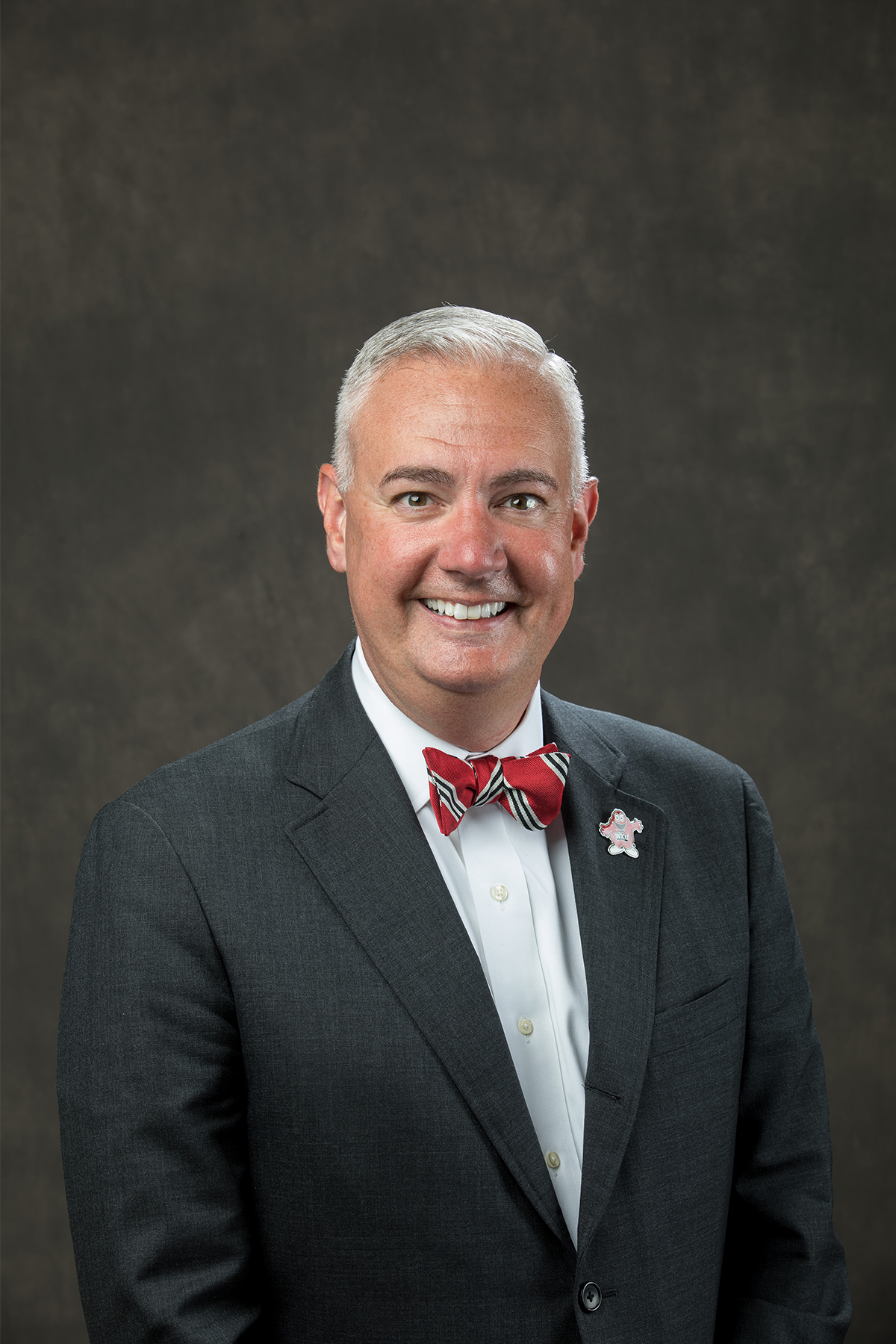
WKU President Timothy C. Caboni
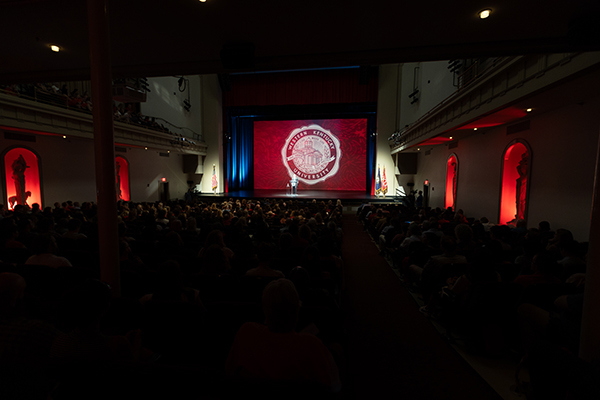
Recording of President Caboni's Convocation Speech
August 17, 2026
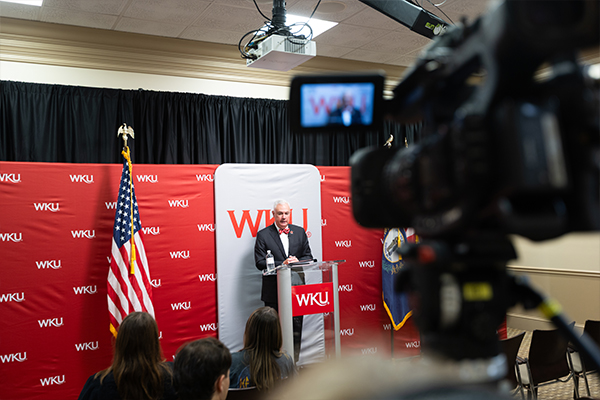
Recording of the Post-Convocation Press Conference
August 17, 2026
Spirit of WKU Award:
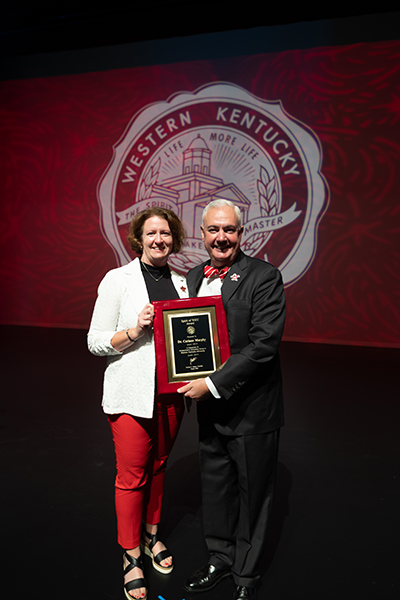
Dr. Corinne Murphy, Ph.D., BCBA-D
Dean of the College of Education and Behavioral Sciences
Some of the links on this page may require additional software to view.