

WKU Records Management
Records Management online training module now available:
Records Management at WKU is overseen by WKU Archives and includes:
- maintenance
- preservation
- destruction
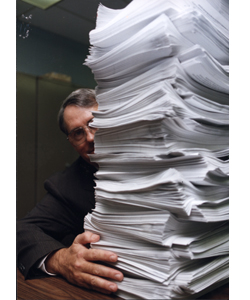
of university records, according to local, state and federal guidelines. The archivist coordinates unit record surveys and recommends methods of disposal, storage, or preservation of documents. Probably only 3% of the paper produced each year by the university is worthy of permanent preservation. The archivist works with staff to determine which materials can be safely destroyed and how long non-permanent records should be retained for reference and legal use.
WKU faculty and staff are responsible for implementing the records retention schedule and transferring permanent records to WKU Archives in a timely manner.
The archivist is also available to consult on records management issues such as application of records schedule, filing systems, digitization and other related topics.
A records retention schedule is a list of records series created by an office. It describes the types of papers included in the series (correspondence, budget, reports, etc.); how long the series is to be maintained within the office; if and when the series is to be transferred to the archives; or destruction instructions.
WKU uses the State University Model created, maintained, revised and approved by the Kentucky Department of Libraries and Archives in conjunction with Kentucky university archivists across the state. Revisions occur quarterly. The schedule is available online:
The most common type of disposition listed on the general schedule is destruction of records, written as follows:
- Destroy in office when reference value ends.
- Destroy in office after x years.
The most common types of retentions listed on a records schedule are:
- Retain in office permanently.
- Transfer to University Archives at the conclusion of each academic year for permanent retention.
Most disposition / retention instructions take effect at the end of the fiscal year, but some records are still maintained on a calendar year. The records schedule should be consulted twice a year, in December and July.
- Following the State Model Records Schedule will make an audit go smoothly.
- Identify and preserve vital records. Vital records contain information necessary to establish or continue the operation of WKU in the event of a disaster.
- Identify records series that have historic or permanent value and make provision for transferring these records to WKU Archives at the end of their in-office life.
- Identify for destruction records that are no longer useful to the unit or WKU.
- Helps insure efficient use of storage space within the unit.
- Litigation. All records created by WKU are potential documentation in lawsuits. Keeping records beyond their retention period or destroying documents too soon can be costly to the university.
- Excessive storage costs from keeping records beyond their retention period.
- Inability to retrieve important documents when needed.
- Loss of WKU history.
- Schedule meeting with WKU Records Officer to discuss viability of digitization.
- Inventory records in office, collecting information on series, date spans, amount of inches / cubic feet of records and annual growth.
- Compare records inventory to the Kentucky State University Model Schedule in order to identify permanent records and / or records that have been kept beyond their retention time.
- Destroy records as appropriate using the Kentucky State University Model Schedule.
- Transfer records as appropriate to WKU Archives.
- Review remaining records, space needs, record types and retention periods and compare to costs of digitization and electronic storage. Is digitization necessary and cost effective?
- Review Understanding Records Management: Electronic Records
- Review PM2010-01 Policy Memorandum on the Storage of Public Records as Scanned Images
- Review Ensuring Long-term Accessibility and Usability of Textual Records Stored as Digital Images: Guidelines for State and Local Government Officials
- Review Library of Congress Format Specifications
Digitization is most cost effective when used for permanent records and non-permanent records with long retention times. Transitioning to electronically born records may be more cost effective than retroactively digitizing paper records. Digitization should not replace active records management.
email: archives@wku.edu
Kentucky State University Model Schedule
Transferring Records to WKU Archives
WKU Records Management 101 & Notes
Faculty Records Management 101
Schedule a Consultation / Training Session
3rd floor Kentucky Building
Hours: Monday - Friday 8 am - 4 pm
Kentucky State University Model Schedule sections:
U0100 - General records found in most offices
U0200 - Fiscal, see also U1500 & U2200
U0300 - Awards Committee
U0400 - Student / Course
U0500 - Library / Archive / Museum
U0600 - Personnel
U0700 - Physical Plant
U0800 - Student Housing
U0900 - Athletics
U1100 - Food Service
U1200 - Bookstore
U1300 - Police
U1500 - Financial Aid
U1600 - Real Property
U1700 - Medical
U1800 - Sponsored Programs
U2000 - University Attorney
U2100 - Electronic Records
U2200 - Development
U2300 - Animal Diagnostic Laboratories
U2400 - Plant Disease Laboratories
Some of the links on this page may require additional software to view.