

Architectural Science, Bachelor of Science (518)
- Undergraduate
- Bachelor of Science
- Science and Engineering
- Engineering & Applied Sciences, School of
Overview
Architectural Science is a bridge between design theory and construction practice. Architectural Technologists perform a variety of important functions in many areas of the architectural and building construction fields and are widely recognized by professionals in the construction industry. Graduates find employment as drafters, designers, construction planners, estimators, inspectors, technical sales representatives, and many other exciting areas.
Career Opportunities
Graduates obtain employment in a wide variety of organizations: architectural firms, engineering firms, interior design firms, contractors, design-build construction firms, surveying firms, government agencies, construction product manufacturers, construction material suppliers, inspection and testing firms, specialty consultants, and computer applications consultants.
Program Description
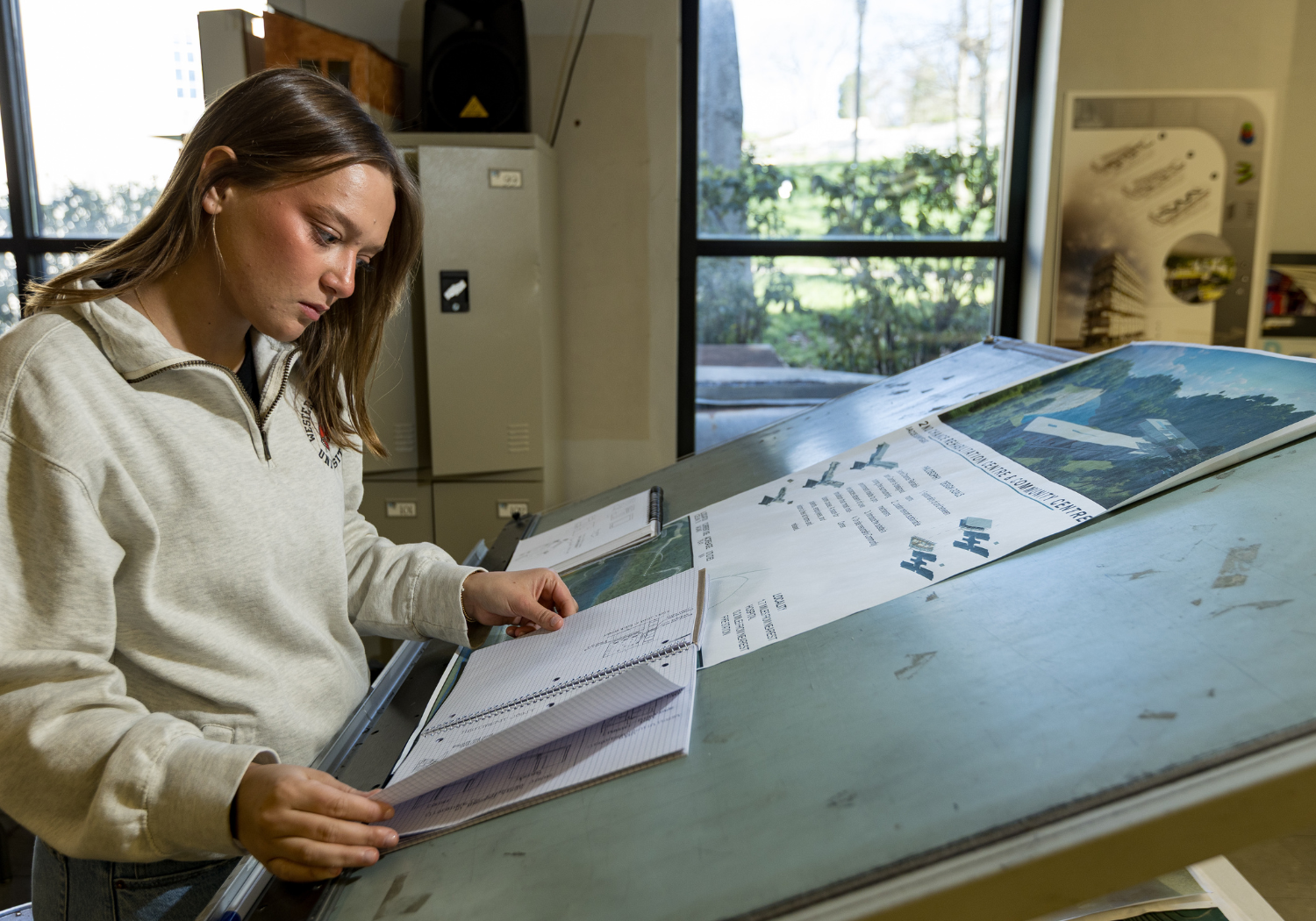
The program in Architectural Science is designed to provide graduates with a practical architectural education combining an understanding of the philosophy of building design with an applied technical knowledge of construction systems and materials. Graduates are prepared with the knowledge and skills to assist in developing drawings and related documentation, constructing architectural models, developing architectural renderings, creating digital images and visualizations, preparing cost estimates and construction planning documentation, and making professional presentations.
Program instruction includes architectural drafting, construction methods and materials, design principles, environmental systems, building systems, building codes, structural principles, project management, sustainability, and professional presentations.
Program Requirements (77 hours)
A baccalaureate degree requires a minimum of 120 unduplicated semester hours. More information can be found at www.wku.edu/registrar/degree_certification.php.
Students who began WKU in the Fall 2014 and thereafter should review the Colonnade requirements located at: https://www.wku.edu/colonnade/colonnaderequirements.php.
| Code | Title | Hours |
|---|---|---|
| Program Courses | ||
| AS 151 | Architectural Graphics | 3 |
| AS 163 | Architectural Drafting | 3 |
| AS 251 | 3D Modeling and Imaging | 3 |
| CM 261 | Construction Methods and Materials | 3 |
| AS 263 | Architecture Documentation I | 3 |
| AS 273 | Architectural Detailing | 3 |
| CM 282 | Building Structures | 3 |
| AS 305 | Building Codes | 3 |
| SEAS 325 | Survey of Building Systems | 3 |
| AS 351 | Building Information Modeling | 3 |
| AS 373 | Architecture Documentation II | 3 |
| AS 369 | Architectural Design Studio I | 4 |
| MFGE 390 | Project Management | 3 |
| SEAS 398 | Internship I | 1 |
| CM 363 | Construction Estimating and Bidding | 3 |
| AS 469 | Architectural Design Studio II | 4 |
| AS 488 | Comprehensive Design | 3 |
| AS 490 | Senior Research for Architectural Sciences | 3 |
| CE 303 | Construction Management | 3 |
| ENG 306 | Business Writing | 3 |
| or ENG 307 | Technical Writing | |
| MGT 200 | Legal Environment of Business | 3 |
| or MGT 210 | Organization and Management | |
| Select 14 hours of advisor-approved architectural science electives | 14 | |
IDFM 120 | Visual Design I | |
IDFM 201 | Interior Design Studio I | |
IDFM 221 | Visual Design II | |
IDFM 243 | Materials and Finishes for Interior Design | |
IDFM 300 | Interior Design Studio II | |
IDFM 301 | Interior Design Studio III | |
IDFM 304 | Lighting and Environmental Controls | |
IDFM 344 | Revit for Interiors I | |
IDFM 401 | Interior Design Studio V | |
IDFM 421 | Portfolio Design | |
IDFM 427 | Revit for Interiors II | |
CE 160 | Principles of Surveying | |
CE 161 | Principles of Surveying Lab | |
CE 316 | Equipment & Methods | |
CM 462 | Construction Scheduling | |
| Total Hours | 77 | |
A minor or second major is not required.
Additional Courses Required for the Major
| Code | Title | Hours |
|---|---|---|
| AS 180 | Introduction to Architecture | 3 |
| MATH 117 | Trigonometry | 3 |
| ECON 150 | Introduction to Economics | 3 |
| or ECO 150C | Introduction to Economics | |
| or ECON 202 | Principles of Economics (Micro) | |
| or ECO 202C | Principles of Economics (Micro) | |
| or ECON 203 | Principles of Economics (Macro) | |
| or ECO 203C | Principles of Economics (Macro) | |
| or ECON 375 | Moral Issues of Capitalism | |
| or ECON 390 | Economics, Law, and Public Choice | |
| Total Hours | 9 | |
Finish in Four Plans
Finish in Four Plan
| First Year | |||
|---|---|---|---|
| Fall | Hours | Spring | Hours |
| AS 151 | 3 | AS 163 | 3 |
| AS 180 | 3 | CM 261 | 3 |
| MATH 117 | 3 | ENG 200 | 3 |
| ENG 100 | 3 | Colonnade - Arts & Humanities | 3 |
| HIST 101 or HIST 102 | 3 | Colonnade - Natural & Physical Science w/out lab | 3 |
| 15 | 15 | ||
| Second Year | |||
| Fall | Hours | Spring | Hours |
| AS 251 | 3 | AS 273 | 3 |
| AS 263 | 3 | AS 351 | 3 |
| AS 305 | 3 | COMM 145 | 3 |
| ECON 202 | 3 | SEAS 325 | 3 |
| CM 282 | 3 | AS 369 | 4 |
| 15 | 16 | ||
| Third Year | |||
| Fall | Hours | Spring | Hours |
| AS 373 | 3 | MFGE 390 | 3 |
| CE 303 | 3 | Architectural Science Elective | 3 |
| Architectural Science Elective | 3 | ENG 300 | 3 |
| Colonnade - Social & Cultural | 3 | General Elective | 3 |
| SEAS 398 | 1 | Colonnade - Local to Global | 3 |
| General Elective | 1 | ||
| 14 | 15 | ||
| Fourth Year | |||
| Fall | Hours | Spring | Hours |
| AS 469 | 4 | Colonnade - Natural & Physical Science w/Lab | 3 |
| AS 488 | 3 | AS 490 | 3 |
| General Elective | 3 | Colonnade - Connections | 3 |
| Architectural Science Elective | 2 | Management Elective | 3 |
| CM 363 | 3 | ENG 306 or ENG 307 | 3 |
| 15 | 15 | ||
| Total Hours 120 | |||