Justification
The United States faces one of its greatest challenges as Asia (specifically, China and India) soars to economic and scientific heights. Both Fishman’s China, Inc.: How the Rise of the Next Superpower Challenges America and the World and Friedman’s The World is Flat point out numerous ways that the United States is slipping academically, economically, and technologically.
Fully aware of the world picture, two United States Senators requested that the National Academies name ten actions that the United States must take in order to prosper in the global economy of the 21st century. In Rising Above the Gathering Storm: Energizing and Employing America for a Brighter Economic Future (draft, fall, 2005), the National Academies made four recommendations rather than ten and presented twenty recommended actions. The four recommendations follow:
Recommendation A: Increase America’s talent pool by vastly improving K-12 mathematics and science education.
Under Action A-3, statewide specialty schools are listed as a way to improve science and mathematics education: “Specialty secondary education can foster leaders in science, technology, and mathematics. Specialty schools immerse students in high-quality science, technology, and mathematics education; serve as a mechanism to test teaching materials; provide a training ground for K-12 teachers; and provide the resources and staff for summer programs that introduce students to science and mathematics” (p. 20).
Recommendation B: Sustain and strengthen the nation’s traditional commitment to the long-term basic research that has the potential to be transformational to maintain the flow of new ideas that fuel the economy, provide security, and enhance the quality of life.
Recommendation C: Make the United States the most attractive setting in which to study, perform research, and retain the best and brightest students, scientists, and engineers from within the United States and throughout the world.
Recommendation D: Ensure that the United States is the premier place in the world to innovate, invest in downstream activities, and create high-paying jobs that are based on innovation by modernizing the patent system, realigning tax policies to encourage innovation, and ensuring affordable broadband access.
The report argues: “This nation must prepare with great urgency to preserve its strategic and economic security. …the United States must compete by optimizing its knowledge-based resources, particularly in science and technology, and by sustaining the most fertile environment for new and revitalized industries and the well-paying jobs they bring.” Through the Academy of Mathematics and Science in Kentucky, Kentucky certainly is addressing this challenge.
In response to the four recommendations in Rising Above the Gathering Storm, Senators Domenici (R-NM), Bingaman (D-NM), Alexander (R-TN), and Mikulski (D-MD) introduced the Protect America’s Competitive Edge (PACE) Act. The PACE legislation was proposed in three bills to implement the 20 recommended actions. One of the pieces of legislation that is of particular interest involves high school math and science specialty schools. The funding for this part of the proposed legislation would be in the energy budget. After all, the impact of developing top level talent in science, technology, engineering, and mathematics will impact all aspects of our economy, energy included. The Carol Martin Gatton Academy of Mathematics and Science in Kentucky will certainly have such a positive impact and would benefit from support the PACE legislation could provide.
The Gatton Academy of Mathematics and Science in Kentucky is designed for the entire Commonwealth of Kentucky. Kentucky’s very talented young people reside in Appalachia, the Pennyrile, the knobs – in large cities and tiny little towns. The Gatton Academy provides challenging opportunities for those Kentucky young people who are exceptionally advanced in math and science. And those young people (if they follow patterns similar to Texas Academy of Mathematics and Science upon which it is based) will provide economic growth and innovation in their home state, Kentucky. (Sixty-seven per cent of responding TAMS alumni are currently in Texas, with the majority of the remaining third attending west coast or east coast schools. Most attending east coast schools return to their home state to live and work.)
What Can the Gatton Academy Do for Kentucky?
1. Prepare Kentucky to Compete in a Knowledge-Based Economy
Ensure that Kentucky embraces the new knowledge economy – and reverses the downward trend in national ranking (from 39th to 42nd in the last three years). Get Kentucky off the 47th ranking for the number of scientists and engineers in the state.
2. Stop The Brain Drain
Provide appropriately challenging educational opportunities for high school juniors and seniors which will encourage them to stay in the state rather than to flee to find a challenge.
3. Eliminate the Achievement Gap
Realize that for highly talented young people who are interested in mathematics and science, the achievement gap to be eliminated is between the learning opportunities available and their potential to learn at exceptionally high levels.
4. Create Higher Paying Jobs
Create jobs for scientists, engineers, and mathematicians in Kentucky so that our talented young people will choose to spend their adult lives in our Commonwealth.
5. Be the Beacon of Excellence
Serve as the catalyst for raising achievement and interest in science, technology, engineering, and mathematics at all educational levels.
The U.S. Commission on National Security for the 21st Century says in its report, Road Map for National Security: Imperative for Change (February 15, 2001): “Second only to a weapon of mass destruction detonating in an American city, we can think of nothing more dangerous than a failure to manage properly science, technology, and education for the common good over the next quarter century … The capacity of America’s educational system to create a 21st century workforce second to none in the world is a national security issue of the first order. As things stand, this country is forfeiting that capacity.”
Kentucky’s Science and Technology Corporation recently conducted the Kentucky Survey of Critical Technologies (2004) “which studied teacher awareness levels in twenty-five scientific concepts shaping the face of modern science – as well as Kentucky’s competitive standing in the knowledge-based economy. This survey brought strategic attention to the implications of science teachers not being aware of, nor teaching, many of these new technologies.”
The final report by The National Commission on the Senior Year, Raising Our Sights (2001), outlines “the need to raise our sights to prepare more students for college and an increasingly complex world of work, to enroll more students in rigorous academic programs, to provide greater economic returns, and to ensure that our democracy continues to flourish.” A recommendation by the Commission in its final report is to “greatly expand the opportunity for high school students to experience the challenges of college-level work and increase the number of ‘middle college’ options for older students in the last two years of high school.”
North Carolina can well attest to what an academy can do for a state – and they’ve known it for 26 years! The North Carolina School for Science and Mathematics (NCSSM) was established in l980. According to the National Science Foundation, North Carolina increased its number of scientists and engineers by 125% from 1980 to 1990. NCSSM reports that 66% of their students stay in-state to finish their degrees and 57% stay or return to live and work.
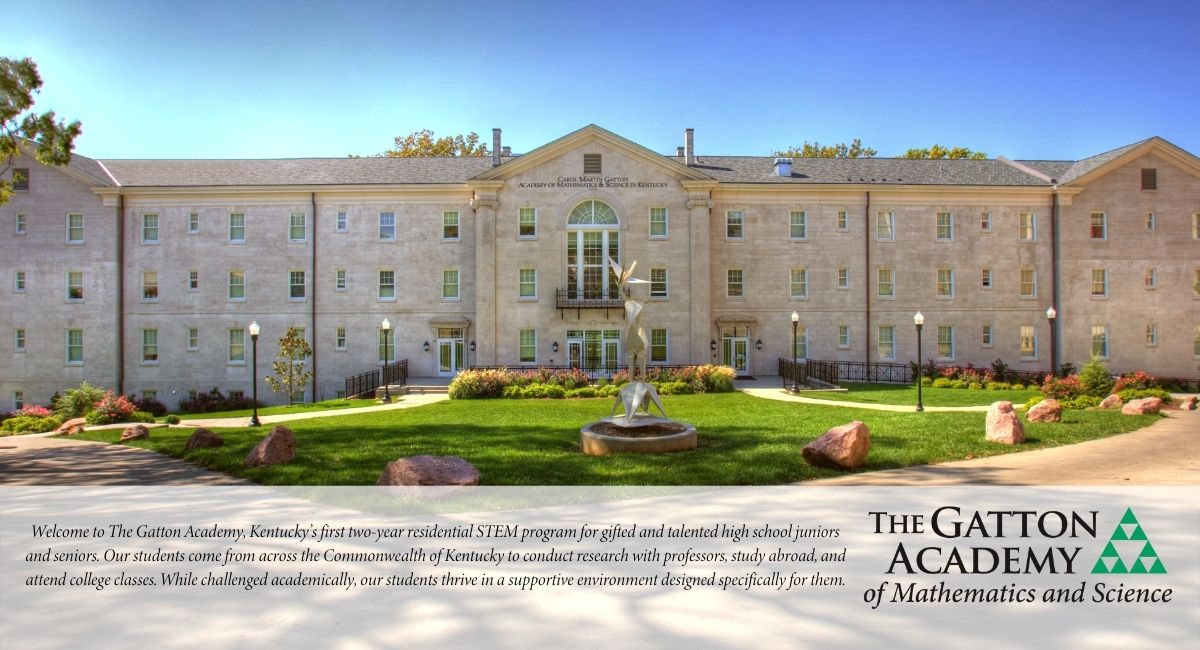
Kentucky juniors and seniors in high school who have exceptional interest and ability in science, technology, engineering, and mathematics need opportunities to learn at the highest levels possible and many high schools cannot meet their needs for advanced learning. The Carol Martin Gatton Academy of Mathematics and Science in Kentucky will enable Kentucky’s exceptional young mathematicians and scientists to learn in an environment which offers advanced educational opportunities, preparing them for leadership roles in the Commonwealth of Kentucky.


The Gatton Academy welcomes prospective students, parents, and educators to explore the infinite possibilities our living/learning environment affords outstanding high school students. You are welcome to arrange a campus visit by telephoning our office at 270.745.6565.