Alfred Russel Wallace : Alfred Wallace : A. R. Wallace :
Russel Wallace : Alfred Russell Wallace (sic)
A Catalogue of the Cetoniidæ of the Malayan
Archipelago, With Descriptions of the New Species
(S135: 1867)
Editor Charles H. Smith's Note: A catalogue of species, presented to the Entomological Society
of London meeting of 1 July 1867, and later printed in Volume Four of the third series of their
Transactions series, in 1868. My thanks to John van Wyhe for allowing me access to the part of
the transcription of this work at his "Wallace Online" website that I had not already
transcribed; some further corrections have been added here. Original pagination indicated
within double brackets. To link directly to this page, connect with:
http://people.wku.edu/charles.smith/wallace/S135.htm
[Read 1st July, 1867.]
[[p. 519]] The following Catalogue is founded mainly upon the specimens collected by
myself, with the addition of those found by Mr. Lamb at and near Penang; and I have
incorporated all those contained in the Collections of the British Museum and of Major Parry,
and have further introduced the names of all the described species of which I have not seen
specimens, so as to form as nearly complete a local catalogue as can be done without studying
the Continental Collections. In Gory and Percheron's "Monographie des Cétoines," published in
1833, only 45 species were described from the Malayan Islands, and a large portion of these were
from the single island of Java. Burmeister's "Handbuch der Entomologie," dated 1842, has 60
species from the same region. The British Museum "List of Cetoniadæ," in 1847, gives 74
species as known, but several of these were undescribed. Lacordaire, in his "Genera des
Coléoptères," in 1856, gives a list of 85 described species as found in this district. Since then
Thomson has described 9, all collected by myself; Vollenhoven has added 14, obtained from
Dutch collectors, and other authors 5; and in this paper are described 68 additional species, (also
two from Cambodia),1 bringing up the total to 181 Malayan Cetoniidæ, not including the
Trichiidæ.
Taken as a whole the Cetoniidæ are decidedly scarce in the equatorial regions. Now and then
a species will occur in profusion, but this is an exception; the rule being that single specimens of
a very few species are to be found at any one time. There are few groups in which mere
collecting will do so little towards obtaining a fair proportion of the species. Fine weather, and
good luck in being in the right place at the right time, will help the travelling collector to a few
good things; but to obtain any thing like a complete knowledge of the group requires a long
residence and the assistance of the whole native population. This is well shown by the
comparatively small number of species collected by [[p. 520]] myself. During eight years most
assiduous search, in about thirty different localities, I only obtained 85 species, or considerably
less than half the number now known. Compare this with other families. I collected about a
thousand species of Longicorns, and I feel certain that the additional species from the Malayan
region either described or existing in English collections could not exceed four hundred. So in
the Buprestidæ, the 355 species collected by me must form a very large proportion of all that are
known from the region, for Lacordaire's work does not indicate more than 50 species from the
same countries. In the Papilionidæ, out of 123 known species I collected myself no less than 92;
and of Pieridæ 121 out of a total of 169.
The Cetoniæ of the Malayan islands are neither so large, so varied, nor so numerous as those
of the continent of Asia. The fine horned Goliathinæ of the Himalayas are represented only by
two species of Mycteristes and a few small Heterorhinæ, and there is nothing to make up for this
deficiency. Lomaptera, Chalcothea, and Macronota, are the most characteristic Malayan genera,
and contain many beautiful species, but none exceed the middle size. The number of species
found in any one locality seems to be influenced, first, by proximity to the continent, and next, by
the mass of the island. The Peninsula of Malacca, though but very partially explored, has 44
species; Java, the best known by far of all the Eastern Islands, has 46; but some of these are book
species which may have been already included under other names, and even if they were all
distinct, the number is really less in proportion than that of Malacca, when we consider that the
whole surface of Java is more or less known, and that the whole island has been for more than a
century in the possession of Europeans, while in the Malay Peninsula small collections have been
made only in a very few limited localities. Further from the continent, we find the whole group of
the Philippines with 32 species; further still, Celebes with 19; Ceram and Amboyna with 11; the
Aru Islands with 9, and the great Island of New Guinea with 12,--the slightly increased number
being due to its large area, and very many more species remaining to be discovered there. The
same diminution in receding from the continent is visible if we divide the Indian from the
Australian regions of the Archipelago, the [[p. 521]] former (extending as far east as Java,
Borneo, and the Philippines) having 114 species, while the latter (stretching from Celebes to the
Solomon Islands) has but 70.
This group of insects furnishes us with a very satisfactory confirmation of the view that the
division of the Archipelago just alluded to is a truly natural one, however much it may be
occasionally masked by special circumstances. No less than nine genera, Mycteristes, Agestrata,
Clerota, Plectrone, Chalcothea, Centrognathus, Rhagopteryx, Macroma, and Euremina, are
strictly limited to the Indian region; and two more, Heterorhina and Clinteria, only pass beyond
it into the closely connected chain of islands from Java to Timor, and in the case of a single
species into Celebes. Three genera, on the other hand, Schizorhina, Anacamptorhina, and
Sternoplus, are restricted to the Australian region, and the genus Lomaptera is almost so, only 3
species out of 25 passing beyond its limits, of which one, L. striata, is the most aberrant of the
genus, and the other two are closely allied forms which have a wide range on the continent.
These remarkable limitations of genera do not accord with the supposition that the whole
Archipelago forms a single zoological region, but they strikingly support the view that there is a
line of very ancient division between its eastern and western halves, while the divisions between
islands and groups of islands within either half are of more recent establishment, and are
therefore less efficacious in limiting the range of species or of genera.
In classification I have not attempted to do more than follow Lacordaire, and do not profess
to criticize his work in this very difficult family. I have proposed two new genera for species that
appear to me strikingly distinct, and I have indicated two others that will probably have to be
established when more materials are obtained.
The phenomena of variation are well exhibited here, and there are many cases in which
structural characters are not a surer guide to specific distinction than colour or markings. In
Lomaptera pulla and Macronota regia we have insects of wide range, and with such an amount
of variation, that few would consider it possible that the extremes, considered alone, could be the
same species; but these extremes are united by a series of intermediate forms, many of which
occur together in the same locality. In other cases we have allied forms from adjacent islands [[p.
522]] which so nearly resemble each other that it seems impossible to separate them, but close
examination reveals minute but important differential characters which seem quite constant. Such
are Macronota carbonaria and M. egregia, var. nigra; Schizorhina Whitei and S. bouruensis;
Lomaptera arouensis, L. ceramensis, and L. cambodiensis; Lomaptera pygidialis and L.
batchiana, and some others. Such cases force us to the conclusion that structural and superficial
characters are about on a par as regards introducing any certainty into the definition of a species,
and that a decided difference of colour and marking is often a better character than a slight
modification of the form or sculpture of some important organ. Both are sometimes very
constant, both are at times liable to much variation, and it is a matter of judgment and opinion
how far we are to be guided by either in any particular case.
It will be as well, to avoid misapprehension, to say a few words about the localities given for
the various species. All the specimens noted as from my collection were either obtained directly
by myself in the localities named, or through collectors whom I knew well. All these localities
therefore may be relied upon as perfectly authentic. The specimens collected by Mr. Lamb, and
noted as from "Penang," were most of them collected, not in the island, but in the main land of
the Malay Peninsula opposite, termed the "Province of Wellesley." "Penang" may therefore be
held to signify merely a particular sub-district of the Malay Peninsula. The collections presented
to the British Museum by Mr. Bowring comprise several thousand specimens labelled "Java."
These were not collected by Mr. Bowring himself, but formed part of an extensive collection
purchased by him, and said to have been collected in "Java and the adjacent islands,"--but
chiefly in Java. It is to be remembered also, that for the last hundred years, collections have
arrived in Europe from Java, which did not necessarily consist only of Javanese
insects,--sometimes, on the contrary, they have been entirely formed in other islands. It follows
that my own collections and those of Dr. Horsfield are the only perfectly authentic materials for
the Entomology of Java, although I fully believe that by far the larger part of the species imputed
to that island do really inhabit it, since it is unusually rich in every department of Zoology. The
specimens from the [[p. 523]] Philippine Islands are no doubt mostly well determined. A large
number were collected by the late Hugh Cuming, and as there is scarcely any direct
communication between this part of the Archipelago and any other, the collections are not likely
to have been misappropriated. I have prefixed to each genus a few words on its distribution, and
on any particulars of its habits known to me; and have added tables exhibiting at one view the
distribution of the species, genera, and sub-families, through the various islands, groups of
islands, and regions of the Archipelago.
Sub-fam. I. GOLIATHINÆ.
Gen. I. MYCTERISTES, Castelnau.
The two species of this genus are both rare. They are the only representatives of the fine
Indian Goliathinæ yet found in the Archipelago.
1. MYCTERISTES RHINOPHYLLUS, Wiedemann.
Goliathus rhinophyllus, Wied. Zool. Mag. ii. p. 82. Macronota rhinophyllus, Gory & Perch.
Mon. Cet. p. 317, pl. 62, f. 5. Mycteristes rhinophyllus, Westw. Arc. Ent. i. p. 2, pl. i. f. 3.
Hab.--Java (Coll. Parry, B. M., Horsfield).
2. MYCTERISTES CUMINGII, Waterhouse.
Mycteristes Cumingii, Waterh. Proc. Ent. Soc. 1841, p. 26. M. (Phædimus) Cumingii, Westw.
Arc. Ent. p. 5, pl. i. f. 1, 2, ♂, ♀ .
Hab.--Philippine Islands (Coll. Parry, B. M.).
Gen. II. HETERORHINA, Westwood.
This genus contains several distinct types of form. Diceros, Gory & Perch., of which Cetonia
bicornis, Latr., is the type, may be held to include also the hornless species, such as H. confusa,
Westw., which have exactly the same style of colouration. H. dives resembles Diceros [[p. 524]]
in its double horn, while in colour it approaches Coryphocera, which contains the green species
with a small flat horn or none. Diceros is a group very characteristic of the Archipelago, in which
all the horned species are found. Coryphocera is more abundant in India and Africa. Neither of
them extends into the Moluccas, New Guinea, or Australia.
*(Diceros, [err. Dicheros], Gory & Perch.).
1. HETERORHINA BICORNIS, Latreille.
Cetonia bicornis, Latr. Regn. An. t. iii. Pl. 17, f. 4. Diceros plagiatus, Gory & Perch. Mon.
Cet. p. 300, pl. 58, f. 3.
Hab.--Timor (Coll. Parry, B. M).
2. HETERORHINA FLORENSIS, n. s.
Nigra, nitida; thorace utrinque macula magna triangulari rubra; elytris singulis macula magna
oblonga subquadrata flavo-testacea. Mas: cornubus duobus divergentibus recurvatis.
Black, shining; clypeus dilated, rounded in front and slightly notched; head of the male
produced into two slightly divergent upcurved horns about as long as the thorax, head of the
female nearly as in H. bicornis figured by Westwood (Arc. Ent. pl. 36, f. 8c), but the short horn
is entire; head deeply punctured; thorax convex, finely punctured, the sides from the eye to near
the outer angle blood-red, which colour extends in an irregular triangle to near the middle of the
base; scutellum triangular, nearly equilateral, with scattered punctures; elytra punctate-striate and
with scattered punctures, the disk covered by an elongate pale yellow patch, leaving a broad
border at the base and apex, but a very narrow one at the sides; pygidium and the last abdominal
segment blood-red; the sides of the thorax beneath the posterior coxæ, and a spot on the posterior
femora, red; sternal process elongate, abruptly bent up between the anterior pair of legs.
Length, male 11 lines, female 10 lines.
Hab.--Flores (Coll. Wall.); ? Celebes (Coll. Parry).
[[p. 525]] 3. HETERORHINA MALAYANA, n. s.
Nigra, nitida; clypeo truncato; thorace lateribus et fascia lata postica rubris; elytris singulis
macula magna elongata flavo-testacea; femoribus rubris. Mas: cornubus duobus rectis, non
divergentibus, sed apicibus dilatatis.
Black, shining; clypeus truncate in front; head of the male with two straight horns longer
than the thorax, parallel, but flattened and curved on the outside at the apex; thorax distinctly
punctured, with a narrow marginal band on the sides, connected by a broad transverse band close
to the hind-margin, blood-red; elytra finely and regularly punctate-striate, the yellow patch still
larger than in H. florensis; beneath, the sides of the thorax, all the thighs, the last abdominal
segment, and the pygidium, blood-red. The sternal process as in H. florensis, but hardly so much
incurved at the apex. Anterior tibiæ unarmed.
Length, male, 11 lines.
Hab.--Penang (Coll. Lamb).
The form of the horns of this species, no less than the colouration, distinguishes it from D.
ornata as figured by Westwood, the thorax of which is also less punctured.
4. HETERORHINA ORNATA, Hope.
Diceros ornatus, Hope, Proc. Ent. Soc. 1841, p. 33; Burm. Handb. iii. p. 219. Heterorhina
ornata, Westw. Arc. Ent. i. p. 140, pl. 36, f. 6, 7.
"Niger, capite medio excavato, postice tridentato, thorace nigro, fascia obliqua rubra fere
interrupta, elytris nigris, macula lata flava, basi apice suturaque, nigricantibus, pedibus nigris,
femoribus rubro-corallinis. Long. corp. lin. 8. Hab. Mysore." (Hope.)
Hab.--Philippine Islands (B. M. ♂, Coll. Parry, ♀). India? (Oxford Mus. ♀.)
The supposed Indian specimen (Hope's type) is identical with those from the Philippines; but
as no specimens have arrived from India during the last twenty-five [[p. 526]] years, and as the
horned form of this group appears to be absent from the Indian Peninsula, I feel satisfied that the
locality of that specimen is incorrect, and that it really came from the Philippines.
5. HETERORHINA BIGUTTATA, Westwood.
Heterorhina biguttata, Westw. Arc. Ent. i. p. 141, pl. 36. f. 5. ♀.
Hab.--Philippine Islands, (B. M.), type ♀.
This species seems very different from the Philippine island males which appear to be
identical with Hope's type (a female) of H. ornata from India. It is a striking example of how
much collections are still required from the East, that during the twenty-five years that have
elapsed since Mr. Cuming returned from the Philippine Islands, no males of this species have
been received in this country. This may probably be an extreme form of H. ornata ♀, from which
it hardly differs except in the form and size of the spots.
6. HETERORHINA PETELII, Buquet.
Gnathocera Petelii, Buq. Ann. Soc. Ent. Fr. 1836, p. 206. Heterorhina Petelii, Westw. Arc.
Ent. i. p. 141, pl. 36. f. 4, ♀. Diceros decorus, Gory & Perch. Mon. Cet. p. 301, pl. 58, f. 4, ♀,
(nec Illiger); Burm. Handb. iii. p. 219.
Hab.--Java.
Westwood's figure shows that this must be a very distinct species of the horned group, the
male of which is not yet known. There appear to be no specimens in this country.
7. HETERORHINA DIVES, Westwood.
Heterorhina dives, Westw. Arc. Ent. i. p. 134, pl. 33, f. 5 (details.) Gnathocera Macleay,
Gory & Perch. Mon. Cet. p. 129, pl. 19, f. 2, (nec Macleaii, Kirby.)
Hab.--Philippine Islands (Paris Mus.).
[[p. 527]] 8. HETERORHINA NIGROTESTACEA, n. s.
Nigra, nitida; clypeo quadrato, integro; capite cornu parvo depresso; elytris macula magna
quadrata testacea ad suturam interrupta; subtus immaculata, processu sternali longo, incurvato.
Black, shining; clypeus square; head rugose-striate, with a smooth ridge between the eyes,
forming a depressed horn rather larger than in H. Petelii; thorax immaculate, punctured at the
sides; elytra narrowed towards the apex, punctate-striate, on each side a large quadrate testaceous
spot extending from the lateral margin to the sutural stria. Beneath immaculate; the sternal
process long, incurved at the apex; anterior tibiæ with a flat tooth just below the apical spine.
Length 9 lines.
Hab.--Malay Peninsula (Coll. Parry), Siam (Coll. Wall.).
9. HETERORHINA CONFUSA, Westwood.
Heterorhina confusa, Westw. Arc. Ent. i. p. 139, pl. 36, f. 2. Gnathocera bimaculata, Gory
& Perch. Mon. Cet. p. 142, pl. 22, f. 3, (nec Cet. bimacula, Wied.)
Hab.--Java (Gory & Perch.), India (Westw.), Philippine Islands (B. M.).
A species of the form of H. bicornis, but with the long horns in the male.
* * (Coryphocera, Burm.).
10. HETERORHINA MACLEAII, Kirby.
Cetonia Macleaii, Kirby, Trans. Linn. Soc. xii. p. 408, pl. 21, f. 11 (nec Gory & Perch.).
Heterorhina Macleaii, Westw. Arc. Ent. i. p. 134, pl. 33, f. 4.
Hab.--Philippine Islands (B. M.).
[[p. 528]] 11. HETERORHINA DECORA, Illiger.
Cetonia decora, Ill. Vers. Oliv. ii. p. 148. Heterorhina decora, Westw. Arc. Ent. i. p. 135, pl.
33, f. 6. C. maculata, Gory & Perch. Mon. Cet. p. 310, (C. 6-maculata) pl. 19, f. 3.
Hab.--Java (B. M.), Penang (Coll. Lamb.), Sumatra (Burm.).
12. HETERORHINA BORNEENSIS, n. s. (Pl. XI. fig. 2).
Viridis; thorace punctato, macula magna centrali nigra; elytris rubro-nigris, fasciis (una
mediana alteraque apicali) viridibus; capite cornu parvo dilatato, clypeo rotundato recurvato
minime emarginato.
Silky green; clypeus rounded, recurved, slightly emarginate; head with a flat depressed horn
dilated semicircularly at the end; thorax semicircular, thickly punctate, with a large central
brown-black spot; scutellum triangular, smooth; elytra pitchy brown, punctate-striate, with a
green band across the middle wider at the outer margins, and a curved green spot at the apex on
each side; antennæ and tarsi pitchy, tibiæ with green markings inner side of all the thighs and
posterior coxæ pitchy brown; anterior tibiæ dilated, and with a strong lateral tooth; sternal
process flat, elongate, curved upwards.
Length 9 lines.
Hab.--Borneo (Coll. Wall. ♀).
This agrees very nearly in many characters with H. dives, of which only the male is known
from the Philippine Islands, but so much confusion has been caused by describing opposite sexes
found in distant localities as the same species, that I think it much better to describe this insect as
distinct.
13. HETERORHINA MITRATA, n. s. (Pl. XI. fig. 1).
H. borneensi similis, sed capite cornu acuto et clypeo elongato bidentato.
[[p. 529]] Green; the spot on the thorax as in H. borneensis, the elytra with the median band
broader and sloping backwards from the suture so as to join the apical spots; clypeus elongate,
recurved, and deeply cleft; a very short flat triangular horn between the eyes; pygidium green on
the outer edge only; antennæ and legs as in H. borneensis.
Length 10 lines.
Hab.--Penang (Coll. Lamb, ♀.)
This species and H. borneensis are strikingly alike in form and colouration, but differ
completely in the armature of the head. The males of both may perhaps be as fine insects as H.
dives.
14. HETERORHINA MODESTA, n. s. (Pl. XI. fig. 3).
Nigra, elytris singulis macula magna obliqua viridi-sericea; clypeo quadrato, margine antico
integro; vertice obscure carinato.
Elongate, attenuate behind, black; clypeus quadrate, the margins reflexed, entire; head
unarmed, with traces of a ridge between the eyes; thorax convex, smooth, its base as broad as the
elytra, the hind-angles acute; elytra very smooth, a large irregular silky-green patch extending
from the basal half of the suture to near the apical half of the outer margin, the apex somewhat
produced and spined; anterior tibiæ of the male unarmed, of the female with a strong tooth near
the extremity; posterior tibiæ rather long; sternal process elongate, flattish, much curved.
Length 9 lines.
Hab.--Tondano, North Celebes (Coll. Wall, ♂. ♀).
This elegant species presents no sexual differences but those of the furrowed abdomen and
unarmed anterior tibiæ of the male. Major Parry possesses a male from the same locality, which
is much broader in proportion than my specimens, but otherwise exactly resembles them.
15. HETERORHINA LÆTA, Fabricius.
Cetonia læta, Fabr. Syst. El. ii. p. 150. Gnathocera læta, Gory & Perch. Mon. Cet. p. 135, pl.
20, f. 6. [[p. 530]] Coryphocera læta, Burm. Handb. iii. p. 223. Heterorhina læta, Westw. Arc.
Ent. i. p. 137, pl. 34, f. 2. (details).
Hab.--Java (B. M.), Siam (Coll. Wall.), Sylhet (Coll. Parry).
Sub.-fam. II. GYMNETINÆ.
Gen. III. CLINTERIA, Burmeister.
A group of small-sized dull-coloured Cetoniæ, not common in the Archipelago. C.
sexpustulata was, however, very abundant in the island of Timor. They have evidently spread
from the continent into the large islands at the time of their union, since they are not found in
Celebes, or any of the islands further east, except the closely connected chain which extends
from Java to Timor.
1. CLINTERIA ATRA, Wiedemann.
Macronota atra, Wied. Zool. Mag. ii. p. 84. Gymnetis funeraria, Gory & Perch. Mon. Cet. p.
375, pl. 76, f. 5 G. biguttata, Gory & Perch. ib. p. 374, pl. 76, f. 4.
Hab.--Java (B. M.).
2. CLINTERIA FLAVOMARGINATA, Wiedemann.
Macronota flavomarginata, Wied. Zool. Mag. ii. p. 84.
Hab.--Java (B. M.).
Very near C. atra, but smaller, and distinguished by its broad yellow margins to the elytra.
3. CLINTERIA SEXPUSTULATA, Gory & Percheron.
Gymnetis sexpustulata, Gory & Perch. Mon. Cet. p. 376, pl. 77, f. 1.
Hab.--Timor (Coll. Wall.).
An abundant species in Timor, and very variable in its markings. Found in foliage and in
flowers.
[[p. 531]] 4. CLINTERIA EGENS, Vollenhoven.
Clinteria egens, Voll. Tijd. voor Ent. vii. p. 152.
"Nigra, subopaca, elytrorum macula pallide ochracea. Long. 15. mm."
Hab.--Borneo (Leyden Mus.), Penang (Coll. Lamb).
I have some hesitation in referring Mr. Lamb's specimen to this species, as Vollenhoven's
description is by no means precise; the elytra are rather finely and regularly punctate-striate;
whereas Vollenhoven says:--"Elytres à lignes de gros points enfoncés mais peu profonds." It is
allied to C. flavonotata, Gory & Perch.
5. CLINTERIA BOWRINGII, n. s.
Nigra, opaca, elytris singulis macula magna laterali roseo-cinnabarina.
Black; clypeus quadrate, elongate, emarginate; thorax with coarse scattered punctures on the
disk, thickly rugose--punctured on the sides; scutellum small, triangular, very narrow; elytra
punctate-striate, the spaces elevated, a large irregular roundish spot on each side extending from
about the middle of the lateral margin two-thirds across the elytra of a bright rosy cinnabar red;
beneath shiny black, sternum with scattered coarse punctures, its process straight, conical, acute;
anterior tibiæ with two acute lateral spines.
Length 7 lines.
Hab.--Java (B. M.).
6. CLINTERIA MALAYENSIS, n. s.
Nigra, subtus nitida, supra opaca subænea; thorace punctis quatuor, elytris singulis maculis
duabus flavis, una magna, altera apicali minore.
Black, very brilliant beneath, opaque and slightly brassy above; clypeus as in C. Bowringii;
thorax faintly punctured on the sides, two distinct yellow spots on the disk, and two or four
minute ones near the margin; scutellum very small as in C. Bowringii; elytra punctate-striate, a
large rotundate marginal spot notched on the inner side below, and a smaller apical spot, pale [[p.
532]] ochre yellow, pygidium opaque, faintly wrinkled; a small spot on the side of the sternum,
and others on the margin of the two first abdominal segments, whitish-yellow; sternal process
conical, blunt; thighs, coxæ and sternum coarsely rugose-punctate; spines of anterior tibiæ very
stout.
Length 6½ lines.
Hab.--Penang (B. M.).
Very near C. flavonotata, but I think distinct; that species is rather broader, entirely wants the
apical spot, the surface of the sternum is more irregularly punctate, the elytra are deep opaque
black, and more coarsely punctate, and the trochanters of the hind legs are strongly spined.2
7. CLINTERIA CINCTIPENNIS. Gory & Percheron.
Gymnetis cinctipennis, Gory & Perch. Mon. Cet. p. 376, pl. 77, f. 2.
Hab.--Java.
I have not seen a specimen of this species. It may be a variety of C. sexpustulata or C. atra.
8. CLINTERIA DIVES, Vollenhoven.
Clinteria dives, Voll. Tijd. voor Ent. vii. p. 153.
"Nigra, supra opaca, elytris striatis, subtus subnitida, elytrorum macula magna transversali
aurantiaca. Long. 16 mm."
Hab.--Borneo and Biliton (Leyden Mus.).
9. CLINTERIA VIDUA, Vollenhoven.
Clinteria vidua, Voll. Tijd. voor Ent. vii. p. 153, pl. 9, f. 6.
"Nigra, supra opaca, subtus nitida; elytrorum maculis duabus magnis subovalibus, lunulisque
duabus lacteis. Long. 17 mm."
Hab.--Sumatra (Leyden Mus.).
[[p. 533]] 10. CLINTERIA FLORA, n. s. (Pl. XI. fig. 4).
Supra nigro-brunnea; thorace punctis duobus et macula marginali fulvo-luteis; elytris singulis
fascia lata longitudinali brunneo-rufa, punctis duobus discalibus, maculisque marginalibus et
apicalibus fulvo-luteis.
Black; clypeus quadrate, emarginate, lobes rounded, coarsely punctate; thorax deep
olive-brown, finely punctate, the sides rounded, an irregular marginal patch not reaching the
outer angle, and two small oval spots on the disk, orange-ochre; scutellum very small, triangular;
elytra punctate-striate, the punctures large and shallow, appearing as semicircular impressions in
some lights, deep olive-brown, a broad longitudinal band on the middle of each elytron from the
base to near the apex brownish-red, an elongate apical spot, a smaller one on the outer margin
nearer the apex than the base, and a small discal double spot, orange-ochre; pygidium black,
hairy, and with a small yellowish spot on each side; beneath are patches of orange on the margins
of the sternum, the coxæ of the hind legs, and on the last abdominal segment; the sternal process
curves outwards and is rounded at the end; head and legs with rufous hairs; anterior tibiæ with
two strong lateral teeth.
Length 7 lines.
Hab.--Flores (Coll. Wall.).
A pretty species, perhaps nearest to C. mœrens, from Ceylon.
Gen. IV. AGESTRATA, Eschscholtz.
Although these fine insects are so common in collections, I never myself met with them.
They are strictly confined to the Indian region of the Archipelago.
1. AGESTRATA ORICHALCA, Linnæus.
Scarabæus orichalcus, Linn. Amœn. Acad. vii. p. 504. Scarabæus chinensis, Auct. Cetonia
chinensis, Herbst, iii. p. 199, pl. xxviii. f. 2. Agestrata chinensis, Gory & Perch. Mon. Cet. p.
305, pl. 59, f. 2. [[p. 534]] A. Dehaan, Gory & Perch, lib. cit. p. 304, pl. 59, f. 1. Cetonia nigrita,
Fabr. Syst. El. ii. p. 136, var. Agestrata Withillii, Hope, Proc. Ent. Soc. 1841, p. 33. A. gagates,
Hope, l. c.
Hab.--China, India, Penang, Borneo, Java.
2. AGESTRATA LUZONICA, Eschscholtz.
Agestrata luzonica, Eschsch. Zool. Atlas, p. 13, pl. 4, f. 8. A. splendens, Gory & Perch. Mon.
Cet. p. 306, pl. 59, f. 3.
Hab.--Philippine Islands (Coll. Parry, B. M.).
3. AGESTRATA PARRII, n. s.
Sub-convexa, læte viridis, subtus viridi-cuprescens; tibiis cupreis, apicibus nigris; tarsis
rufo-cupreis, nigro-terminatis; antennis nigro-rufis.
Green, not so metallic as A. orichalca, rather more convex; the head and clypeus less
coarsely punctured; thorax less rugose, and with fine scattered punctures; elytra somewhat
smoother; beneath, the sternal process is narrow, bent in, not dilated; the tibiæ are coppery, with
the apical spines black, the tarsi dark coppery, with the apex of each joint black; the antennæ
dark purple-copper or rufous; anterior tibiæ with the second tooth below the apex, small.
Length 27 lines; width 12 lines.
Hab.--Borneo (Coll. Parry, B. M.).
This fine species appears to differ sufficiently from the other two, to be considered distinct.
Gen. V. LOMAPTERA, Gory & Percheron.
This fine genus is especially characteristic of the Moluccas and New Guinea, where the
species are often very abundant. They frequent the flowers of palms, or the sap which flows from
their cut flower-stalks, and are sometimes found on foliage. They were also sometimes very
abundant in new clearings, flying about near the ground, and settling on rotten wood. In the
Kaioa Islands, Lomaptera pygidialis was seen flying about by [[p. 535]] hundreds. In the great
islands of the Indo-Malayan region, on the contrary, I never saw a specimen of the genus, and
this fact will illustrate its peculiar distribution, as well as the localities of the several species.
1. LOMAPTERA STRIATA, n. s. (Pl. XI. fig. 8).
Viridis, lata, sub-convexa; pygidio conoideo, transverso, compresso, vix carinato; thorace
punctato; elytris punctato-striatis; tarsis viridi-cupreis.
Broad, slightly convex; head deeply punctate, thorax finely punctate throughout, more deeply
at the sides, lobe rather short, entire; scutellum visible, elongate, triangular; elytra distinctly
punctate-striate, with a few scattered punctures, gradually rounded at the sides, where the
punctures merge into coarse transverse striæ, apex rather deeply notched; pygidium broad and
short, terminating in an obtuse transverse keel, not projecting beyond the apex of the elytra.
Anterior tibiæ with two strong lateral teeth in the female, in the male much smaller, the second
almost obsolete; posterior tibiæ stout, with a notch on the outside about one-third from their
apex; sternum with the sides punctured, the sternal process much curved, stout at the base, and
ending in a rather acute point, in some specimens with a boss or tubercle between the middle pair
of legs. Colour entirely green or bronzy-green, the tarsi more bronzy, the club of the antennæ
bronzy-black, and the sternal spine bronzy.
Length 15-17 lines.
Hab.--Borneo (Coll. Wall. ♀.), Penang (Coll. Lamb, ♀.) (B. M. ♂.)
A fine species, but differing much from the usual type of Lomaptera by the sub-convex
striated elytra which entirely cover the abdomen. It must be considered the most aberrant form of
the genus.
2. LOMAPTERA TIMORIENSIS, n. s.
Nigra, polita; thoracis disco tenuiter punctato; elytris lateribus distincte, disco obsolete
punctato-striatis; pygidio conoideo, obtuso.
Head punctate; thorax smooth, polished, very finely [[p. 536]] punctate on the disk, coarsely
on the sides; scutellum distinct, triangular; elytra punctate-striate at the base and sides, obscurely
striate with a few obsolete rasied points on the disk, transversely striate at and near the apex;
pygidium very obtuse, transversely conoidal; anterior tibiæ with two lateral teeth, sternal spine
moderate, slightly curved. Colour entirely black, the elytra sometimes pitchy and more distinctly
punctate-striate.
Length 10-12 lines.
Hab.--Timor (Coll. Wall. ♂, ♀).
Very near L. pulla, (ebena, Burm.), but broader, less smooth, less parallel, and has a larger
scutellum.
3. LOMAPTERA PULLA, Schönherr.
Cetonia pulla, Schönh. Syn. Ins. I. iii. App. p. 46 (1817). C. nigrita, Frölich, Naturf. xxvi. p.
110 (1792), ib. xxix. pl. iii. fig. 5 (nec Fabr., 1775). Lomaptera cupripes, Waterhouse, Proc. Ent.
Soc, 1841, p. 27. L. nigroænea, Waterhouse, l. c. L. viridiænea, Gory & Perch. Mon. Cet. p. 309,
pl. 60, f. 5. L. ebena, Burm. Handb. iii. p. 315.
These forms, which vary much in size and colour, all have the scutellum visible, the hind
tibiæ with a distinct notch forming a small tooth about one-third from the apex, and the sternal
spine curved from the base. The surface is very glossy and smooth, either bronzy black, purple
black, or brassy green; the thorax is punctured or striated only at the sides, and the elytra are
faintly punctate and somewhat striate towards the sides, and more deeply striate at the apex. L.
cupripes is a fine variety of a rich brassy green, with the legs and the shoulders and apex of the
elytra bronzy purple. The Penang specimens are smaller and glossy purple, but offer no
distinctive characters. The Hongkong specimens are very fine and glossy, with the punctuation of
the elytra almost entirely wanting. Some of the small Indian specimens, on the contrary, have the
elytra very much punctured, and there seems to be every form between these extremes. The
anterior tibiæ are spined as in L. agni.
[[p. 537]] Hab.--Philippine Islands (Cuming), Tenasserim (Oxford Mus.), Penang (Coll.
Lamb), China (Bowring), India (B. M.).
Schaum, Lacordaire, and Thomson adopt nigrita, Frölich, as the name for this species.
Frölich however quotes the name from Fabricius (Syst. Ent. p. 43), on referring to which it is
evident that he gave that name to the black variety of Agestrata orichalca. Frölich's description
is very detailed, and no doubt refers to this species, but the name must drop, and Schönherr's
name pulla be adopted. The description of pulla is good, and refers undoubtedly to this species. I
have compared the type specimen of L. viridiænea in the Oxford Museum, and find that it must
be referred here.
4. LOMAPTERA AGNI, n. s.
L. pullæ simillima. Viridi-ænea vel purpurea, subtus magis purpurea, nitidissima; thorace
valde lobato, scutellum tegente; elytris lateribus rugosis; corpore subtus lævi, processu sternali
longo, recto, apice incurvato.
Very like L. pulla; brassy or purple green, very brilliant; thorax flat above, the sides rugose-striate, the lobe much produced, entirely concealing the scutellum; elytra flat, the sides somewhat
wrinkled and finely rugosestriate, entirely without punctures, the apex somewhat emarginate, the
suture produced into a short spine; beneath with a few scattered striations on the sides of the
body and abdomen, the sternal process very flat, straight, incurved only at the end, but rather
shorter and more curved in the male; the hind tibiæ without a marginal tooth, the anterior tibiæ
with two lateral teeth, rather stronger in the female.
Length 15 lines.
Hab.--Penang (Coll. Lamb and Wall.).
A beautiful species, very close to some of the varieties of L. pulla, but always distinguishable
by such structural characters as the concealed scutellum, the smooth hind tibiæ, and the straight
sternal spine.
[[p. 538]] 5. LOMAPTERA VIRENS, Hombron and Jacquinot.
Lomaptera virens, Homb. et Jacq. Voy. au Pol. Sud. Col. pl. 9. f. 6. ? L. valida, Gory and
Perch. Mon. Cet. p. 308, pl. 60. f. 2. Cetonia plana, Schönh. Syn. Ins. I. iii. App. p. 57.
Hab.--Amboyna, Ceram (Coll. Wall., B. M.).
Very abundant, flying about the ground in newly cleared forest. Gory and Percheron's figure
is quite unrecognizable and can hardly represent this species.
6. LOMAPTERA D'URVILLII, Burmeister.
Lomaptera D'Urvillii, Burm. Handb. iii. p. 315; Homb. et Jacq. Voy. Pol. Sud. pl. 9, f. 7.
Hab.--New Guinea (Coll. Parry, B. M.), ? Amboyna (H. & J.).
Thorax smooth, elytra punctate-striate near the base, transversely wrinkled towards the apex.
Messrs. Hombron and Jacquinot say this was the most common species of Lomaptera at
Amboyna. I cannot help thinking that this remark should apply to L. virens, which I found very
abundant at Amboyna, but I saw nothing of L. D'Urvillii. In the British Museum Catalogue New
Guinea is given as the locality which seems more probable.
7. LOMAPTERA LATREILLII, Gory & Percheron.
Lomaptera Latreille, Gory & Perch. Mon. Cet. p. 307, pl. 60, f. 1; Thoms. Mus. Scient. p. 34.
Rather larger than L. olivacea, head and thorax more punctate, elytra covered with fine short
transverse striæ except at the base. Coxæ and femora of fore legs clothed with rufous hairs.
Anterior tibiæ spined in both sexes as in L. olivacea.
Hab.--Kaioa Islands, Ternate (Coll. Wall., B. M.).
Abundant at palm sap in these islands, and probably also in Makian and Tidore, which lie
between them. Mr. Thomson says he has determined this to be the true L. Latreillii, by an
examination of the type specimen; [[p. 539]] Messrs. Gory and Percheron's description and
figure will apply equally well, or even better, to L. olivacea.
8. LOMAPTERA RUGATA, Hombron & Jacquinot.
Lomaptera rugata, H. & J. Voy. au Pol. Sud. Col. pl. 9, f. 8.
"Læte viridis, nitida; clypeo profunde emarginato; elytris fere parallelis, punctis impressis
strigis transversalibus minutis numerosissimis." (Homb. et Jacq.).
Hab.--Solomon Islands (H. & J.), New Hebrides (Coll. Parry).
Major Parry's specimen of this species is very close to L. Latreillii, but smaller and of a more
vivid green colour. The thorax and base of the elytra are much more strongly and closely
punctured. The clothing of rufous hair beneath is more dense, the sternum is more distinctly
punctured, and the under surface of the pygidium in the female is broader. It agrees very well
with the figure and description above quoted.
9. LOMAPTERA ESMERALDA, n. s.
Intense viridis; thorace lævi, lateribus punctatis; scutello distincto; elytris basi lævibus,
deinde punctatis et rugoso-striatis; processu sternali elongato, incurvato.
Intense glossy green; clypeus deeply notched, punctate; thorax very smooth and glossy,
punctate only at the margins; scutellum more visible than in L. Latreillii; elytra with the
shoulders elevated, very smooth at the base, thence punctured and thickly covered with
transverse wrinkles, pygidium of the female transverse, keeled not quite so sharply as in L.
Latreillii; club of antennæ pitchy; claws and tibial spines black; sternal process longer than in L.
Latreillii, acute, incurved at the tip; thighs of the fore legs with rufous hairs; anterior tibiæ with
two strong lateral teeth.
Length 1 inch.
Hab.--"N. Hebrides, Solomon or Fidji Is." Mac Gillivray. (B. M. ♀).
A very beautiful species, allied to L. Latreillii.
[[p. 540]] 10. LOMAPTERA OLIVACEA, Thomson.
Lomaptera olivacea, Thoms. Mus. Scient. p. 34.
Male with one, female with two sub-apical teeth on the fore tibiæ. Female rather more
distinctly punctured. Anterior coxæ and femora clothed with black hairs.
Hab.--Batchian, Gilolo, Morty Island (Coll. Wall., B. M.).
The Morty Island specimens are as much punctured in the male sex as the females of the
other islands, and form a partial transition to L. Latreillii. This species was abundant at the
flowers and sap of palm trees.
11. LOMAPTERA WALLACEI, Thomson.
Lomaptera Wallacei, Thoms. Arch. Ent. i. p. 426, pl. 16, f. 1.
Male with one small tooth, female with two teeth below the apex of the anterior tibiæ.
Hab.--Aru Islands (Coll. Wall., B. M.).
Rather plentiful, flying in hot places in the forest, and settling on rotten stumps.
12. LOMAPTERA WALLISIANA, Thomson.
Lomaptera wallisiana, Thoms. Mus. Scient. p. 34.
Hab.--Wallis Island (Thoms.), Cape York (Coll. Parry).
Very near L. Wallacei; differs by its smaller size and rather rounder thorax.
13. LOMAPTERA FASCIATA, Burmeister.
Lomaptera fasciata, Burm. Handb. iii. p. 313. Cetonia bifasciata, Quoy & Gaim. Voy. de
l'Uranie, 548, pl. 82, f. 5. L. bivittata, Gory & Perch. Mon. Cet. p. 308, pl. 60, f. 3.
Male. Abdomen slightly furrowed, anterior tibiæ with two obsolete teeth below the apical
spine.
Female. Anterior tibiæ with two acute teeth.
Hab.--New Guinea, Mysol, Waigiou (Coll. Wall.).
One specimen of this rare and beautiful insect was [[p. 541]] captured in each of the above
localities. It varies in the width of the bands and in the shade of green of the surface. It was
observed flying swiftly near the ground, settling occasionally among rotten wood and dead
leaves.
14. LOMAPTERA AROUENSIS, Thomson.
Lomaptera arouensis, Thoms. Arch. Ent. i. p. 428, pl. 16, f. 4.
Hab.--Ké Islands (not Aru Is.), (Coll. Wall., B. M.).
Found abundantly at the flowers of cocoa-nut palms on the beach at the Ké Islands; I possess
a male specimen of a purple-bronze colour instead of the usual glossy olive-green.
15. LOMAPTERA CERAMENSIS, n. s.
Viridi-ænea, tenue punctata, pedibus pilis rufis vestitis.
Very near L. arouensis, Thoms., the same form and size, but rather greener in colour. It
differs however by the thorax being more closely and uniformly punctured, by the basal
two-thirds of the elytra being thickly covered with fine transverse striæ, which form themselves
into lines of punctures towards the base, and by the hair on the coxæ, femora, and tibiæ being
rufous, whereas it is black in the allied species.
Hab.--Ceram (Coll. Wall., B. M.).
A very closely allied species from Cambodia is described below.*
* LOMAPTERA CAMBODIENSIS, n. s.
L. ceramensi simillima, sed clypeo minus punctato, scutello minimo, elytris in medio tranverse
subangulatis, et processu sternali magis recto.
Very close to L. ceramensis, rather narrower, colour more bronzy, elytra somewhat angulated, with a
distinct elevation across the disk and another above the apical prominence; clypeus less closely punctured;
scutellum very small, oblong; beneath, the sternal process is straight, not abruptly incurved at the tip as it is
in L. ceramensis; hairs rufous as in that species.
Length 13 lines.
Hab.--Cambodia (Coll. Parry, ♂).
This species so closely resembles L. ceramensis that I was at first disposed to think there must be an
error in its locality. A closer examination however has shown that there exist several slight but important
structural characters which distinguish it from that species, and Major Parry assures me he obtained it from
the late M. Mouhot's collections from Cambodia. It is however a curious example of such closely allied
forms being so widely separated geographically.
[[p. 542]] 16. LOMAPTERA CONCINNA, n. s. (Pl. XII. fig. 1).
Minor, nitide viridis; elytris punctato-substriatis; pedibus, antennis, clypei apice, et
abdominis segmentis duobus ultimis, purpureo-cupreis.
Male. Form of L. ceramensis; head rather closely punctured; thorax very smooth, punctate
only near the margins, the middle lobe distinctly bifid; scutellum visible; elytra rather abruptly
deflexed at the sides, the base smooth, the disk with lunate punctures disposed in somewhat
irregular striæ, the apical half of the margin with deep transverse striæ, the suture near the apex
abruptly raised. Anterior tibiæ with a strong tooth below the apical spine, sternal process slightly
curved upwards, pygidium tranversely keeled, its lower surface less than half the upper, abdomen
deeply furrowed.
Above, pure glossy green, the apex of the clypeus coppery red; antennæ entirely rufous
copper; legs entirely purplish copper; pygidium and the adjoining segment of the abdomen rich
purple copper.
Length 11 lines.
Hab.--Aru Islands (Coll. Wall., ♂).
A single specimen only of this species was obtained.
17. LOMAPTERA VALIDIPES, Thomson.
Lomaptera validipes, Thoms. Arch. Ent. i. p. 427, pl. 16, f. 2.
Male, with the outer edge of the fore tibiæ smooth; in the female one-toothed. The male has
(sometimes?) the front of the clypeus and the extremity of the abdomen rufous.
Hab.--Aru Islands, New Guinea (Coll. Wall., B. M.).
A fine species, and uncommon.
18. LOMAPTERA XANTHOPUS, Boisduval.
Lomaptera xanthopus, Boisd. Faune de lOceanie, ii. p. 225, Col. pl. 7, f. 3, ♂.
Anterior tibiæ of male smooth, of female with one small tooth.
Hab.--New Guinea, Mysol (Coll. Wall., B. M.).
Very few specimens were obtained of this rare species.
[[p. 543]] 19. LOMAPTERA PYGIDIALIS, Thomson.
Lomaptera pygidialis, Thoms. Mus. Scient. p. 35.
Hab.--Kaioa Island (Coll. Wall., B. M.).
The anterior tibiæ have a single strong tooth in the female, and a very obsolete one in the
male.
Abundant at certain seasons, and would probably be also found in Makian, and perhaps in
Tidore and Ternate.
20. LOMAPTERA BATCHIANA, Thomson.
Lomaptera batchiana, Thoms. Mus. Scient. p. 35.
Hab.--Batchian, Gilolo, Morty Is. (Coll. Wall., B. M.).
This species differs from L. pygidialis by its less punctured and striated upper surface, and
by the pygidium of the female being much more produced and compressed. The specimens from
Morty Island show a further slight difference in the form of the pygidium, but are not sufficiently
marked or definite to be described as specifically distinct. Both species were abundant at the
flowers and sap of palms.
21. LOMAPTERA AUSTRALIS, n. s.
Læte virens, nitida, elytris tenuissime transverso-striatis: mas, pygidio conoideo, tibiis
anterioribus inermibus.
Male. Form of L. batchiana; bright glossy green or golden-green; thorax very finely
punctured in the middle, more coarsely at the sides, anterior angles acute; elytra finely
transversely-striate, the base smooth. The pygidium regularly conoidal, finely rugose-striate;
abdomen deeply furrowed beneath, outer edge of anterior tibiæ quite smooth; sternal process
straight, slightly divergent, scarcely incurved at the tip.
Length 13-15 lines.
Hab.--Cape York (Coll. Parry), Lizard Island (B. M.).
The Lizard Island specimens are larger and more golden, but otherwise do not differ.
[[p. 544]] 22. LOMAPTERA PUNCTATA, Montrouzier.
Lomaptera punctata, Montr. Ann. Sc. Phys. &c. de Lyon, ser. 2, vol. vii. p. 26.
Hab.--Woodlark Island (B. M., ♂).
Allied to L. batchiana, but jet black and glossy, the thorax finely and regularly punctate, and
the elytra covered throughout with fine rugose transverse striæ.
23. LOMAPTERA ADELPHA, Thomson.
Lomaptera adelpha, Thoms. Arch. Ent. i. p. 428, pl. 16, f. 3.
"Pygidium apud ♂ in medio longitudinaliter elevatum."
"Diffère de la L. validipes par les characteres que voici: Moins allongée. Elytres non
echancrées à l' extremité, ayant deux bosselures postérieurement; point de granulations sur les
bords lateraux; sillonnées transversalement en arrière; lisses anterieurement; la ponctuation se
changeant ensuite en sillons transversaux confluents." (Thomson.)
Hab.--Aru Islands (Coll. Thoms. ♂ ?).
This specimen was obtained by me in the Aru Islands, but was overlooked, and thus passed
into the collection of Mr. Thomson.
24. LOMAPTERA PAPUA, Guérin.
Lomaptera papua, Guér. Voy. Coquille, Zool. pl. 3, f. 11; Gory & Perch. Mon. Cet. p. 309,
pl. 60, f. 4, ♂.
"Obscure viridis, nitidissima; fronte bicornuta; thorace postice producto, scutellum tegente.
Elytris elongatis, postice sub-attenuatis, subtilissime transversim rugosis, punctatis. Corpore
subtus viridi, sternum antice productum, pedibus concoloribus. Long. 34 mill." (Guérin.).
Male with the anterior tibiæ unarmed and the pygidium conical. Female with one tooth near
the end of the tibiæ, the pygidium transversely rhomboidal, with a vertical keel.
Hab.--Waigiou (Coll. Wall. ♀), New Guinea (Paris Mus. ♂).
I obtained a single specimen only of this species.
[[p. 545]] 25. LOMAPTERA INERMIS, n. s. (Pl. XII. fig. 2).
Viridis; capite, pedibus, pygidio et elytrorum apice viridi-rufis; tibiis rufis, anterioribus
inermibus.
Female. Form of L. papua, metallic green; antennæ fore part of the head, legs, and the
extremity of the body and elytra, rufous, shading in to the green of the body. Thorax very finely
punctate and transversely striate at the sides, scutellum concealed, hinder part of the elytra
covered with very fine transverse striæ; pygidium of the same form as in L. papua, but the keeled
portion rather more protuberant below; anterior tibiæ without any tooth on the margin.
Length 14 lines.
Hab.--New Guinea (Coll. Wall. ♀).
I obtained only a single specimen of this species.
Sub-fam. III. MACRONOTINÆ.
Gen. VI. CLEROTA, Burmeister.
The only species of this genus is rare, and was not met with by myself.
1. CLEROTA BUDDA, Gory & Percheron.
Macronota budda, Gory & Perch. Mon. Cet. p. 310, pl. 61, f. 1. M. vittigera, Westw. Arc.
Ent. i. pl. 28, f. 6.
Hab.--Penang (Coll. Lamb, ♀), Java (Coll. Parry, B. M.).
nbsp; The Penang specimens agree with those from India as figured by Westwood.
Gen. VII. PLECTRONE, n. g.
Clypeus broad, but slightly bilobed; club of antennæ moderate, scarcely elongate in the male;
prothorax narrow in front, the sides angulated, nearly parallel or concave behind, base much
narrower than the elytra, the middle produced into a rounded lobe, the surface rounded and but
slightly furrowed longitudinally; scutellum large, triangular; elytra much undulated, depressed
along the suture, and with a large impressed space about [[p. 546]] the middle; legs very long, the
anterior tibiæ nearly as in Chalcothea, the posterior tibiæ of the male dilated, and with a large
curved spur on the inner edge, near the apex; sternum flat, its median process short, truncate, and
slightly rounded.
This genus differs from Chalcothea in the form of the thorax and elytra, and in the
remarkably spurred hind tibiæ of the males.
1. PLECTRONE NIGROCÆRULEA, Waterhouse.
Macronota nigrocærulea, Waterh. Proc. Ent. Soc. 1841, p. 27, ♀. Chalcothea Barrotiana,
Burm. Handb. iii. p. 319, ♂.
Hab.--Philippine Islands (Coll. Parry, B. M.).
A male from the Philippines, in the collection of Major Parry, agrees with Burmeister's
description, but the impression of the elytra is not striated, and the whole surface is exceedingly
smooth and glossy. Mr. Waterhouse's type specimen in the British Museum is blue-black, but
otherwise agrees in form and all other details. This species has the thorax almost as distinctly
sulcate as in Chalcothea.
nbsp; Length 13½ lines.
2. PLECTRONE TRISTIS, Westwood. (Pl. XIII. fig. 1).
Macronota tristis, Westw. Arc. Ent. i. p. 104, pl. 28. f. 5.
Hab.--Java (B. M. ♀); Penang (Coll. Lamb, ♂, ♀).
This species varies from brassy-green to blue-black. The male has the hind tibiæ much
dilated, and armed with a short spur almost the shape of a ploughshare; and in this sex the
clypeus is dilated in front and almost entire. In other respects Mr. Westwood's description is very
accurate. The nearly flat thorax, the striated impression on the elytra, the entire surface slightly
roughened with minute punctures, and the different form of the spur, distinctly separate this
species from its Philippine ally.
Length 16 lines.
Gen. VIII. CHALCOTHEA, Burmeister.
The species of this beautiful group were generally found flying near the ground, in the
sunshine, and set- [[p. 547]] tling on rotten wood. They were sometimes tolerably abundant, but
difficult to capture. They are confined to the Indo-Malayan region.
1. CHALCOTHEA SMARAGDINA, Gory & Percheron.
Macronota smaragdina, Gory & Perch. Mon. Cet. p. 311, pl. 61, f. 2.
Hab.--Penang, Malacca (Coll. Wall., B. M.), Java? (Coll. Parry, B. M.).
Gory and Percheron give Borneo as the locality of this species. All my specimens from
Borneo have the short sternal process and lighter colouring of C. resplendens. Major Parry and
the British Museum Collection have specimens labelled Java, but I consider this locality
somewhat uncertain; these specimens differ from those of Penang, in their more golden green
colour, and the rather broader sternal process slightly enlarged at the point.
2. CHALCOTHEA AFFINIS, Vollenhoven.
Chalcothea affinis, Voll. Mem. Ent. i. p. 23, pl. ii. f. 2.
Hab.--Borneo (Coll. Wall.).
This species may be at once distinguished from C. resplendens by its short rounded sternal
process. It is in other respects almost exactly like that species.
3. CHALCOTHEA RESPLENDENS, Gory & Percheron.
Macronota resplendens, Gory & Perch. Mon. Cet. p. 311, pl. 61, f. 3.
Hab.--Java (Coll. Parry).
A smaller and darker coloured species than its two allies.
Gen. IX. MACRONOTA, Hoffmansegg.
This genus is very characteristic of the Indo-Malayan region. The larger species have the
habits of Chalcothea, while the smaller ones frequent palm blossoms, or are found occasionally
on foliage.
[[p. 548]] 1. MACRONOTA DIARDI, Gory & Percheron.
Macronota Diardi, Gory & Perch. Mon. Cet. p. 313, pl. 61, f. 5.
Hab.--Borneo, Sumatra, Malacca, Penang (Coll. Wall., B. M.)
This handsome species is rather common in newly cleared forest, flying in the hottest
sunshine, close to the ground, and settling on dry and decaying wood.
2. MACRONOTA TRISULCATA, Gory & Percheron.
Macronota trisulcata, Gory & Perch. Mon. Cet. p. 312, pl. 61, f. 4.
Hab.--Java (Coll. Parry, B. M.).
This fine species appears to be absolutely restricted to the Island of Java.
3. MACRONOTA ACICULATA, Vollenhoven.
Macronota aciculata, Voll. Tijd. v. Ent. vii. p. 153.
"Viridi-cuprea, elytris olivaceo-viridibus, humeris vinosis, prothorace antice tuberculato,
elytrorum parte externa aciculata." (Voll.)
Hab.--Java.
4. MACRONOTA LUDEKINGII, Vollenhoven.
Macronota Ludekingii, Voll. Tijd. v. Ent. vii. p. 154, pl. 10, fig. 1.
"Olivaceo-viridis, nitida, elytrorum margine laterali usque ad medium rubro, exinde ad
suturam viridi, serrato." (Voll.)
Hab.--Sumatra.
5. MACRONOTA CELEBENSIS, n. s. (Pl. XI. fig. 5).
Rufo-castanea, glaberrima, corpore et abdomine, thorace et elytris in medio, antennis et tarsis
nigris, scutello, elytrorum singulorum macula in medio alteraque ad apicem, fasciisque subtus
lateralibus luteis.
Clypeus ovate, notched in front, elevated between the eyes, with a few scattered punctures;
thorax dilated in the middle, the hinder angles acute, moderately lobed behind, convex, with deep
scattered punctures about the anterior angles, and a small group in the middle behind; [[p. 549]]
scutellum rather large, triangular, striated at the base; elytra with a depression round the
scutellum which extends on to the base of the thorax, shoulders elevated, a depression in the
middle near the suture where there are five striæ, the three inner ones reaching nearly to the
apex; at the sides are a few deep scattered punctures disposed in two rows; sternum coarsely
punctured, its anterior process short, compressed, and obliquely truncate; abdomen with scattered
punctures; anterior tibiæ with two acute lateral spines; pygidium densely hairy above,
transversely striate beneath.
Head rufous, the base between the eyes and antennæ black; thorax black, the lateral margins
broadly rufous; scutellum black, with an ovate yellow spot; elytra rufous, with a broad sutural
band, black at the base, dusky towards the apex, two median and two apical yellow spots; coxæ,
femora, and tibiæ rufous, tarsi and tips of the tibiæ black; sternum black, with a yellow lateral
band on its anterior margin; abdomen black, with four narrow yellow bands bordering the
segments on each side. Hairs rufous, those on the pygidium and apex of abdomen black. Male ?
with a pale yellow round spot on the pygidium.
Length 10 lines.
Hab.--Tondano, N. Celebes (Coll. Wall.).
A very distinct species.
6. MACRONOTA CASTANEA, n. s. (Pl. XI. fig. 6).
Nigra, nitida; elytris disco late castaneis, lateribus sparse punctatis, postice ad suturam
striatis; subtus pilis nigris vestita.
Allied to M. celebensis, same form, and the head, thorax, and elytra punctate and striate in
the same manner, except that the outer short stria on the elytra is wanting. The scutellum with a
small group of striæ behind. Entirely black, with the exception of the elytra, which are dark
chesnut, with a narrow black border. The whole insect very glossy.
Length 9 lines.
Hab.--Macassar, Celebes (Coll. Wall.).
[[p. 550]] 7. MACRONOTA LUCTUOSA, Vollenhoven.
Macronota luctuosa, Voll. Mem. Ent. i. p. 25, pl. ii. f. 4.
Hab.--Amboyna, Ceram (Coll. Wall.).
This very distinct species is abundant in Ceram and Amboyna, where it seems to replace the
various forms of M. regia, which are spread over almost all the rest of the Archipelago.
8. MACRONOTA NIGERRIMA, n. s.
Nigra; clypeo minime emarginato; thorace convexo, subheptagono, bituberculato,
rugoso-punctato; elytris basi latis, abrupte attenuatis, ad suturam de pressis, pone humeros
elevatis et foveolatis, lateribus transverse rugosis, prope suturam valde striatis.
Black, shining, clypeus scarcely emarginate, finely punctate, head somewhat tubercled
between the eyes; thorax heptagonal, convex, coarsely punctured, with a median furrow, and a
polished eminence on each side of it; elytra broad at the base, abruptly sinuate below the
shoulders, sides nearly parallel, apex rounded, the region of the suture depressed and deeply
striate; at the shoulder a short curved ridge, within which is a depression, the sides transversely
rugose; beneath coarsely punctate, scantily clothed with pale yellowish hairs; anterior tibiæ
broad, with two very stout teeth below the apical spine; sternal process short, rounded.
Length 7½ lines.
Hab.--Menado, N. Celebes (Coll. Parry).
This curious species seems to come nearest to M. luctuosa from Ceram, from which,
however, it is very distinct.
9. MACRONOTA VIDUA, n. s.
Nigra; thorace creberrime punctato, linea mediana punctisque quatuor albis; elytris punctatis
et striatis, maculis duodecim parvis albis.
Allied to M. luctuosa; black, shining, clypeus with the sides rounded, moderately emarginate,
coarsely punctate; thorax densely punctured, a short median line, a spot on the lateral margin,
and at the anterior angle, white; scutellum with a small white spot; elytra with a humeral [[p.
551]] elevation and a median ridge, the marginal region densely punctate and rugose, the sutural
region behind closely striate, a spot on the margin behind the middle, one at the apex, two sutural
and two humeral spots, white; pygidium with a central spot; anterior tibiæ with two lateral teeth;
beneath punctured, the sides with broad white bands, the sternal process small, scarcely dilated.
Length 7 lines.
Hab.--Philippine Islands (B. M.).
Besides other differences, this species is distinguished from M. luctuosa by the antennæ and
anterior edge of the clypeus being black instead of rufous.
10. MACRONOTA GUTTULATA, n. s.
Nigra, elongata et attenuata; elytris costatis, punctis albis rotundatis sparsis decoratis.
Black; head keeled between the eyes, coarsely punctate; clypeus elongate, the sides rounded,
deeply notched; thorax smooth, considerably lobed behind, with scattered shallow impressions;
scutellum elongate, triangular; elytra broad at the shoulders, much attenuated at the apex, faintly
striate, an elevated ridge from the shoulder to near the apex, on each side from twenty to thirty
small round white spots; anterior tibiæ strong, dilated, roughened, with a strong lateral tooth;
under surface closely covered with coarse punctures; sternal process large, straight, compressed
at the apex, obliquely truncate; sides of the body and abdomen with white bands.
Length 8½ lines.
Hab.--Philippine Islands (B. M.).
11. MACRONOTA PATRICIA, Gory & Percheron.
Macronota patricia, Gory & Perch. Mon. Cet. p. 320, pl. 63, f. 4.
Hab.--Java (B. M.).
A fine species, near the Indian M. flavomaculata.
12. MACRONOTA CLATHRATA, Gory & Percheron.
Macronota clathrata, Gory & Perch. Mon. Cet. p. 326, pl. 64, f. 5.
Hab.--Java.
I have not seen this species, which seems to be very near M. patricia.
[[p. 552]] 13. MACRONOTA REGIA, Fabricius.
Macronota regia, Fab. Syst. El. ii. p. 159; Gory & Perch. Mon. Cet. p. 316, pl. 62, f. 3. M.
fraterna, Westw. Trans. Ent. Soc. 2nd ser. iii. p. 71, pl. vii. f. 5 (Philippines). M. Forsteni, Voll.
Mem. Ent. i. p. 24 (Celebes). M. venerea, Thoms. Arc. Ent. i. p. 284 (Celebes). M. apelles,
Thoms. Mus. Scient. p. 36 (Batchian).
Hab.--Batchian, Gilolo, Ternate, Morty Island, Kaioa, Celebes, New Guinea, Mysol,
Salwatty, Aru Islands (Coll. Wall.); Philippine Islands (B. M.).
Var. malayana. Thorax more coarsely and less closely punctured, stripes narrow and pale.
Hab.--Borneo, Sumatra, Penang (Coll. Wall.); Java (B. M.).
My extensive series of specimens from all the above localities shows that there is much
variation in each locality, and no permanent characters between specimens from distinct
localities, except in those from the western islands, which can, however, only be considered a
local form. The Philippine form is not distinguishable from some Moluccan specimens.
14. MACRONOTA VARIEGATA, n. s. (Pl. XII. fig. 7).
Nigra, thorace tricarinato, interstitiis crusta rugosa cinereo-fulva vestitis; elytris sub-planis,
nigro rubro et cinereo variegatis; subtus rude punctata, lateribus cinereo-aureis.
Black; clypeus a little emarginate, rugose punctate, with an ashy crust, keeled behind
between the eyes; thorax with elevated median and lateral ridges, the rest of the surface covered
with a rugose ashy crust; scutellum ashy, with a blackish median line; elytra with an elevated
ridge from the shoulder to near the apex, and another in continuation of the lateral thoracic ridge,
but vanishing about the middle of the elytra, yellowish-red, with three black spots on each side,
and a black stripe from the arc at the humeral angle; between the ridges and the black spots are
linear patches of the ashy rugose crust, and a patch of the same at the apex between the two black
[[p. 553]] subapical spots; beneath, the entire prothorax the sides of the sternum, and a broad
band on each side of the abdomen, and the pygidium, golden ashy; the whole under surface much
punctured, and with the legs clothed with pale yellowish hairs.
Length 8 lines.
Hab.--Penang (Coll. Wall.).
Near M. cineracea, Gory and Perch., in form, but very distinct in other characters.
15. MACRONOTA CERVINA, n. s. (Pl. XI. fig. 7).
Lata, plana, fulvo-cinerea; capite parvo, antice vix emarginato; thorace heptagono, carina
mediana postice abbreviata, alterisque lateralibus conniventibus; elytris maculis quatuor, striis
duabus lateralibus alterisque basalibus nigris, pygidio maculis duabus rotundatis nigris.
Fulvous ashy, flat; head small, keeled between the eyes, clypeus pitchy, punctured, scarcely
emarginate; thorax small, heptagonal, punctured, the sides nearly parallel, somewhat incurved,
posterior angle acute, a central polished keel from the head to a little beyond the middle, and two
lateral ones meeting behind, but not reaching the posterior border, the edges also slightly
elevated, black; scutellum large, triangular, with a basal pitchy spot; elytra very broad at the
base, narrow behind, sides nearly straight, covered with wrinkled striæ which are parallel to the
suture near the apex, with black spots and lines, namely, one sub-quadrate at the shoulder, one
smaller near the apex, a line joining these on the side of the suture and an abbreviated line
between them near the margin, a small spot near the outer angle of the thorax, a short line
between it and the scutellum, and another below it nearer the suture, along which is a line
interrupted above the middle; pygidium with an ovate oblique spot on each side; beneath
yellowish ashy, the antennæ, tarsi, and lines on the tibiæ, and two hind pairs of femora, black;
sternum very coarsely punctured, the sternal space very short, obtuse. Anterior tibiæ with one
strong tooth below the apical spine.
Length 6½ lines.
Hab.--Malay Peninsula (Coll. Wall.).
[[p. 554]] 16. MACRONOTA CORTICALIS, n. s.
Rufo-ochracea, pallida; capite linea nigra mediana, clypeo nigro integro; thorace grosse
punctato; elytris planis valde striato-rugosis, maculis parvis quinque subquadratis nigris.
Form of M. cervina; pale rufous earthy; head punctate, with a black median line, clypeus
black, dilated, the front edge entire; thorax heptagonal, moderately lobed, behind flat, with very
coarse deep confluent punctures, three small black vertical lines in front, behind which are two
small dots; scutellum elongate, deeply punctured; elytra flat, very coarsely and deeply
rugose-striate, a spot on the suture just below the scutellum, one on the humeral angle, and one
just above the apical angle with a smaller spot within it, black; beneath, the sternum squamulated
with black, and a black spot on each side; abdomen coarsely punctured, with a lateral row of
spots, and a median double row, that in the last two segments confluent, black; antennæ, tarsi,
and tips of the tibiæ black; anterior tibiæ black with two lateral teeth.
Length 7 lines.
Hab.--Penang (B. M.).
17. MACRONOTA THORACICA, n. s. (Pl. XII. fig. 3).
Elongata; capite et thorace aureo-fulvo vestitis; elytris nigris, undulatis et carinatis, punctatis,
singulis maculis quatuor fulvis; antennis pedibusque rufis.
Head golden fulvous, with a short black keel between the eyes, clypeus with the rounded
sides black-edged, the slightly emarginate front rufous-edged; thorax fulvous, densely clothed
with short rufous hairs, convex, semicircular in front, sides nearly parallel, hinder angles square,
a semicircular middle lobe, the lateral and posterior edges black; scutellum fulvous, elongate,
triangular, narrowed behind; elytra black, scantily clothed with rufous hairs, with a strong
median and a shorter humeral keel, with scattered punctures at the base, transversely rugose at
the sides, and striate in the middle sutural region, a large subquatrate spot on the suture in the
middle, a curved spot at the apex, a rounded spot on the outer margin, and an elongate one below
the humeral keel all fulvous, as also a large spot on the pygidium; [[p. 555]] beneath black,
punctured, the sides of the prothorax and sternum, and a band on the lower edge of each
abdominal segment, pale golden fulvous; antennæ, femora, tibiæ, and tarsi pale rufous; anterior
tibiæ with one small acute tooth below the terminal spine.
Length 9 lines.
Hab.--Tondano, N. Celebes (Coll. Wall.).
This very distinct species seems nearest to M. philippinensis. I obtained a single specimen,
which appears to be a male, in the mountain district of North Celebes.
18. MACRONOTA FLAVOPUNCTATA, Blanchard.
Tæniodera flavopunctata, Blanch. Cat. Coll. Mus. Paris, i. p. 41.
"Supra nigra, subtus medio nigra, lateribus cinerea, thoracis vittis quinque maculisque
duabus baseos, scapulis elytrorumque maculis octo aureis. Long. 14 mm." (Blanchard).
Hab.--Philippine Islands (Paris Museum).
19. MACRONOTA PHILIPPINENSIS, Waterhouse.
Macronota philippinensis, Waterh. Proc. Ent. Soc. 1841, p. 27. M. auroguttata, Burm.
Handb. iii. p. 323.
Hab.--Philippine Islands (Coll. Parry, B. M.).
A very handsome species. One of the same form, and almost equally beautiful, from Siam
and Cambodia, I describe below.*
* MACRONOTA MOUHOTII, n. s. (Pl. XII. fig. 4).
Nigra, creberrime punctata et dense hirsuta; thorace medio, scutello toto, elytris singulis maculis
quatuor suturaque in medio, et pygidio macula rotundata, aureo-rufis.
Clypeus broad, somewhat dilated at the end, emarginate, a narrow keel between the eyes; thorax and
elytra very closely punctate, and thickly clothed with black hairs; a stripe on each side of the head,
diverging before the eyes, a broad median band on the thorax narrowed in the middle, the whole clypeus,
two sub-triangular spots on the outer margin of each elytron, the upper one largest, and a central figure
formed of a large anterior and smaller posterior sutural spot, united by a narrow stripe, a round spot on the
pygidium, and several large irregular patches on the sides of the body and abdomen, all rich ochreous
yellow. Tibiæ and tarsi pitchy, antennæ rufous pitchy.
Length 8 lines.
Hab.--Siam, Cambodia (Coll. Wall. ex Mouhot).
Nearest to M. philippinensis, but very distinct.
[[p. 556]] 20. MACRONOTA SUTURALIS, Vollenhoven.
Macronota suturalis, Voll. Mem. Ent. i. p. 25, pl. 2, f. 3.
Hab.--Borneo, Sumatra, Penang (Coll. Wall.).
This species is abundant, and varies considerably in size and colouration. It is most nearly
allied to M. cineracea of Java.
21. MACRONOTA CINERACEA, Gory & Percheron.
Macronota cineracea, Gory & Perch. Mon. Cet. p. 324, (M. cinerea) pl. 64, f. 3. M. quartata,
Gory & Perch, ib. p. 325, pl. 64, f. 4. Tæniodera cinerea, Burm. Handb. iii. p. 328.
Hab.--Java (Coll. Parry, B. M., Horsfield).
22. MACRONOTA ANTIQUA, Gory & Percheron.
Macronota antiqua, Gory & Perch. Mon. Cet. p. 317. pl. 62, f. 4. Tæniodera antiqua, Burm.
Handb. iii. p. 328.
Hab.--Java (Coll. Parry, B. M.).
23. MACRONOTA CARBONARIA, n. s.
Nigra, obscura; clypeo elongato, emarginato; thorace heptagono, convexo, punctato, postice
in medio rotundato; elytris sub-planis, basi dilatatis, postice attenuatis, striis quatuor abbreviatis;
sterno convexo, processu parvo, mucronato.
Form of M. antiqua, but the posterior lobe of the thorax very short and rounded; clypeus
elongate, coarsely punctured and deeply notched; thorax heptagonal, convex, coarsely punctate;
scutellum large, triangular, the sides rather rounded; elytra flattish, broad at the base, behind
abruptly narrowed, three fine striæ parallel to the suture, the two outer abbreviated, the sides
sub-rugose, apex truncate; sternum very convex, punctate, the anterior portion keeled, and
terminating in a small compressed mucronate process; anterior tibiæ with one lateral tooth;
under-surface more or less clothed with pale yellowish hairs.
Length 9 lines.
Hab.--Java (Coll. Parry).
[[p. 557]] This species differs in essential points of structure from M. antiqua to which it
seems most nearly allied. It may possibly be M. anthracina, G. & P., but their descriptions are
quite inadequate for the separation of forms outwardly resembling each other, however distinct
they may really be. It scarcely differs from the black form of M. egregia, (post, p. 559), except by
the curious sharp sternal tubercle.
24. MACRONOTA MONACHA, Gory & Percheron.
Macronota monacha, Gory & Perch. Mon. Cet. p. 323, pl. 64, f. 1. Tæniodera monacha,
Burm. Handb. iii. p. 326. M. Luxerii, Buquet, Ann. Soc. Ent. Fr. 1836, p. 204.
Hab.--Borneo, Singapore, Penang (Coll. Wall.); Java (B. M.).
This pretty species is found in the flowers of palms, but is not abundant.
25. MACRONOTA ELONGATA, Gory & Percheron.
Macronota elongata, Gory & Perch. Mon. Cet. p. 327, pl. 64, f. 6.
Hab.--Borneo, Singapore, Penang (Coll. Wall.).
Found in palm flowers, along with M. monacha.
26. MACRONOTA MARMORATA, n. s. (Pl. XII. fig. 5).
Ochraceo-cinerea, thorace macula subannulari nigra; elytris nigro-marmoratis et maculatis;
pygidio maculis duabus nigris; antennis tibiis tarsisque nigris; tibiis posticis spinis duabus
terminalibus dilatatis foliaceis.
Clypeus emarginate; head punctate, keeled between the eyes; thorax heptagonal, punctate,
ashy-ochre, with a large horseshoe-shaped black mark and an interrupted median line; scutellum
triangular, with a black sagittate mark; elytra broad, narrowed behind with an obtuse lateral ridge
and slight sutural depression, four waved striæ parallel to the suture, the outer margins and
numerous irregular markings and punctures ochre-ashy; pygidium crenate-striate, with two lateral
oval spots; [[p. 558]] beneath pale ochre, the middle of the sternum and abdomen pitchy black;
legs pitchy, with the femora and tibiæ more or less irrorated with ochre; anterior tibiæ with two
lateral spines; sternal process very short, obtuse; posterior tibiæ with the two upper terminal
spines dilated and foliaceous.
Length 9½ lines.
Hab.--Sarawak, Borneo (Coll. Wall.).
A single specimen of this fine species was taken on foliage in the swampy forests of the
Sadong River.
27. MACRONOTA ANNÆ, n. s. (Pl. XII. fig. 6).
Nigra, thorace marginibus et lineis duabus medianis divergentibus cinereo-fulvis; elytris
fulvo-rubris, tertia parte apicali nigra, lineis tribus transversis et sutura apicali cinereo-aureis.
Black; clypeus punctured, emarginate; thorax heptagonal, convex, obscurely punctate, a
narrow band commencing above each eye, and passing along the outer margin to above the
scutellum, where it sends out a branch touching the median line of the thorax, and then curving
out so as to approach the starting-point, fulvous-ashy; scutellum triangular, of the same colour,
but black across the centre; elytra rather broad at the base, narrowed behind, the basal two-thirds
red, with the suture black, and a bent ashy mark across the middle, the apical third black, with the
suture and an apical and lateral transverse mark golden ashy; a vertical stripe of the same colour
on the pygidium; beneath coarsely punctured, with numerous pale golden-ashy lateral stripes, and
scattered pale yellow hairs, which more densely clothe the thighs; anterior tibiæ with two acute
lateral teeth; sternal process tubercular, somewhat compressed.
Length 7½ lines.
Hab.--Penang (Coll. Wall.).
Nearest to M. picta, but very distinct.
28. MACRONOTA PICTA, Guérin.
Macronota picta, Guér. Rev. Zool. 1840, p. 81; Schaum, Ann. Soc. Ent. Fr. 1844, p. 369. M.
aurantiaca, Voll. Mém. Ent. i. p. 26, pl. ii. f. 5.
Hab.--Penang (B. M.); Singapore, Malay Peninsula, Borneo (Coll. Wall.); Java (B. M.,
Horsfield).
[[p. 559]] In some specimens from Borneo, the yellow of the elytra is replaced by black, the
yellow-ashy markings being dull ochre; but I can see no other differences.
22. MACRONOTA EGREGIA, Gory & Percheron.
Macronota egregia, Gory & Perch. Mon. Cet. p. 319, pl. 63, f. 1. M. biplagiata, G. & P. ibid,
f. 2. M. anthracina, G. & P. ib. p. 324, pl. 64, f. 2.
Hab.--Java (B. M., Horsfield).
A series of this species in the British Museum shows great variation. Some have the elytra
with blood-red spots on the shoulder, or on the middle, and one has small transverse yellowish
marks on the elytra, nearly as in M. Rafflesiana.
30. MACRONOTA MALABARIENSIS, Gory & Percheron.
Macronota malabariensis, Gory & Perch. Mon. Cet. p. 320, pl. 63, f. 3. Tæniodera
malabariensis, Burm. Handb. iii. p. 327.
Hab.--Ceylon, S. India (Gory); Sylhet (B. M.); Penang, Malacca (Coll. Wall., B. M.).
In the Penang specimens, the markings on the elytra are white, and the sutural mark is
broadly V-shaped.
31. MACRONOTA RAFFLESIANA, Westwood.
Macronota Rafflesiana, Westw. Arc. Ent. i. p. 104, pl. 28, f. 4 (1842). Tæniodera histrio,
Burm. Handb. iii. p. 326 (1842).
Hab.--Penang, Sumatra, Malacca, Macassar (Coll. Wall.) (Type, B. M.).
This species appears to be extremely variable. The curved yellow border to the thorax is
either very brilliant, or entirely disappears; in some specimens the yellow colour covers
two-thirds of the basal portion of the elytra, and is quite immaculate; in others faint indications
of black spots beneath the shoulders appear, and these increase in magnitude till, at length, the
whole insect is jet black, with the exception of the few pale transverse marks. I believe
Burmeister's T. histrio to be the same species, and, as I cannot ascertain the exact priority of
publication, I adopt the name which is illustrated by a good figure.
[[p. 560]] 32. MACRONOTA QUADRILINEATA, Gory & Percheron.
Macronota quadrilineata, Gory & Perch. Mon. Cet. p. 321, pl. 63, f. 5. Tæniodera
quadrilineata, Burm. Handb. iii. p. 329. M. scenica, Gory & Perch. Mon. Cet. p. 322, pl. 63, f. 6.
Hab.--Java (Coll. Parry, B. M., Horsfield); India (B. M.).
33. MACRONOTA ANTENNATA, n. s.
Nigra, lanugine flavescente vestita; thorace Y signato; elytris rufo-undulato-fasciatis, sutura
in medio punctisque sex albo-flavis.
Black, more or less entirely clothed with pale yellow hairs; clypeus large, elongate, dilated,
emarginate; head with a black mark between the eyes; thorax small, rounded in front, somewhat
narrowed behind, densely punctate, bearing in the middle a yellow line, forked towards the eyes;
scutellum large, triangular, pale yellow, the sides only black; elytra with a mark at the base next
the scutellum, an interrupted band across the middle deeply curved behind, and a double curved
band near the apex, rufous; two small spots below the shoulders, two lateral below the middle,
and two linear apical spots pale yellow; pygidium with a large central yellow spot; beneath
glossy, finely punctured; an irregular interrupted pale yellow marginal band, the sternal process
small, acute; legs slender, entirely black; antennæ with the club as long as the head, bright
rufous.
Length 4 lines.
Hab.--Penang (Coll. Parry, B. M.).
A beautiful little species, very distinct from all others, but allied to M. setipes, from North
China, and apparently nearest to M. ornata.
Sub.-fam. IV. SCHIZORHININÆ.
Gen. X. SCHIZORHINA, Kirby.
This is an Australian genus, which has spread over many of the Austro-Malayan islands,
extending as far west as Batchian. The larger species are obtained chiefly at the sap of the sugar
palm (Arenga saccharifera), the smaller ones at the flowers of cocoa-nut palms.
[[p. 561]] 1. SCHIZORHINA FLAMMULA, Blanchard.
Schizorhina flammula, Blanch. Voy. au Pol. Sud. Zool. iv. p. 132, Ent. pl. 9, f. 4. S. Idæ,
White, Proc. Zool. Soc. 1856, p. 16, pl. xli. f. 7, ♀.
Hab.--Ceram, Amboyna (Coll. Wall.).
The male specimens are often wholly black, with two elongate patches of orange on the
elytra, and have one lateral tooth on the anterior tibiæ, and the hind tibiæ unarmed; the females
have the anterior tibiæ with two lateral teeth, and the hind tibiæ with a strong spine, and are
coloured more or less as in White's figure. In the Tijdschrift voor Entomologie (vol. vii, p. 155),
Vollenhoven notes the varieties of this insect, but says nothing of the sexual differences. It is
rare, and is only captured at the sap of the sugar palm (Arenga saccharifera.)3
2. SCHIZORHINA NIGERRIMA, Vollenhoven.
Schizorhina nigerrima, Voll. Tijd. v. Ent. vii. p. 156.
"Nigerrima, nitida, clypeo parum emarginato." (Voll.)
Hab.--Morty Is. (Voll.); Batchian (Coll. Wall.).
Distinguished from S. ebenina, Butler, by the scarcely emarginate clypeus.
3. SCHIZORHINA EMILIA, White.
Schizorhina (Hemipharis?) emilia, White, Proc. Zool. Soc. 1856, p. 16, pl. xli. f. 9.
Hab.--New Hebrides (Coll. Parry, B. M.).
This, and the three following species, form a little group, having a facies very distinct from
the rest of the genus.
[[p. 562]] 4. SCHIZORHINA WHITEI, Thomson.
Schizorhina Whitei, Thoms. Mus. Scient. p. 36. S. emiliæ?, Thoms. Arch. Ent. i. p. 429, pl.
16, f. 5. (nec S. emilia, White).
Hab.--Ké Islands, Matabello Islands (Coll. Wall.).
The specimens from the Matabello islands (which lie between Ké and Ceram) form a distinct
variety of a deep brassy-blue colour, with the tibiæ and the under surface generally brassy-black.
They agree, however, in all essential characters, and especially in the deeply impressed line
parallel to the suture and scutellum, and the scarcely emarginate clypeus, which distinguishes
this species from S. emilia. There appear to be no sexual differences in this form.
5. SCHIZORHINA ARUANA, n. s.
S. Whitei similis sed minor, elongata, purpureo-cuprea, luteo-maculata, elytris lineis
punctorum sex ornatis.
Very near S. Whitei, but smaller and more elongate, entirely of a bronze colour, with
irregular yellowish markings disposed as in S. Whitei: the elytra have six lines of somewhat
irregular punctures, whereas there are only four, or rarely five, in the former species.
Length 9 lines.
Hab.--Aru Islands (Coll. Wall.).
6. SCHIZORHINA BOURUENSIS, n. s.
S. Whitei similis, sed colore viridi obscuriore, thorace immaculato, et elytris linea suturali
interrupta.
Size and form of S. Whitei, but of a darker green colour; thorax immaculate, the yellow
margin either quite absent or only occupying a small space on each side; elytra with a few
markings on the margin or none, the sutural line always interrupted below the scutellum; tibiæ
blackish-green, tarsi black.
Length 10-11½ lines.
Hab.--Bouru (Coll. Wall.).
Though the differences between this and S. Whitei are small, yet the immaculate thorax,
interrupted sutural line, and black tarsi, appear constant in a very large number of specimens, and
seem to warrant their separation. Varieties occur of a bronzy-black, with purple metallic
reflections.
[[p. 563]] Gen. XI. ANACAMPTORHINA, Blanchard.
A very rare genus, and so far as is yet known, confined to New Guinea. In the new species
here described, there occurs the sexual peculiarity, unusual in this family, of the elytra of the
female being distinctly punctate-striate, while those of the male are quite smooth.
1. ANACAMPTORHINA IGNIPES, Blanchard.
Anacamptorhina ignipes, Blanch. Voy. au Pol. Sud, Ent. p. 136, pl. 9, f. 9.
"Tota viridi-chalybea, nitidissima; capite punctato, prothorace scutello elytris lævissimis;
pedibus rubro-igneis. Long. 25 mill." (Blanch.).
Hab.--New Guinea, N.W. extremity (Coll. Wall.).
In what appears to be the female, the clypeus is much less broadly notched, and rather more
punctured; and the anterior tibiæ are slightly broader, and have the teeth stronger.
2. ANACAMPTORHINA FULGIDA, n. s. (Pl. XIII. fig. 2).
Æneo-aurata, fulgida, tibiis rubro-cupreis, tarsis nigris.
Fem. Clypeo vix emarginato, elytris singulis striis quatuor punctatis.
Golden-green, metallic, very brilliant, tibiæ and antennæ purplish-copper, tarsi black;
clypeus of the male finely punctured and very distinctly notched, of the female coarsely
punctured and with a scarcely perceptible notch; thorax not quite so wide as the elytra, with a
few scattered punctures at the sides; elytra intensely glossy and smooth in the male, less glossy in
the female, and with three short lines of punctures on the disk near the base, the line parallel to
the suture is also more distinctly punctured than in the male; pygidium broad, compressed,
transversely rugose-striate; beneath, with a few coarse scattered punctures, the sides of the
abdominal segments with large confluent punctures in the female, smooth in the male except on
the extreme margin; sternal spine elongate, attenuate, incurved. Anterior tibiæ with two lateral
teeth in both sexes, as in A. ignipes.
Length 9½-10½ lines.
Hab.--New Guinea, "N. W. extremity" (Coll. Wall.).
[[p. 564]] A pair only of this superb insect were obtained, with the other species, on the
extreme N.W. Peninsula of New Guinea. They are fortunately of opposite sexes, and enable me
to point out the somewhat unusual sexual characters, which are much more strongly marked than
in the other species.
Sub.-fam. V. CETONIINÆ.
Gen. XII. EURYOMIA, Burmeister.
This genus comprises many very distinct-looking insects. Some are found on foliage, others
on flowers, and one (E. quadriguttata) was taken on a fœtid Boletus. The species are spread over
the whole Archipelago.
1. EURYOMIA FELINA, Gory & Percheron.
Cetonia felina, Gory & Perch. Mon. Cet. p. 270, pl. 52, f. 4.
Hab.--Celebes (Coll. Wall.).
2. EURYOMIA RAJA, n. s. (Pl. XIII. fig. 6).
Lata, convexa, supra viridis; clypeo tumido; thorace antice albo-marginato; elytris fasciis
brevibus decem marginalibus; epimeris, pygidio, et corpore subtus cinereo-argenteis.
Form of E. rustica. Above green; clypeus black, convex, notched in front, punctate; thorax,
an irregular hexagon, narrow in front, slightly rounded behind, rather deeply punctured; elytra
punctate-striate, the lateral and apical margins black, bearing on each side five transverse white
marks, the second from the shoulder longest, the apex of each elytron truncate, not spined, the
suture slightly gaping; pygidium silvery white, with a central black spot; beneath silvery white, a
median line on the sternum, and a median row of triangular confluent spots on the abdomen,
black; legs black, thighs white, with a black line beneath, tibiæ fringed with whitish hairs,
anterior tibiæ with one stout sub-apical tooth; sternal process small, rhomboidal.
Length 9½ lines.
Hab.--Penang (Coll. Lamb).
This species has a remarkable similarity in colouration and marking to E. malayana, but has
no close affinity with that species.
[[p. 565]] 3. EURYOMIA RUSTICA, n. s. (Pl. XIII. fig. 7).
Lata, convexa, nigra; elytris postice maculis duabus rotundatis et epimeris ochraceis; pygidio
et corpore subtus ochraceis, abdomine basi et sterno in medio nigris.
Black; head convex, punctured, clypeus but slightly emarginate; thorax convex,
sub-heptagonal, the sides straight, the posterior angles acute, the hind edge rounded, finely
punctured; elytra broad, sub-quadrate, convex, slightly wrinkled; finely and indistinctly
punctate-striate; a large round spot on each side below the middle, the epimera, and the very
large pygidium, ochre; beneath, the body and abdomen are almost entirely covered with an
ochreous crust, the median line of the sternum and base of the abdomen are black; legs clothed
with pale rufous hairs; anterior tibiæ with one lateral tooth close to the end.
Length 7½ lines.
Hab.--Borneo, "Sarawak" (Coll. Wall.).
A very distinct and well-marked species, not obviously allied to any other of the genus.
4. EURYOMIA TRIVITTATA, n. s. (Pl. XII. fig. 8).
Depressa, nigra; thorace vitta mediana et alteris lateralibus inæqualibus rubris; elytris
maculis duabus sub-quadratis rubris.
Black; clypeus rather broad, closely punctate, emarginate; thorax broad, transversely
rounded, sub-angular behind, finely punctate, the sides coarsely punctured, a median stripe not
quite reaching the clypeus, and an irregular oblique one on each side, red; elytra with four striæ
on each side next the suture, beyond punctate, a sub-quadrate red spot on each side above the
middle; pygidium red at the base; the epimera red; beneath, black, lateral segment of the sternum
red, the sternal process short, abruptly dilated at the end, pubescence pale yellow; anterior tibiæ
with one stout lateral tooth near the apex, and a small obscure one below.
Length 7½ lines.
Hab.--Bouru (Coll. Wall.).
A very distinct species, perhaps nearest to E. marginicollis.
[[p. 566]] 5. EURYOMIA CINCTA, n. s. (Pl. XIII. figs. 3, 4).
Nigra; thorace rugoso-punctato; elytris striatis, lateraliter punctatis, post medium linea alba
interrupta, interdum macula basali magna fulvo-rubra.
Black above, opaque; clypeus punctate, emarginate; thorax punctate, more deeply at the
sides, the punctures confluent in patches; scutellum smooth; elytra with about four abbreviated
striæ parallel to the suture, beyond punctate, somewhat striate, with slightly elevated ridges and
an apical tubercle, apex rounded, forming a deep notch at the suture; just beyond the middle is a
narrow white somewhat-interrupted band from the outer margin, but not reaching the suture; in
some specimens there is, above this band, a large patch of dark brownish-red, extending on to the
scutellum, but not quite reaching the base of the elytra; beneath, with a patch of white scales
almost covering the coxæ of the hind legs, otherwise immaculate; anterior tibiæ with two lateral
teeth, one near the apex; sternal process abruptly dilated at the extremity.
Length 7-8 lines.
Hab.--Penang (Coll. Lamb and Wall.).
As the colouring in this genus is known to vary so much, I have not considered the
red-marked specimen distinct, although it looks very different. I can find no other character to
separate them, and a series of specimens would probably show many intermediate forms.
6. EURYOMIA MARGINICOLLIS, Gory & Percheron.
Cetonia marginicollis, Gory & Perch. Mon. Cet. p. 251, pl. 47, f. 6. Glycyphana Horsfieldii,
Burm. Handb. iii. p. 346.
Hab.--Penang (B. M.); Siam (Coll. Wall.); India (B. M.).
7. EURYOMIA BINOTATA, Gory & Percheron.
Cetonia binotata, Gory & Perch. Mon. Cet. p. 250, pl. 47, f. 5. Glycyphana binotata, Burm.
Handb. iii. 347.
Hab.--Java (B. M.); Penang, Malay Peninsula, Borneo (Coll. Wall.).
Gory and Percheron describe the spots on the elytra as white, but figure them as yellow,
which is the colour in my specimens.
[[p. 567]] 8. EURYOMIA REGALIS, Vollenhoven.
Euryomia regalis, Voll. Tijd. v. Ent. vii. p. 157.
"Atra, supra opaca, pronoti limbo postico et elytrorum vitta hamata sanguinolentis, horum
fascia interrupta punctoque aureis; subtus nigra, nitida, maculis aureis fuscisque. Long. 14 mm."
(Voll.)
Hab.--Tondano and Macassar, Celebes (Coll. Wall.).
9. EURYOMIA SUMATRENSIS, Vollenhoven.
Euryomia sumatrensis, Voll. Tijd. v. Ent. vii. p.157, pl. 10, f. 5.
"Atra, opaca, prothorace rufo, margine pronoti postico undulato nigro. Long. 15 mm." (Voll.)
Hab.--Sumatra (Leyden Mus.).
10. EURYOMIA FORSTENI, Vollenhoven.
Euryomia Forsteni, Voll. Tijd. v. Ent. vii. p. 156, pl. 10, f. 4.
"Atra, supra opaca, pronoti limbo postico sanguineo; epimeris et epipleuris flavis, in singulo
elytro maculis tribus aureis. Long. 14 mm." (Voll.)
Hab.--Celebes; "Tondano" (Voll.), "Macassar" (Wall.).
This is probably only a variety with the principal markings obsolete, as it agrees with E.
regalis in all essential characters.
11. EURYOMIA BELLA, n. s. (Pl. XIII. fig. 5).
E. regali similis sed major; scutello nigro, elytris lineis rubris interruptis et maculis duabus
apicalibus sanguineis.
Black, velvety above; head and clypeus as in E. regalis; thorax margined at the sides and
behind with blood red (interrupted at the scutellum); elytra with a short line at the shoulder, and
an oval spot near the apex, blood red, a yellow median band of four linear spots; the pygidium
rich chrome-yellow; beneath, shining black, four ovate lateral spots on the abdomen, one on the
margin of the hind coxæ, and one on the epimera, orange-ochre; the sternum rugose-striate, and
the sternal process transversely dilated.
Length 8 lines.
Hab.--Batchian (Coll. Wall.).
This species is closely allied to E. regalis, but has the spots beneath differently placed, as
well as being differently coloured above, and much larger.
[[p. 568]] 12. EURYOMIA QUADRIGUTTATA, Vollenhoven.
Euryomia quadriguttata, Voll. Tijd. v. Ent. vii. p. 58.
"Nigra, opaca, in singulo elytro maculis duabus transversalibus, in meso- et meta-thorace
necnon in abdomine maculis lateralibus flavis. Long. 14-17 mm." (Voll.)
Hab.--Ceram, Batchian, Gilolo, Morty Is. (Coll. Wall.).
Vollenhoven gives Sumatra also as a locality, but it is probable that a specimen of the nearly
allied E. binotata, Gory & Perch., has been mistaken for the present species.
13. EURYOMIA CELEBENSIS, n. s. (Pl. XIII. fig. 8).
Nigra, supra opaca; thorace angulis externis sanguineo-marginatis, elytris maculis quatuor et
epimeris aureis; subtus immaculata, aut macula utrinque abdominali basali alba.
Black, above opaque, velvety; head and clypeus finely punctate, the latter emarginate; thorax
red-margined at the outer angles only; elytra with a large median and smaller sub-apical marginal
spot, and the epimera, chrome-yellow; scutellum and pygidium immaculate; beneath shining
rugose-punctate, finely hirsute, immaculate, or with a white spot on each side of the second
abdominal segment; a small yellow spot on the outer edge of the posterior coxæ.
Length 7 lines.
Hab.--Macassar and Tondano, Celebes (Coll. Wall.).
Allied to E. binotata, but sufficiently distinct by the arrangement of its spots and markings,
although not presenting any tangible structural differences.
14. EURYOMIA ÆTHIESSIDA, n. s.
Glycyphana æthiessida, (White, MS., List of Ceton. B. M. p. 20).
Nigra, subtus nitida, supra opaca; thorace maculis duabus anterioribus fulvis; elytris maculis
quatuor fasciam transversam formantibus; subtus maculis ovatis sexdecim albis ornata.
Near E. quadriguttata. Black, above opaque, clypeus finely punctate, notched; head convex;
thorax obscurely [[p. 569]] punctate at the sides, near each anterior angle an elongate fulvous
spot; elytra punctate-striate, a transverse band across the middle of four fulvous spots, the middle
ones small; the epimera and coxæ with whitish spots; beneath, shining black, five white spots on
each margin (three on the abdomen), and three on each side the median line (two on the
abdomen); sternal process much dilated transversely.
Length 7 lines.
Hab.--Philippine Islands (Coll. Parry, B. M.).
15. EURYOMIA ATERRIMA, Wiedemann.
Cetonia aterrima, Wied. Zool. Mag. ii. p. 86; Gory & Perch. Mon. Cet. p. 252, pl. 48, f. 1.
Hab.--Java (B. M.).
16. EURYOMIA PAPUA, n. s.
Nigra, supra opaca; thorace punctato; elytris striatis et impressis; pygidio fere toto
aurantiaco: subtus abdomine maculis quatuor utrinque elongatis albis.
Black, above velvety; clypeus shining, punctate, slightly emarginate; thorax covered with
close, faint, large punctures; elytra with five striæ on each side, the suture punctured beyond,
moderately hollowed below the shoulders; pygidium covered with a large orange spot, sometimes
divided in the line of the suture; beneath, shining black, rugose punctured, the sternal process
short and much dilated laterally; four elongate white spots on each side of the abdomen.
Length 7 lines.
Hab.--New Guinea, Mysol (Coll. Wall.).
A very distinct species, allied to E. Forsteni.
17. EURYOMIA LATERALIS, n. s. (Pl. XIII. fig. 9).
Supra obscure purpureo-nigra, subtus nigra, nitida; elytris striatis, lateribus striato-punctatis,
maculis fulvo-ochraceis marginatis; subtus corpore toto maculis marginalibus aureo-fulvis vel
ochraceis.
Very near E. perviridis (post, p. 570), and of the same form; black, above dark velvety black,
beneath shining black; the elytra with two simple striæ parallel to the suture, beyond
punctate-striate, [[p. 570]] but not so coarsely as in E. perviridis; six unequal buff spots along the
lateral margin, and a small one at the apex; a spot on the epimera above, and the upper margin of
the pygidium, of the same colour; beneath, the sides of the thorax, sternum, and abdomen with
spots of rich golden-buff; sternal process not much dilated, rounded at the end.
Length 7 lines.
Hab.--Ceram (Coll. Wall.).
18. EURYOMIA PERVIRIDIS, n. s.
Viridis, supra opaca, subtus cum clypeo nitens; thorace immaculato, elytris punctato-striatis,
singulis maculis quatuor vel quinque marginalibus rufo-ochraceis; pygidio et corpore subtus
rufo-ochraceo-maculatis; antennis et tarsis nigris.
Form of E. malayensis, green, underside and clypeus shining green; clypeus and thorax
immaculate, finely punctured; elytra punctate-striate, region of the scutellum smooth--of the
apex with scattered punctures, the outer margins blackish, with three larger and three smaller
ochreous-orange spots (the smaller sometimes obsolete); pygidium with a broad interrupted
ochreous-orange border; the epimera and large spots on the sides of the thorax, sternum, and
abdomen beneath, ochreous-orange; sternum and sides of the abdomen coarsely punctured,
sternal process dilated, rounded at the end; thighs and body clothed with pale rufous hairs.
Length 7-8½ lines.
Hab.--Amboyna, Ceram, Matabello (Coll. Wall.).
A very distinct species, remarkable for the shining green of the under surface.
19. EURYOMIA MALAYENSIS, Guérin.
Cetonia malayensis, Guér. Rev. Zool. 1840, p. 81: Burm. Handb. iii. p. 793.
Hab.--Penang, Java, Borneo (Coll. Wall.).
In a fine Penang specimen, the elytra are glossed with rich purply-brown, and there is an
additional spot near the outer angle of the thorax.
[[p. 571]] 20. EURYOMIA TENERA, n. s.
E. malayensi similis sed minor; elytris apicem versus maculis linearibus sex vel octo albis;
subtus thorace et corporis lateribus albis.
Closely resembles E. malayensis in form and general appearance; above green, clypeus
pitchy; thorax immaculate, finely punctate; elytra with the margins towards the apex blackish,
sometimes broadly blue-black, two small transverse white lines on each side towards the apex,
another between the lower one and the suture, sometimes wanting, and a small spot close to the
apex, white; pygidium with a large triangular white spot on each side; beneath, the thorax
entirely white, body and abdomen deep green, or rufous, with broad lateral white bands; legs
rufous-greenish, or nearly black.
Length 6½ lines.
Hab.--Penang, Java (B. M., Coll. Wall. and Lamb).
21. EURYOMIA ASPERA, n. s.
Obscure viridis; thorace grosse punctato; elytris punctatis et striatis, asperis, maculis sex
marginalibus et apicalibus albis.
Near E. glauca and E. tenera. Above, dark green, clypeus black; thorax finely white-edged at
the anterior angle, coarsely punctate, sometimes with a red median line extending on to the
scutellum; elytra punctate-striate, deeply striate near the suture behind, finely hirsute, behind the
middle on each side two white marginal spots, and one near the suture; a spine at the suture, and
a very small sinuation; beneath, black, the sides broadly white-marked, pygidium and legs black.
Length 6 lines.
Hab.--Penang (Coll. Lamb).
22. EURYOMIA MOLUCCARUM, n. s.
Forma ut in E. malayensi, supra viridis; clypeo nigro; thorace punctis duobus discalibus
maculisque lateralibus (sæpe obsoletis), et elytris singulis punctis tribus discalibus et quatuor vel
quinque marginalibus ochreo-flavis; epimeris ochreis. Subtus nigra, lateribus
aureo-flavo-maculatis.
[[p. 572]] Allied to E. jucunda, Fald., form of E. malayensis; above, green, with spots of
ochre-yellow; clypeus black, finely punctate; thorax punctate towards the margins, on the disk
two points which are sometimes double, at others almost obsolete, on the lateral margins towards
the front two larger spots; elytra with a dot near the shoulder, two on the disk below the middle,
and four or five, sometimes double, pretty equally distributed along each margin; the lateral spots
are somewhat irregular; epimera ochre-yellow; pygidium ochre-margined, leaving a central black
spot; beneath, black, the sides of the body and abdomen with patches of rich golden-ochre, and
more or less dotted with rufous pubescence; sternal process dilated, somewhat triangular in front;
anterior tarsi with one strong lateral tooth just below the terminal spine.
Length 8-9 lines.
Hab.--Batchian, Gilolo, Kaioa, Morty Island and Celebes (Coll. Wall.).
This species varies in colour; a specimen from Batchian is rich brown, and one from Morty
velvety black, but they do not otherwise differ.
23. EURYOMIA VERNALIS, n. s.
Supra læte viridis, opaca; elytris singulis maculis quatuor vel quinque marginalibus ochreis;
subtus nigra, nitida, convexa, lateribus crusta rufo-ochrea vestitis.
Above, fine green, opaque; clypeus black, shining, finely punctured, deeply notched in front;
thorax immaculate, with scattered punctures on the sides; elytra truncate at the apex, finely
punctate-striate, the outer edges blackish, ornamented with from three to five small marginal
spots on each side; pygidium pale ochre, with a large central black spot; beneath, shining black,
the sides of the thorax, sternum, and abdomen broadly crusted with pale reddish-ochre; median
line of the sternum elevated and terminating in a dilated process: the hind thighs with an
ochreous stripe on the inner edge.
Length 8 lines.
Hab.--Philippine Islands (Coll. Parry).
This species is allied to E. moluccarum.
[[p. 573]] 24. EURYOMIA RUFOVITTATA, Guérin.
Cetonia rufovittata, Guér. Rev. Zool. 1840, p. 82.
Hab.--Penang, Malay Peninsula, Borneo (Coll. Wall.).
Guérin's description of this is very imperfect. The upper surface is green, except the clypeus,
which is more or less rufous. The thorax is either immaculate, or has the anterior edge broadly
red-margined, and a red patch on each side, a little above the base, and almost meeting above the
scutellum. The stripe on the elytra is often more or less obsolete, and the elytra are obscurely
punctate-striate.
25. EURYOMIA BOWRINGII, n. s. (Pl. XIV. fig. 5).
E. rufovittatæ similis, sed major; thorace immaculato; elytris lineis brevibus marginalibus et
punctis apicalibus albis.
Above, green; clypeus rufous, finely punctate, emarginate; thorax finely punctate,
immaculate; elytra with a longitudinal rufous stripe from the shoulder to near the apex, two fine
short transverse marks on the outer margin beyond the middle, and a spot at the apex, with the
epimera, white; under surface, pygidium, and legs pitchy rufous, with a greenish tinge; sternal
process broad, much dilated; sides of the body and abdomen white-banded.
Length 7 lines.
Hab.--Borneo (Coll. Wall.); Penang (B. M.).
26. EURYOMIA QUADRICOLOR, Wiedemann.
Cetonia quadricolor, Wied. Zool. Mag. ii. p. 88. Glycyphana quadricolor, Burm. Handb. iii.
349.
"Obscure viridis, supra opaca, subtus nitida; pronoti annulo intra-marginali aurantiaco;
elytris, pectore abdomineque albonotatis. Long. 5 lin." (Burm.)
Hab.--Java (Wied., Burm.); Penang (Coll. Lamb).
[[p. 574]] 27. EURYOMIA GLAUCA, Blanchard.
Cetonia glauca, Blanch. Voy. au Pol. Sud. iv. p. 131, pl. 9, f. 5.
"Oblonga, parallela, obscure viridis, clypeo emarginato; prothorace punctato, limbo laterali
maculisque duabus minutis albido-sericeis; elytris seriato-punctatis, singulis maculis quinque
albido-sericeis. Long. 11 mill." (Blanch.)
Var.--Minor, maculis nonnullis sæpe obsoletis.
Hab.--Ceram, Mysol (Coll. Wall.); Var., Mysol (Coll. Wall.).
28. EURYOMIA SINUATA, n. s.
E. teneræ similis, viridis, elytris feminæ ad apicem valde sinuatis, singulis maculis sex parvis
albis. Subtus nigra, lateribus albo-maculatis.
Near to some forms of E. tenera; above, uniform green; clypeus black, emarginate, punctate;
thorax roundish, finely punctate, with a small white mark at each anterior angle; elytra
punctate-striate and finely hirsute, the apex spined at the suture and sinuated (very deeply in the
female), with two or three white spots on each side parallel to the suture and three others near the
margin, all in the apical half of the elytra; pygidium immaculate in the male, with a broad patch
of white on each side in the female; beneath, black, with white patches on the sides of the thorax,
body and abdomen.
Length 6 lines.
Hab.--Malacca, Borneo (Coll. Wall.).
29. EURYOMIA LABECULA, n. s.
Viridis, clypeo nigro; capite maculis duabus, thorace duabus vel quatuor, elytris singulis
octo, albis; subtus nigra, maculis lateralibus albis.
Very near E. sinuata, the elytra spined, but not sinuated at the apex; above, green, the
clypeus black, thorax with the anterior angle and two or four points white; scutellum broader
than in E. sinuata; elytra with two spots at each shoulder, and five or six others disposed as in E.
sinuata, but more prominent, white; pygidium black or white bordered; beneath, black, marked
with white on the sides, much more broadly in the female.
Length 6 lines.
Hab.--Macassar, Celebes (Coll. Wall.).
[[p. 575]] 30. EURYOMIA MODESTA, Fabricius.
Cetonia modesta, Fab. Syst El. ii. 158; Gory & Perch. Mon. Cet. p. 286, pl. 55, f. 7.
Glycyphana modesta, Burm. Handb. iii. p. 352.
Hab.--Penang, Borneo, Java, Sumatra (Coll. Wall.); Philippine Islands (Coll. Parry).
31. EURYOMIA CUCULUS, Burmeister.
Glycyphana cuculus, Burm. Handb. iii. p. 352.
"Viridis, albido sparsim squamosa, subtus in latere alba; punctis duobus pronoti, elytri
singuli septem albis, pygidio immaculato. Long. 5 lin." (Burm.).
Hab.--Philippine Islands.
This is probably only a variety of E. modesta.
32. EURYOMIA SWAINSONII, Gory & Percheron.
Cetonia Swainson, Gory & Perch. Mon. Cet. p. 249, pl. 47, f. 4. ? C. bimacula, Wied. Zool.
Mag. ii. p. 85.
Hab.--Tenasserim (?), Java (B. M.).
33. EURYOMIA INCERTA, n. s. (Pl. XIV. figs. 1, 2).
Nigra, supra viridi-obscura vel viridi-rufa, sæpe rufo-varia; thorace albo-marginato, sæpe
bipunctato; elytris maculatis, pone medium maculis quatuor in fasciam curvatam dispositis.
Black, above dark green or brownish-green, often with reddish patches; clypeus black,
punctate; thorax blackish, with a broad lateral border and two discal points, yellowish-white, the
border often continues on the head, and extends on to the sides of the clypeus; scutellum often
reddish, sometimes nearly black; elytra obscurely punctate-striate and finely hirsute with minute
scattered bristly points, a little behind the middle a band formed of four spots, two larger
touching the outer margin and two smaller near the suture advanced a little forward, often a
single humeral spot and sometimes a group in the anterior part of the elytra; behind, a second
apical band of four smaller spots parallel to the [[p. 576]] first, and an apical spot; these are not
unfrequently all absent; the pygidium is generally bordered more or less broadly, and on the
undersurface the thorax, sternum, and abdomen are spotted on the sides, all these spots and
markings being white or yellowish; the whole body beneath is rather densely covered with bristly
points, and the sternal process is short and very much dilated at the end.
Length 5 lines.
Hab.--New Guinea, Waigiou, Mysol, Aru Islands, Timor (Coll. Wall.).
A variable species, closely allied to E. brunnipes and to E. fasciata, from Australia, but I
think distinct; the median band of spots is the most constant. In a variety from Waigiou, the
thorax and scutellum are orange-rufous.
34. EURYOMIA FULVIPICTA, n. s. (Pl. XIV. fig. 6).
Viridis; capite lineis vel maculis lateralibus, thorace marginibus lateralibus, elytris singulis
vitta obliqua macula magna marginali et fascia curvata apicali, fulvis; pygidio infra
fulvo-marginato; subtus viridi-nigra, thorace antico, sterno et abdomine late fulvo-aureo
marginatis; processu sternali dilatato; antennis rufis, pedibus rufis vel nigris.
Green, clypeus black, a broad line on each side curved between the eyes, or separated into
spots, fulvous-yellow; thorax broadly margined on the sides; elytra with a stripe on each side
from near the shoulder converging towards the apex, a large oval spot on the outer margin and a
small curved apical band, rich fulvous yellow; pygidium with the lower half of the same colour;
beneath, blackish-green, the fore part of the thorax, the sternum and abdomen broadly margined
with rich golden-fulvous; the sternal process much dilated; antennæ rufous; legs either light
rufous, or pitchy black (the latter specimen is a female).
Length 6 lines.
Hab.--Ceram, Amboyna (Coll. Wall.).
A very distinctly marked and handsome little species.
[[p. 577]] 35. EURYOMIA CRETATA, n. s. (Pl. XIV. fig. 4).
Nigra, thorace lateribus et maculis rotundatis duabus albis; elytris obscure viridibus, regione
suturali apicem versus nigra, singulis maculis quatuor linearibus et quinque subrotundatis
cretaceis; subtus lateribus argenteis.
Black; clypeus shining, closely punctate, emarginate; thorax opaque, obscurely punctate, the
lateral margins broader in front, and two spots on the disk, white; scutellum black; elytra dark
green, punctate-striate, with simple striæ towards the apex, a black stripe from the middle of each
elytron meeting on the suture near the apex, an interrupted stripe parallel to the suture, a short
line beyond it towards the shoulder below which is a small dot, and four marginal spots on each
side, chalky-white; pygidium pitchy, with a buff mark on each side; beneath, the sides of the
thorax and sternum, the epimera, the ends of the coxæ, and a large patch on each side of the
abdomen, silvery-white; antennæ and legs black, or pitchy black, hirsute; the sternal process
small, flat, dilated at the end.
Length 5 lines.
Hab.--Macassar, Celebes (Coll. Wall.).
Closely allied to E. aromatica.
36. EURYOMIA AROMATICA, n. s. (Pl. XIV. fig. 3).
Obscure viridis; thorace bipunctato; elytris singulis maculis quinque vel sex, una mediana
lineari, altera marginali gemina. Subtus nigro-viridis, hispida, processu sternali valde dilatato.
Above, dull green; clypeus black, notched and punctate; thorax finely punctate and hispid,
the disc with two white spots and the anterior angles more or less white-margined, a median line
on the thorax extending on to the scutellum is sometimes more or less rufous; elytra rounded
behind, the suture very slightly produced, rather irregularly punctate-striate, and finely hispid, on
each side five or six opaque white spots, one on the disc near the base, small and roundish, one
lower down and nearer the suture larger and linear, slightly below this and close to the margin a
small double spot, near the apex an oblique spot and one or two small ones at the apical margin;
[[p. 578]] pygidium black, hispid, sometimes with an interrupted whitish border; beneath,
blackish green, punctate and hispid, the sides and appendages of the sternum more or less
patched with white, the abdomen variably white-bordered; the sternal process flat, truncate,
much dilated; anterior tibiæ with one sharp tooth near the apex, and a blunt indistinct one lower
down; legs and antennæ black.
Length 6 lines.
Hab.--Batchian, Morty Island, Kaioa Islands (Coll. Wall.).
Closely allied to E. glauca and E. aspera, but appears to differ constantly both in marking
and in other characters.
37. EURYOMIA PLAGIATA, Schaum.
Glycyphana plagiata, Schaum, Trans. Ent. Soc. v. p. 69.
Hab.--Java (B. M., Coll. Parry).
38. EURYOMIA PENANGA, n. s.
Nigra, parva, subquadrata; elytris singulis macula magna subquadrata rubra; pygidio et
lateribus corporis abdominisque cinereo-albis.
Black, thorax convex, finely punctate; scutellum large; elytra punctate-striate, two pairs of
deep striæ parallel to the suture behind, on the sides a large roundish red spot: pygidium very
large, ashy-yellow; beneath, black, shining, the sides of the body and abdomen ashy-white; legs
and antennæ black.
Length 4½ lines.
Hab.--Penang (B. M.).
39. EURYOMIA MACQUARTI, Gory & Percheron.
Cetonia Macquarti, Gory & Perch. Mon. Cet. p. 251, pl. 47, f. 7. Glycyphana Macquarti,
Burm. Handb. iii. p. 347.
Hab.--Java (Coll. Parry).
40. EURYOMIA BEHRII, Schaum.
Glycyphana Behrii, Schaum, Trans. Ent. Soc. v. p. 70.
Hab.--A small island east of Java (Coll. Schaum).
[[p. 579]] 41. EURYOMIA FESTIVA, Fabricius.
Cetonia festiva, Fabr. Syst. Eleuth. ii. 153; Schön. Syn. Ins. I. iii. p. 137; Burm. Handb. iii. p.
791.
Hab.--Sumatra (? Lac.); Tranquebar (Burm.).
Burmeister thinks this is a Protætia, Lacordaire makes it a Euryomia of the section
Glycyphana. I have not seen a specimen.
(I do not give Euryomia jucunda = C. Goryi, Guér., said to be from Java, because authentic
specimens are now known from India, China, and Mongolia, a range which renders it probable
that the former locality is erroneous.)
Gen. XIII. CETONIA, Fabricius.
All the Malayan species belong to the Protætia group. The fine large species from Celebes
were obtained at the sap of the sugar palm; C. taciturna was found on foliage, while C.
mandarinea was taken eating twigs and leaves, and on another occasion on posts of houses. This
genus is almost absent from the Australian region.
1. CETONIA SPECTABILIS, Schaum.
Cetonia spectabilis, Schaum, Anal. Entom. p. 43. Protætia spectabilis, Burm. Handb. iii. p.
473.
Hab.--Java (Coll. Wall., B. M.).
2. CETONIA BIFENESTRATA, Chevrolat.
Cetonia bifenestrata, Chevr. Rev. Zool. 1841, p. 223. Protætia bifenestrata, Burm. Handb.
iii. p. 492. C. indra, Hope, Proc. Ent. Soc. 1841, p. 33. C. gemella, Newm. Entomol. i. p. 169.
Hab.--Philippine Islands (B. M.).
3. CETONIA CIOCOLATINA, n. s. (Pl. XIV. fig. 8).
Magna, subtus purpureo-cuprea, supra fusco-brunnea, opaca; elytris lævibus, ad suturam
apicem versus elevatis, apice spinosis, lateribus et fasciis paucis brevibus apicem versus luteis.
[[p. 580]] Above, deep opaque chocolate-brown; clypeus entire in front, with a raised border,
closely punctured; thorax smooth, sub-triangular; elytra smooth, the apical half with an angular
sutural keel ending in an acute spine, a short sub-apical transverse stria, one above it near the
suture, and several short striæ and dots on the margin, orange-ochre; pygidium with a spot of the
same colour near each lateral angle; beneath, purple copper, shining; a row of orange-buff spots
on the sides of the body and abdomen; the sternal spine dilated and rhomboidal; the head and
legs fringed with rufous hairs; the anterior tibiæ with a strong tooth below the apex, and an
obscure tubercle about the middle; a notch on the outer margin of the middle and hind tibiæ.
Length 16 lines.
Hab.--Tondano, Celebes (Coll. Wall.).
4. CETONIA PROCERA, White.
Cetonia (Protætia) procera, White, Proc. Zool. Soc. 1856, p. 17, pl. xli. f. 6.
Hab.--Philippine Islands (B. M.).
5. CETONIA INANIS, n. s.
Viridis, subtus metallica, supra obscura, opaca; clypeo metallico, punctato, margine integro;
thorace elytrisque marginibus punctatis, horum apice ad suturam minime producto, rotundato;
subtus, lateribus valde striatis, processu sternali ad apicem valde dilatato.
Green, immaculate; above, dull opaque green; clypeus metallic, entire, finely punctate;
thorax with the anterior angles acute, the posterior rounded, the lateral margins punctate; elytra
smooth, with an abrupt elevation towards the apex, the sides and apex punctate towards the
suture, sub-striate; the apex of the elytra very slightly produced at the suture, and blunt; beneath,
metallic brassy-green, the sides of the thorax, sternum, and hind coxæ deeply striate; the sternal
process very broadly dilated at the end into a hammer-shaped process; thighs and tibiæ with
fringes of rufous hairs.
Length 1 inch.
Hab.--Java (B. M.).
A fine and distinct species, of the form of C. regalis.
[[p. 581]] 6. CETONIA CELEBICA, n. s. (Pl. XIV. fig. 7).
Nigro-cuprea, nitida, punctata, elytris singulis maculis sex fulvis, apice ad suturam acuto, nec
spinoso. Subtus cuprea, corpore et abdominis lateribus rufo-aureo-maculatis.
Above, deep purplish-bronze or coppery-black, shining; head thickly punctate; clypeus
entire, bordered; thorax sub-triangular, finely punctured on the disk, more coarsely on the sides,
sometimes with a marginal line of buff-ochre; scutellum triangular, smooth; elytra finely but
irregularly punctured, an obtuse ridge on each side towards the apex, where there is an angular
keel on each side of the suture, the apex acute but not spined; three lateral and three sutural
transverse golden-buff spots, and a smaller one on the inner angle of the epimera above; a
sub-triangular border on each side of the pygidium. Beneath, dark coppery purple, smooth; the
sides of the abdomen body and thorax banded and spotted with deep golden-rufous; the sternal
spine much dilated and almost circular at the end; legs fringed with deep rufous hairs; anterior
tibiæ with a strong tooth below the apex, and a smaller one beneath; middle and hind tibiæ
slightly notched on the outer margin towards the apex.
Length 10½ lines.
Hab.--Tondano, N. Celebes (Coll. Wall.).
Somewhat allied to C. philippensis, but larger, broader, and differently marked and coloured.
7. CETONIA PHILIPPENSIS, Fabricius.
Cetonia philippensis, Fab. Syst. El. ii. p. 152. Protætia philippensis, Burm. Handb. iii. p.
496. C. hieroglyphica, Gory & Perch. Mon. Cet. p. 175, pl. 31, f. 1.
Hab.--Philippine Islands (Coll. Wall., B. M.).
8. CETONIA GUERINI, Eydoux & Souleyet.
Cetonia Guerini, Eyd. et Soul. Rev. Zool. 1839, p. 265. Gametis Guerinii, Burm. Handb. v.
p. 556. C. Rogeri, Burm. Handb. iii. p. 796.
Hab.--Philippine Islands (B. M.).
[[p. 582]] 9. CETONIA FERRUGINEA, Gory & Percheron.
Cetonia ferruginea, Gory & Perch. Mon. Cet. p. 196, pl. 35. f. 3. C. sybaritica, Newm.
Entomol. i. p. 169. Pratætia cinnamomea, Burm. Handb. iii. p. 491.
Hab.--Philippine Islands (Coll. Wall., B. M.).
10. CETONIA ANOVITTATA, Chevrolat.
Cetonia anovittata, Chevr. Rev. Zool. 1841, p. 223. C. chloris, Newm. Entomol. i. p. 170.
Protætia manillarum, Burm. Handb. iii. p. 497 (nec Chevr.).
Hab.--Philippine Islands (Coll. Parry, B. M.).
A very variable species, very close to C. ferruginea, but generally of a more bronze or purple
colour, and with strong sutural spines to the elytra. In Major Parry's collection are two large
specimens, one bronzy-green, the other blue-black, which must be referred to this species.
11. CETONIA BREMII, Schaum.
Protætia Bremii, Schaum, Ann. Soc. Ent. Fr. 1844, p. 418.
Hab.--Philippine Islands (B. M.).
Near C. ferruginea and C. anovittata, from both of which it appears to me to differ
sufficiently.
12. CETONIA DUBIA, n. s.
Protætia dubia, MS. (B. M.).
Plana, depressa, lateribus angulatis, supra olivaceo-cuprea, subtus cupreo-ænea; thorace
elytrisque albo maculatis; processu sternali non dilatato, incurvato.
Above, coppery-olive; clypeus punctate, the anterior margin recurved and notched; thorax
sub-triangular, punctate, with two linear marks and several spots whitish; scutellum elongate,
triangular, with a white band at the base; elytra flat, sub-quadrate, the sides angular, with
numerous irregular spots and linear markings; [[p. 583]] pygidium white-marked; beneath,
bronzy-green or coppery, the sides more or less covered with a whitish crust; the sternal process
straight, not dilated at the end, incurved in the (?) female.
Length 8-10 lines.
Hab.--Philippine Islands (B. M.).
A curious species, much resembling C. Bremii, but at once distinguished by its flatter elytra
and simple sternal process. Two specimens in the British Museum differ somewhat in the form of
the sternal process, which may be a sexual difference, as they are otherwise very much alike.
This makes some approach to my genus Sternoplus (post, p. 589).
13. CETONIA BIPUNCTATA, Gory & Percheron.
Cetonia bipunctata, G. & P. Mon. Cet. p. 201. pl. 36, f. 4. Protætia bipunctata, Burm.
Handb. iii. p. 489.
Hab.--Celebes (Coll. Wall., B. M.).
14. CETONIA PROLONGATA, Gory & Percheron.
Cetonia prolongata, G. & P. Mon. Cet. p. 173, pl. 30, f. 5.
Hab.--Ternate, Kaioa (Coll. Wall.); Java? (G. & P.).
I have no doubt that this species is not found in Java. It appears restricted to the small chain
of islands from Ternate southward to Kaioa, where it is plentiful, but is replaced by C. taciturna
in Gilolo and Batchian.
15. CETONIA OBTUSA, n. s.
Nigro-ænea; thorace punctato, albo-marginato; elytris truncatis, punctatis, utrinque
bicarinatis, transverse albo-maculatis; subtus purpureo-cuprea, corpore pedibusque pilis pallidis
vestitis.
Brassy-black; clypeus sub-quadrate, rounded in front; thorax coarsely punctate, the sides
margined with whitish; elytra sub-quadrate, truncate at the apex, the suture not spined, two
polished ridges on each side, the sides transversely striate, with numerous short transverse
whitish markings; beneath coppery-purple, the sternal process dilated, the thorax, body, and
thighs thickly clothed with fine yellowish hairs; middle tibiæ deeply excavated near the apex.
Length 6½ lines.
Hab.--Java (B. M.).
Somewhat resembles C. prolongata, but differs in many important characters.
[[p. 584]] 16. CETONIA TACITURNA, Guérin.
Cetonia taciturna, Guér. Voy. Coquille, Ent. pl. iii. f. 12. C. Dejean, Gory & Perch. Mon.
Cet. p. 213, pl. 39, f. 4.
Hab.--Bouru, Amboyna, Ceram, Goram, Ké Islands, Batchian, Gilolo, Sula Islands, Makian,
Morty Island, Gagie Island, Aru Islands (Coll. Wall.); Louisiade Archipelago (B. M.).
17. CETONIA MANILLARUM, Chevrolat.
Cetonia manillarum, Chevr. Rev. Zool. 1841, p. 223. C. ambigua, Chevr. l. c. C. subviridis,
Newm. Entomol. i. p. 170. C. germana, Newm. l. c. Protætia chlorotica, Burm. Handb. iii. p.
500.
Hab.--Philippine Islands (B. M.).
18. CETONIA ACUMINATA, Fabricius.
Cetonia acuminata, Fabr. Syst. El. ii. p. 154. Protætia acuminata, Burm. Handb. iii. p. 479.
C. marmorata, Fabr. Syst. El. ii. p. 154. C. marmorea, Weber, Obser. Ent. p. 69. C. corrosa,
Gory & Perch. Mon. Cet. p. 204, pl. 37, f. 2.
Hab.--Sumatra, Flores, Timor, Banca (Coll. Wall.); Java (B. M.); Penang (Coll. Lamb).
19. CETONIA MANDARINEA, Weber.
Cetonia mandarinea, Weber, Obser. Ent. p. 68. C. mixta, Weber, lib. cit. p. 69. C. atomaria,
Fabr. Syst. El. ii. p. 153; Gory & Perch. Mon. Cet. p. 204, pl. 37, f. 3. C. fusca, Herbst, Col. iii. p.
257, pl. 32, f. 4. C. fictilis, Newm. Ent. Mag. v. p. 169. C. querula, Newm. Entomol. i. p. 171.
Hab.--Philippine Islands, Celebes, Borneo, Banca (Coll. Wall.); Sumatra, Java (B. M.);
Penang (Coll. Lamb).
20. CETONIA ARROGANS, n. s.
Protætia arrogans, MS. (B. M.).
C. mandarineæ similis, sed thorace maculis parvis rotundatis fulvis; elytris ad suturam minus
spinosis; subtus rufo-maculata et pilis rufis vestita.
[[p. 585]] Very near C. mandarinea, yet looking very distinct; also near C. intricata, Saund.
Above, deep brown; clypeus quadrate, punctate, rather wider than in C. mandarinea; thorax with
about sixteen small roundish fulvous spots; elytra with numerous small spots grouped in two
irregular curved bands, the apex slightly spined at the suture; beneath, coppery or coppery-black,
the sides more or less marked with rufous and much clothed with rufous hairs; the sternal process
moderately dilated.
Length 7 lines.
Hab.--Philippine Islands (B. M.).
21. CETONIA CILIATA, Olivier.
Cetonia ciliata, Oliv. Ent. I. No. vi. p. 90, pl. xii. f. 112. Protætia ciliata, Burm. Handb. iii.
p. 488. C. lunulata, Fab. Syst. El. ii. p. 152.
Hab.--Java (B. M.); Sumatra? (Burm.).
22. CETONIA PORCINA, n. s.
Rufo-brunnea; clypeo bidentato recurvato; thorace viridi-brunneo, limbo lato ochraceo
interne angulato; elytris ochraceo-maculatis et punctatis; subtus æneo-cuprea, crusta ochracea
fere in toto vestita.
Above, reddish-brown; clypeus bidentate and turned up in front, dotted with ochre; thorax
olive-green, finely dotted with ochre, a broad border on each side angulated within, pale ochre,
and two spots of the same colour on the disk; elytra truncate at the apex, the suture spined, an
elevated ridge on each side behind, with numerous curved transverse marks (six more distinct)
and many small dots, pale ochreous; beneath, brassy-bronze, the whole surface except the median
line of the sternum and abdomen covered with a crust of pale rufous ochre; the legs rather short
and thick, striated and dotted with ochre; the sternal process very much dilated transversely;
anterior tibiæ unarmed.
Length 7 lines.
Hab.--Java (Coll. Parry).
This may be the same as C. cupripes, Wied., rufo-cuprea, G. & P., (post, p. 587); but their
descriptions do not well correspond, and the size they give is much less.
[[p. 586]] 23. CETONIA SOLORENSIS, n. s.
Rufo-cuprea, pallida, sub-viridis, hirsuta; clypeo emarginato; thorace punctato, utrinque
maculis tribus parvis flavis; elytris punctatis, maculis sparsis flavis; subtus abdomine cupreo
metallico, corpore valde hirsuto.
Pale coppery-brown, tinged with green; the whole upper surface closely set with yellow
hairs; clypeus coarsely punctured, with an elevated border and notched in front; thorax convex,
regularly punctured, with a median line somewhat elevated and smooth, three small yellow spots
on each side of the disk; elytra punctate, the sides obscurely keeled towards the apex, the suture
elevated behind and spined at the apex, with scattered and irregular dots and marks, pale yellow;
beneath, the abdomen coppery polished, with a double row of yellow marks on each side, the rest
of the body and legs densely clothed with pale yellowish hairs; the sternal spine dilated, rounded
at the end; anterior tibiæ with two teeth below the apical spine, the lower one indistinct; middle
and hind tibiæ deeply notched.
Length 9 lines.
Hab.--Solor Island, east of Flores (Coll. Wall.).
Allied to C. acuminata, Fab., but the specimen in my collection is very distinct from all I
have seen of that species.
24. CETONIA OBSCURELLA, Gory & Percheron.
Cetonia obscurella, Gory & Perch. Mon. Cet. p. 270, pl. 52, f. 5.
Hab.--Java (Coll. Wall.); Sumatra (B. M.).
25. CETONIA CRASSIPES, n. s.
Supra olivaceo-brunnea, hirta; elytris apicibus ochraceo-brunneis; subtus rufo-nigra, thorace
et sterno ochraceis, nigro-irroratis; abdomine ochraceo-marginato; pedibus posterioribus valde
crassis.
Above, olive-brown; clypeus entire, semicircular in front; thorax convex, hispid with short
pale rufous hairs more dense on the margins and behind; scutellum triangular, elongate; elytra
hispid, a small spot on each side [[p. 587]] near the suture, a large apical patch extending a little
up the lateral margins, and the pygidium, rufous ochre; beneath, purplish-coppery-black, the
abdomen with the penultimate segment broadly, the rest narrowly margined with rufous ochre;
the rest of the under surface, except the median line of the sternum, pale ochre irrorated with
black; sternal process dilated, acutely rhomboidal; legs very thick, especially the hind pair, dotted
and lined with ochre scales, and fringed with pale ochre hairs; anterior tibiæ dilated, with two
teeth below the apex, the lower one small and indistinct.
Length 7 lines.
Hab.--Penang (Coll. Parry).
26. CETONIA MIXTA, Fabricius.
Cetonia mixta, Fabr. Syst. El. ii. p. 152. C. confusa, Gory & Perch. Mon. Cet. p. 266, pl. 51,
f. 4.
Hab.--Sumatra (Lac.).
27. CETONIA CUPRIPES, Wiedemann.
Cetonia cupripes, Wied. in Germ. Mag. iv. p. 146. C. rufocuprea, G. & P. Mon. Cet. p. 205,
pl. 37, f. 4.
Hab.--Java.
28. CETONIA GUTTULATA, Burmeister.
Protætia guttulata, Burm. Handb. iii. p. 483.
Hab.--Timor.
29. CETONIA RESPLENDENS, Burmeister.
Protætia resplendens, Burm. Handb. iii. p. 475.
Hab.--Timor? (Lac.); Siwas? (Burm.).
30. CETONIA (?) MEGASPILOTA, n. s.
Protætia megaspilota, MS. (B. M.).
Nigra, clypeo bidentato; supra maculis viginti nacreis; subtus processu sternali divergente,
maculis irregularibus nacreis.
Black; clypeus elongate, narrowed at the apex and deeply notched; head with a ridge
between the eyes, punctate; thorax convex, punctate, with a median line and a large lateral patch
fine pearly white; scutellum and [[p. 588]] epimera pearly; elytra with faint chain-like striæ, and
strong sutural spines at the apex; three marginal and four discal spots on each side, with a rich
pearly lustre; pygidium with a central pearly spot; beneath, with four rows of spots on the
abdomen and irregular patches on the sternum and abdomen greenish pearly; sternal process
elongate, straight, somewhat recurved at the end.
Length 8 lines.
Hab.--Philippine Islands (B. M.).
A most elegant and very distinct species.
31. CETONIA (?) FRANCOLINA, Burmeister.
Cetonia francolina, Burm. Handb. iii. p. 794.
"Atra, supra opaca, subtus nitida, undique albo-maculata; pronoti lineis quinque guttisque
duabus, elytro singulo guttis octo, scutello linea, albis. Long. 5 lin." (Burm.).
Hab.--Philippine Islands (B. M., Coll. Parry).
The specimen in the British Museum has the spots ochre-buff.
32. CETONIA (?) IRRORATA, n. s.
Nigra, nitida, sub-convexa, grosse punctata, lateribus albo-irroratis; elytris sinuatis apice
truncatis; subtus corpore et femoribus pilis albis vestitis.
Black, shining, sub-convex; clypeus short, with two upturned teeth in front, wide apart;
thorax convex, coarsely punctate, the sides broadly irrorated with white; scutellum
sub-triangular, smooth, with a few punctures at the basal angles; elytra rugosely punctate, and
with faint elevated ridges, dotted and irrorated with white more densely towards the margins, the
apex truncate; pygidium irrorated with white at the sides; beneath, a white spot at the lower
angles of each abdominal segment; the thighs thorax and body clothed with white hairs; anterior
tibiæ with two strong teeth below the apex; the sternal process abruptly dilated at the end.
Length 7 lines.
Hab.--Philippine Islands (Coll. Parry).
This insect appears to have some of the characters of the African genus Diplognatha, and it
will probably form a new genus between it and true Cetonia. (It is the Ænopoptochilus, White,
MS.). I refrain, however, from forming new genera, without a more complete knowledge of the
whole family.
[[p. 589]] Gen. XIV. STERNOPLUS, n. g.
Clypeus with the sides elevated and terminating in two incurved teeth; thorax and elytra as in
Cetonia; sternal process elongate, not dilated, abruptly divergent, formed almost entirely of the
metasternum, without a suture; anterior tibiæ with only one small lateral tooth, middle and hind
tibiæ with a small marginal notch.
Type, Cetonia Schaumii, White.
Has the appearance of a Cetonia of the Protætia type, but differs from these so remarkably as
to require the establishment of a new genus. The species was taken on foliage near Macassar, and
at the sap of the sugar palm in North Celebes.
1. STERNOPLUS SCHAUMII, White.
Cetonia (Protætia) Schaumii, White, Proc. Zool. Soc. 1856, p. 17, pl. xli. f. 10. Schizorhina
sanguinolenta, Voll. Tijd. v. Ent. vii. p. 155, pl. 10, f. 2.
Hab.--Macassar, Menado, Celebes (Coll. Wall.).
This fine species varies much, the ground colour being rich green or deep black, and the red
spots and bands either very broad or almost obsolete, pale reddish yellow or deep red. The
figures above quoted represent two widely different forms; that of Vollenhoven is badly drawn,
being much too wide behind.
Sub.-fam. VI. CREMASTOCHILINÆ.
Gen. XV. CENTROGNATHUS, Guérin.
This rare genus has only been found at Malacca.
1. CENTROGNATHUS SUBRUGOSUS, Guérin.
Centrognathus subrugosus, Guér. Rev. Zool. 1840, p. 80.
Hab.--Penang (Coll. Parry, type).
Gen. XVI. RHAGOPTERYX, Burmeister.
A rare genus, comprising only a single species from Java.
1. RHAGOPTERYX BRAHMA, Gory & Percheron.
Cremastocheilus brahma, Gory & Perch. Mon. Cet. p. 120, pl. 17, f. 3. Rhagopteryx brahma,
Burm. Handb. iii. p. 650.
Hab.--Java.
[[p. 590]] Gen. XVII. MACROMA, Gory & Percheron.
A continental genus, of which two species only extend into the western part of the
Archipelago, where they appear to be rare.
1. MACROMA JAVANICA, Gory & Percheron.
Macroma javanica, Gory & Perch. Mon. Cet. p. 148. pl. 23, f. 5; Burm. Handb. iii. p. 645.
Hab.--Java (Coll. Parry).
2. MACROMA FLAVOGUTTATA, Vollenhoven.
Macroma flavoguttata, Voll. Tijd. v. Ent. vii. p. 159, pl. 10, f. 6.
"Atra, nitida, pronoti margine laterali anteriori guttisque quinque flavis. Long. 16 mm."
(Voll.).
Hab.--Borneo (Leyden Museum).
Professor Westwood has kindly undertaken the description of the following new genus of
this sub-family, a group to which he has given much attention.
Gen. XVIII. EUREMINA, Westwood.
Gen. nov. corpore parvo, oblongo, supra planiusculo, habitu Cremastochilorum, nonnullorum
necnon Cnemidarum (Rutelidarum); Macromati tamen magis affine.
Caput vertice in tuberculum parvum subconicum prominente; clypeo emarginato; antennæ
10-articulatæ, formæ ordinariæ maxillæ mandone in medio marginis interni dente præditæ, lobo
apicali simplici, longe piloso; mentum truncato-cordatum, margine antico profunde emarginato,
parte antica impressa. Prothorax sub-heptagonus, supra planiusculus; prosternum simplex, medio
marginis antici in angulum parvum conicum productum; meso- et meta-sterna simplicia. Elytra
planiuscula, glabra; in medio longitudinaliter sulcata et striata. Abdomen (in individuo nostro
unico) infra haud sulcatum, segmento penultimo utrinque haud tuberculato. Pedes sat graciles,
tibiis 2 anticis tri-, 4 posticis bi-denticulatis; tarsis gracilibus, 5-articulatis.
1. EUREMINA AGNELLA, Westwood. (Pl. XIV. fig. 9).
Nigra, nitida; capite et pronoto rude punctatis; elytris nigris, basi rufis, colore rufo in
marginem lateralem et ad suturam longitudinaliter extenso, in medio profunde sulcatis et striolis
in profunditate impressis.
Long. corp. lin. 5½.
Hab.--Penang (Dom. Lamb).
[[p. 591]]

[[p. 592]]

[[p. 593]]

[[p. 594]]

[[p. 595]]

[[p. 596]]

[[p. 597]]

[[p. 598]]

[[p. 599]]

[[p. 600]]

[[p. 601]]

NOTE.--For the information of persons wishing to consult the types of new species, I beg to
state that all the insects enumerated in this Catalogue, to the locality of which is appended (Coll.
Wall.), are now in the possession of Edwin Brown, Esq., of Burton-on-Trent.
[[unnumbered page]]

[[unnumbered page]]
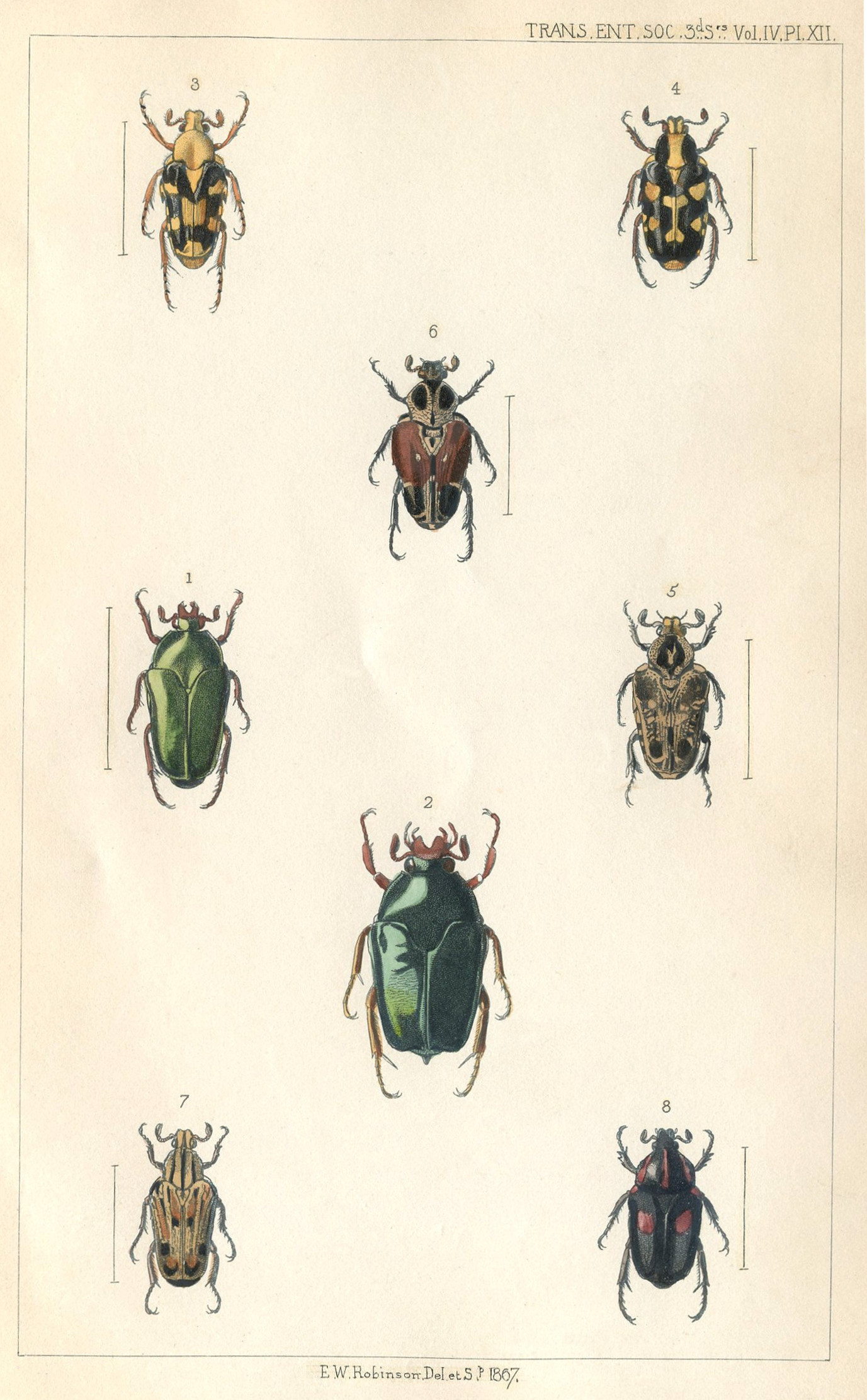
[[unnumbered page]]

[[unnumbered page]]

Notes Appearing in the Original Work
1. [The whole of the new species were characterized in Proc. Ent. Soc. 1867, pp. xcii-xcvii, published
in July, 1867.--Sec. Ent. Soc.] [[on p. 519]]
2. Gymnetis flavonotata, Gory & Perch. Mon. Cet. p. 377, pl. 77, f. 3, from Tenasserim, falls just
beyond the geographical limits assigned to this paper. The type is in the Oxford Museum, and by the
kindness of Prof. Westwood, I have been enabled to compare it with the present species. [[on p. 532]]
3. SCHIZORHINA EBENINA, Butler.
Schizorhina ebenina, Butler, Proc. Zool. Soc. 1865, p. 729 (fig.).
Hab.--Oceania? (B. M., ♀).
This species is very closely allied to S. flammula, and if it were known to be from the same locality, I
should certainly consider it an extreme black form of that species. [[on p. 561]]
*
*
*
*
*
Return
to Home
|
