|
Russel Wallace : Alfred Russell Wallace (sic) with Descriptions of the New Species (S71: 1862)
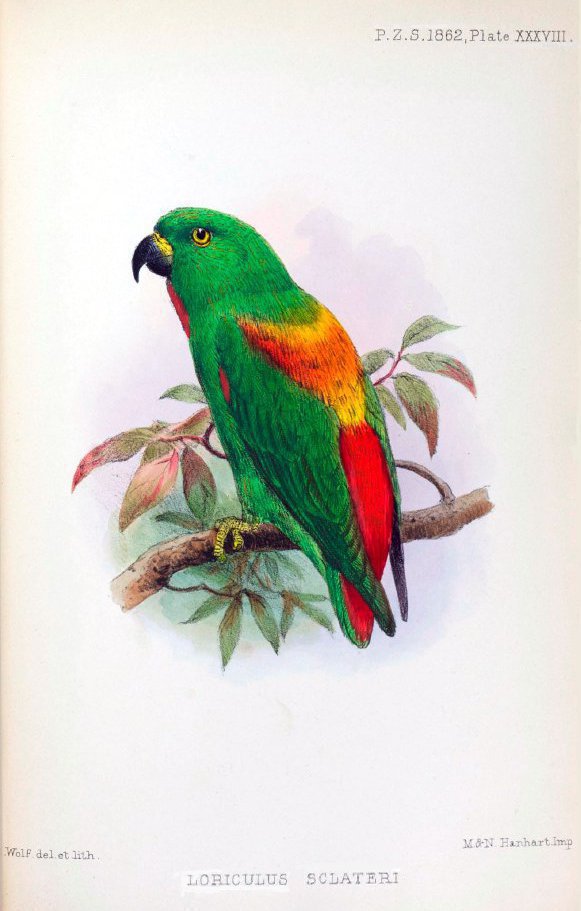
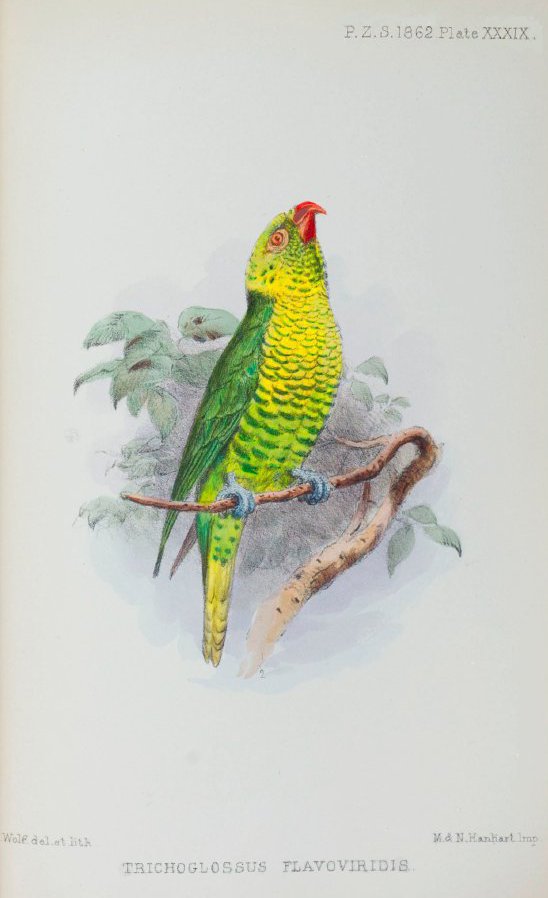
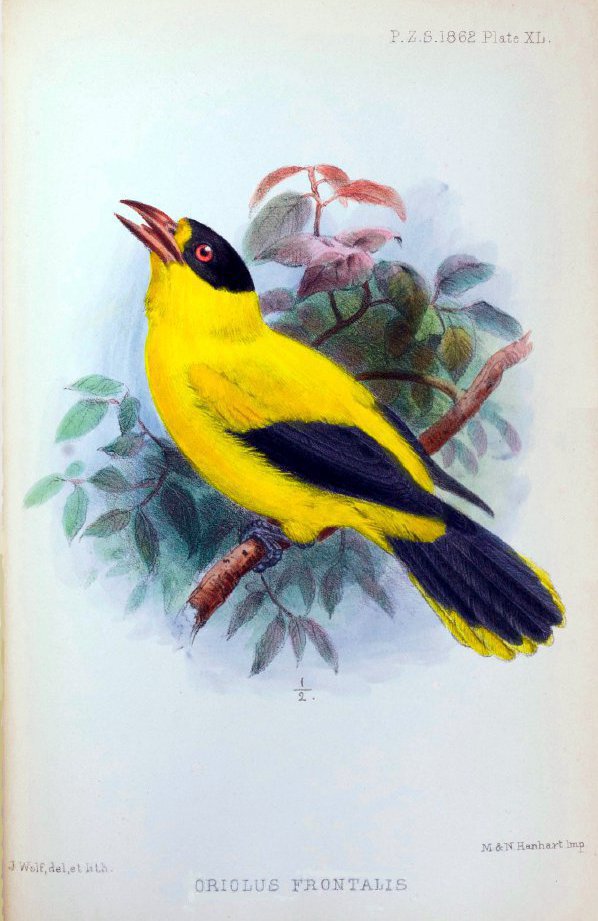
These islands must not be confounded with the Soloo Islands, between Borneo and Mindanao. On our maps they are written Zula, or Xulla; but as neither of these gives the correct pronunciation, I write the name exactly as it is pronounced by the natives. The group consists of three islands, Sula Mangola to the east, Sula Taliabo to the west, and Sula Bessi to the south. They lie nearly equidistant between Celebes and the Moluccas, being about eighty miles from the nearest part of Celebes, but with several intervening islands; only forty from Bouru, but a clear sea between them; and about ninety from Batchian, with the Obi Islands intervening. The two larger of the Sula Islands are each about fifty miles long and twelve to fifteen wide. Islands so small, and so surrounded by others whose productions are more or less known, might be expected to be not worth visiting by the naturalist, as it would seem most probable that they would contain only the common species of the surrounding islands. [[p. 334]] Believing such to be the case, I should probably have taken no trouble to obtain a collection from thence, had I not been told by many of the natives who trade to Sula that a beautiful little bird of the Parrot family was found there and in no other place. In consequence of this and other more or less vague information about its productions, I arranged with my assistant, Mr. Allen, to go there for two months. Owing to bad weather, ill health, and the usual troubles about boats, men, and provisions, he obtained but a very small collection, made on the southern and eastern islands. Only forty-eight species of birds were obtained, yet out of these there were seven new species, which appear to be altogether peculiar to this little group of islands; five or six others are rare birds of the Moluccas or Celebes, and the remainder the commoner species from the same countries. But although the Sula Islands show a mixture of the forms of Celebes and the Moluccas, yet these countries have not contributed towards its fauna in anything like an equal proportion. Deducting ten species which have a wide range over a large portion of the Archipelago, and even beyond it, and dividing the remainder into two portions--those that may be supposed to have been derived from Celebes on the one hand, and from the Moluccas and islands to the east and south of them on the other,--we shall find that the Celebesian forms are almost exactly double the rest. Twenty species are identical with birds found in Celebes, and five new species are of Celebesian forms; whereas only eleven species are found also in the Moluccas, and but two of the new species can be affiliated to Moluccan types. Twenty-five of the species of the Sula Islands must therefore have been derived from Celebes, and only thirteen from the Moluccas. The accompanying Table (p. 335) shows the species distributed according to their derivation. It is further interesting to remark that all the Raptores and all the Pigeons and Parrots, but one of each group, are Celebesian species or forms; while among the Moluccan species are many active but weak-flying birds, including five species of Flycatchers, which would be most likely to be carried over by strong winds. Further, the birds derived from the Moluccas contain three genera which do not occur in Celebes. From these facts it seems to me clear that the Sula Islands are really an outlying portion of Celebes, and must at some former period have had a much closer connexion with that great island than at present. The Moluccan species must therefore be considered as immigrants, many of them from Bouru, which is only forty miles distant; and the fact that some of these early Moluccan immigrants have already become modified into distinct forms, some of which may be classed as species, others as varieties, shows for how long a period of time the small and scattered islands of the Moluccas must have remained in their present disconnected state. The following Table shows the geographical affinities of the birds of the Sula Islands:-- [[p. 335]] 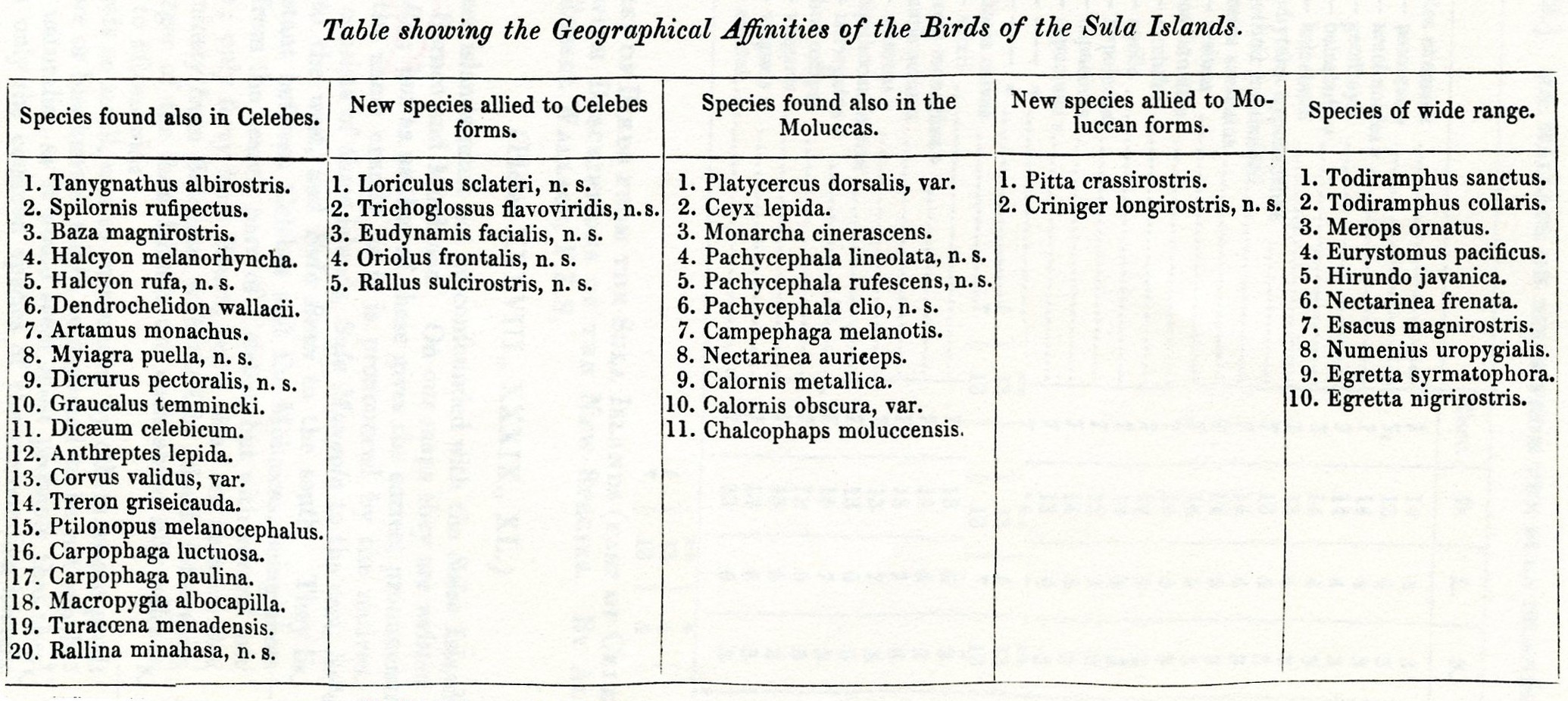 [[p. 336]] There are in all thirteen new species described in the present paper, a few of which are also in my collections from Celebes and the Moluccas. In many cases I have given, from my own notes, the colours of the feet, bill, and iris, as well as the dimensions, from the fresh-killed specimens of rare or interesting species which have been previously described. In the following list of the species I have followed the arrangement of Bonaparte's 'Conspectus,' a work which is in the hands of every ornithologist. TANYGNATHUS ALBIROSTRIS. I have obtained specimens of this bird from the south and north of Celebes and the Sula Islands. The bill is entirely white, with a semitransparent fleshy or waxy tinge when alive, in both sexes and in the fully adult bird; the tip alone is slightly dusky. The iris is very pale yellow or yellowish white, and the feet dull olive. The cry of this bird is different from that of T. mülleri, to which it is nearest; and it is universally recognized by the natives of Celebes as another bird. As this species has received no other specific name than sumatranus, given to it by Sir Stamford Raffles, under the mistaken idea that it was an inhabitant of Sumatra, I have renamed it albirostris from its most characteristic feature. However much I may reprobate the practice of needlessly changing specific names, I think that one so mischievously erroneous as the present must not be retained. Not only is the present bird and the whole genus to which it belongs absent from Sumatra, but they inhabit another primary zoological division of the earth--the great Australian region, of which Celebes and the islands east of it form a part. Hab. The Celebes group. LORICULUS SCLATERI. (Pl. XXXVIII.) Viridis; vitta gulari, flexura alarum, uropygio tectricibusque caudæ superioribus coccineis; macula magna dorsali rubra, aurantiaco marginata; rostro nigro; pedibus luteis. Delicate green, rather deeper on the head and wings; forehead with a tinge of reddish brown; a stripe on the throat, a spot on the outer margin of the wing, the rump, and upper tail-coverts (which nearly reach the end of the tail) bright red; a large spot on the back, extending in a triangle from between the shoulders to the red on the rump, orange-yellow, deepening in the middle to rich orange-red, which colour forms a band across the back; wings and tail beneath blue; quills black, the outer edge green above, the inner edge blue beneath; bill black; cere and base of the upper mandible yellow; feet yellow; iris yellow. Total length 5 1/2 inches; wing 3 1/2 inches; bill, to nostril, 1/2 inch. TRICHOGLOSSUS FLAVOVIRIDIS. (Pl. XXXIX.) Viridis; capite, pectore et abdominis lateribus flavis; pectoris plumis viridi marginatis; abdomine flavo-viridi; cauda subtus fusco-flava; rostro aurantiaco-rubro; pedibus plumbeis. Grass-green; head deep yellow, obscurely fasciated with dusky green, and bounded on the nape by a narrow dusky collar; face, cheeks, and chin dusky olive, each feather margined with yellow; neck, breast, and upper part of the belly bright yellow, each feather narrowly margined with dark green, producing a regular scaly appearance; belly, vent, and under tail-coverts yellowish green, more irregularly banded with dark green; between the shoulders the feathers have a yellow central band, forming a large spot more or less concealed by the arrangement of the plumage; quills dusky black, all but the first with the outer web green, and the first five with the extreme edge yellow; beneath, the secondaries and tertiaries have a yellow spot on the inner web; tail above of an ochreish green, becoming ochre-yellow on the inner web of the lateral feathers, beneath entirely dull ochre-yellow; bill orange-red; orbits bare, yellow; feet lead-colour; iris orange. Total length 8 inches; wing 4 5/8 inches; tail 3 1/3 inches. Hab. Sula Islands and Celebes (?). PLATYCERCUS DORSALIS, var. Psittacus dorsalis, Q. & G. Voy. de l'Astrol. t. 21. f. 1. This bird agrees with my specimens from New Guinea; but the bill in those is black, with a red spot at the base only, near the nostrils; in this variety the bill seems all reddish, except a pale tip and dusky portion at the sides of the upper mandible. This is a curious example of interrupted distribution, the Moluccas intervening with their distinct species, P. amboinensis in Ceram, and P. hypophonius in Gilolo. I can, however, discover no difference of plumage to separate the birds. Hab. Sula Islands and New Guinea. BAZA MAGNIROSTRIS. Pernis magnirostris, Kaup, Isis, 1847, p. 343. Hab. Sula Islands and Celebes (Philippine Islands, B.M.). [[p. 338]] SPILORNIS RUFIPECTUS. Spilornis rufipectus, Gould, Proc. Zool. Soc. 1857, p. 222. Hab. Sula Islands and Celebes. HALCYON MELANORHYNCHA. Alcedo melanorhyncha, Temm. Pl. Col. 391. Bill and feet dusky black; base of bill reddish; inside of bill and soles of the feet orange-red; iris dark. Hab. Sula Islands and N. Celebes. HALCYON RUFA. Rufa, supra purpureo et violaceo micans; gula pallidiore; uropygio albo, violaceo tincto, plumarum apicibus plus minusve cæruleis; rostro pedibusque rubris. Rufous, the whole of the upper parts tinged purplish violet; beneath with sometimes a faint violet gloss; chin and throat paler; a broad stripe on the rump rosy violet, or blue, formed by white feathers tipped with blue; wings short; quills entirely rufous-brown; bill and feet red; iris dark olive. Total length 11 inches; wing 4 5/8 inches; bill, to gape, 2 5/8 inches. TODIRAMPHUS SANCTUS. Halcyon sancta, Vig. & Horsf.; Gould, Austr. t. 21. Hab. Sula Islands and Java, to New Guinea. TODIRAMPHUS COLLARIS. Alcedo collaris, Scop. Hab. Sula Islands, and from the Malay peninsula to New Guinea. CEYX LEPIDA. Ceyx lepida, Temm. Pl. Col. 591, fig. 1. Hab. Sula Islands and the Moluccas. MEROPS ORNATUS. Merops ornatus, Lath.; Gould, Austr. ii. pl. 16. Hab. Sula Islands, Celebes, Timor, and New Guinea. [[p. 339]] EURYSTOMUS PACIFICUS. Coracias pacifica, Lath. Hab. Sula Islands, Celebes, Bouru, Moluccas, and New Guinea. DENDROCHELIDON WALLACII. Dendrochelidon wallacii, Gould, P. Z. S. 1859, p. 100; Birds of Asia, fig. Hab. Sula Islands and Celebes. EUDYNAMIS FACIALIS. Nigro-chalybeus; fronte, gula facieque albis; rostro pedibusque nigris. Male entirely glossy blue-black, except the chin and face, as far as the eyes, white; bill and feet black. Total length 14 inches; wing 7 1/2 inches; tail 6 3/4 inches. PITTA CRASSIROSTRIS. Pitta crassirostris, Wallace, Proc. Zool. Soc. 1862, p. 188. Hab. Sula Islands. CRINIGER LONGIROSTRIS. Supra flavo-viridis, capite obscuriore; subtus flavescens, abdomine crissoque vivide flavis; remigum pogonio interno fusco-nigro; rectricum margine interno apicibusque oblique, flavis; rostro obscuro; pedibus pallidis. Rich olive or greenish yellow; throat and breast dusky yellow; the rest beneath pure yellow; primaries and secondaries with the inner web black; the lateral tail-feathers with the tip and inner margin yellow, the four middle feathers entirely olive-yellow; bill very long, horny black; feet pale fleshy olive. Total length 10 inches; wing 4 3/4 inches; tail 4 1/4 inches; bill, to gape, 1 3/8 inch. [[p. 340]] ORIOLUS FRONTALIS. (Pl. XL.) Flavo-aurantiacus; corona occipitali latissima, alis caudaque nigerrimis; dorso concolore; remigibus ex toto nigris; cauda elongata, rectricibus lateralibus plus minusve flavis, mediis duabus ex toto nigris vel puncto apicali flavo. Pure deep yellow, the black on the head leaving only a small frontal spot; wings entirely black, rarely showing a minute tip or edging of yellow; yellow on the tail beneath generally less than in O. acrorhynchos, diminishing regularly to the middle feathers, which are wholly black, or in some specimens show a yellow point on the extreme apex of the web; bill flesh-colour; feet plumbeous; iris red. In the female the two middle tail-feathers are olivaceous yellow, the tertiaries olive-margined, and the primaries white-edged. A variety of the female occurs with the bill jet-black. Length 11.3 inches; wing 6 inches; tail 4 3/4 inches. ARTAMUS MONACHUS. Artamus monachus, Bp. Consp. p. 343, ex Temm. Albus, capite cinereo, alis caudaque fusco-plumbeis. Pure white; head and neck ashy, with a warm purplish tinge; lores blackish; wings and tail ashy lead-colour, primaries blackish on the outer webs and towards the tips; under wing-coverts and base of wings and tail beneath white, shading into ash-colour; bill pale blue; feet lead-colour. Total length 8 inches; wing 5 3/4 inches; tail 2 7/8 inches; bill, to gape, 1 1/8 inch. HIRUNDO JAVANICA. Hirundo javanica, Lath.; Temm. Pl. Col. 82. fig. 2. I have specimens of this bird from Sumatra, Borneo, Java, and Lombock, as well as the Sula Islands. It agrees well with Temminck's figure, and scarcely differs from H. neoxena, Gould, figured in the 'Birds of Australia,' but in being darker on the under surface, and having a brassy tinge on the wings. Hab. Sula Islands and westward to Sumatra. MYIAGRA PUELLA. Cærulea; dorso abdomineque cæruleo-cinereis; ventre et caudæ tectricibus inferioribus albis, cinereo tinctis; alis caudaque cinereis, plumis cæruleo marginatis. [[p. 341]] Delicate cobalt-blue, paler and with an ashy tinge on the body beneath; the belly and under tail-coverts nearly white, tinged with ashy blue; wings and tail ashy, the feathers with the outer edges blue; bill and eyelids blue; iris dark; feet blue-lead. Total length 6 1/2 inches; wing 3 inches. MONARCHA CINERASCENS. Drymophila cinerascens, Temm. Pl. Col. 430. fig. 2. Hab. Sula Islands, Moluccas, and Timor. PACHYCEPHALA LINEOLATA. Supra cinerea, olivaceo tincta, subtus albo-fulvescens; gula et pectoris plumis tenuiter nigro striatis; rostro pedibusque fusco-nigris. Above ash-coloured, more or less tinged with olive-green; beneath pale-ochreish yellow; the feathers of the throat and breast with a median dusky stripe; lores light ash; chin nearly white; quills dusky, bordered with olivaceous; bill and feet blackish; iris dark. Total length 5 3/4 inches; wing 2 7/8 inches. PACHYCEPHALA RUFESCENS. Supra fusco-plumbea, capite obscuriore; subtus alba, pectore et abdomine rufescentibus; remigibus rectricibusque fusco-nigris, cinereo-brunneo marginatis. Above dull-brownish ash; head darker; lores ashy; beneath white, on the breast and belly more or less rufous-tinged; quills dusky, rather broadly margined with brownish ash; under wing-coverts white, rufous-tinged; tail dusky, the feathers towards the base margined with ash; bill and feet black; iris dark. Total length 6 inches; wing 3 1/8 inches. PACHYCEPHALA CLIO. Olivaceo-viridis, subtus cum cervice flava; capite, genis, colli lateribus et torque pectorali lato nigris; gula alba; cauda ejusque tectricibus superioribus nigris; remigibus tectricibusque [[p. 342]] alarum nigris, olivaceo marginatis; rostro nigro, pedibus obscuris. Fœm. obscurior; capite fusco; gula albescente; pectore et abdomine pallide rufis; crisso flavescente; tectricibus caudæ inferioribus flavis; alis caudaque olivaceo-brunneis. Very like Pachycephala melanura, Gould, from which it differs only in the broader pectoral band, the rather larger size, and the upper tail-coverts, which are black; whereas by Gould's figure and description they are olive-yellow or green, like the back. Total length 6 3/4 inches; wing 3 1/2 inches. DICRURUS PECTORALIS. Nigro-cæruleus; alis nitide æneis; plumis pectoris maculis magnis purpureo-æneis terminatis; colli plumis lateralibus, elongatis, purpureo-nitidis. Rich blue-black; wing of a brilliant metallic-bluish green; the feathers of the head and breast terminating in metallic purple spots, which on the breast are large and very conspicuous; sides of the neck with elongated metallic-purple plumes; the tail and rump also have metallic tinges; tail rather short, and moderately forked and recurved; bill moderate; iris red. Total length 12 inches; wing 6 inches. GRAUCALUS TEMMINCKII. Ceblepyris temminckii, Müll. Verh. Nat. Gesch. Ethnog. p. 190. Hab. Sula Islands and Celebes (Müller). CAMPEPHAGA MELANOTIS. Campephaga melanotis, G. R. Gray, P. Z. S. 1860, p. 353. Hab. Sula Islands, Batchian, and Gilolo. DICÆUM CELEBICUM. Dicæum celebicum, Müll. Verh. Nat. Gesch. iii. p. 162. Hab. Sula Islands and Celebes. NECTARINIA FRENATA. Nectarinia frenata, Müll. Verh. Nat. Gesch. Zool. t. viii. fig. 1. Hab. Sula Islands, Celebes, and the Moluccas. [[p. 343]] NECTARINIA AURICEPS. Nectarinia auriceps, G. R. Gray, Proc. Zool. Soc. 1860, p. 348. Hab. Sula Islands, Batchian, and Gilolo. ANTHREPTES LEPIDA. Certhia lepida, Lath. Hab. Sula Islands, Celebes and islands westward of it. CORVUS VALIDUS, var. Corvus validus, Schleg. "Not. sur le genre Corvus." In size between C. validus and C. enca (but the latter has the third quill longest): fourth and fifth quills longest, nearly equal; third a little longer than the sixth; second between sixth and seventh; wings reach nearly to end of tail; wings 10 3/4 to 11 inches; tail 5 3/4 inches; total length 16 inches; bill 2 inches to 2 1/8 inches to root of feathers on culmen x 3/4 inch deep. Skin bare and black behind the eye; tail rounded; side feathers 1/2 inch, shorter than middle feathers, entirely purple-black, less glossy beneath; iris olive-brown. Hab. Sula Islands, Celebes, Java, and Sumatra. CALORNIS METALLICA. Lamprotornis metallica, Temm. Pl. Col. 266. I cannot separate the birds of this little group, whether from Amboina, Ceram, Gilolo, Batchian, or the Aru Islands, from this specimen from Sula; and as Temminck first described the Amboina bird, his name must be retained. Hab. Sula Islands and the Moluccas. CALORNIS OBSCURA, var. Lamprotornis obscura, Bp. (ex Forst.) Consp. Gen. Av. 417. The numerous modifications of this bird, varying slightly in colour, form, and dimensions in every island of the Moluccas, cannot, I think, be separated into distinct species, for the simple reason that it is quite impossible to characterize them intelligibly, or even to separate them from each other, when their localities are unknown. This variety is rather larger and rather greener than the type form of Gilolo. C. mysolensis, G. R. Gray, has a more purple tinge, and C. placidus, G. R. Gray, MSS., more olivascent. These I would consider all as local varieties. C. cantoroides, G. R. Gray, from Mysol, will alone stand as a good species, being very distinct from C. obscura in its short square tail. Hab. Sula Islands and the Moluccas. [[p. 344]] TRERON GRISEICAUDA. Treron griseicauda, G. R. Gray, B. M. Cat. Columbæ, p. 10. Flavo-viridis; pileo genisque plumbeis; dorso medio scapularibusque purpureo-castaneis; dorso superiore lateribusque colli fulvo tinctis; uropygio rectricibusque duabus mediis lutescentibus; tectricibus caudæ inferioribus rufis, ad basin albo variis; alis plumbeo-nigris, tectricibus remigibusque secundariis flavo marginatis; rectricibus nigris, albo-griseo terminatis; rostro albo-viridi, basi viridi-olivaceo; pedibus rubris. Fœm. Dorso scapularibusque fusco-viridibus; tectricibus caudæ inferioribus albis, viridi maculatis. Greenish yellow, richer on the rump, and lighter beneath; top of head and cheeks in front of the eyes ashy blue, paler near the bill; keel of the bill bare above the nostrils; chin nearly white; sides of the neck above and between the shoulders tinged with orange-brown; wings slaty black; secondaries and wing-coverts more or less broadly yellow-margined; under tail-coverts rufous, more or less marked with white and green at the base and on the thighs; tail with the two middle feathers entirely olive-yellow, the rest slaty black with a broad terminal band of ashy white; wings beneath, under wing-coverts, and sides of the body ash-coloured; bill pale yellow-green, the base dark olive-green; iris red; orbits bare, green; feet red. The female wants the purple colour on the back and wings, and has the under tail-coverts white or rufous white, more or less green-spotted. Total length 10 1/4 inches; wing 6 inches. PTILONOPUS MELANOCEPHALUS, var. Columba melanocephala, Gm.; Knip, Pig. i. t. 30. The numerous specimens sent are all slightly different from those obtained in Java, Lombock, and Celebes--the yellow streak on the throat being of a much deeper colour, and the black occipital patch decidedly smaller. In the Java bird the bill is yellow, with a greenish horny tip, the bare skin of the orbits is green, the feet pink, and the iris yellow. Hab. Sula Islands, Celebes, Lombock, and Java. CARPOPHAGA LUCTUOSA. Columba luctuosa, Reinw.; Temm. Pl. Col. 247. The specimens agree with those from Celebes; but a variety occurs with the outer tail-feathers black at the tip. This species may be at once distinguished from others of the white group of Carpophaga (Myristicivora) by the powdery-white colour almost concealing the black of the wings. [[p. 345]] The bill and feet are bluish lead, with the tip of the former bright yellow; and the iris is almost black. Hab. Sula Islands and Celebes. CARPOPHAGA PAULINA. Columba paulina, Temm.; Knip, Pig. i. t. 4. The specimens have the rich brown of the nape rather less dilated than in those from Celebes. Bill lead-colour, the base above as far as the nostrils deep red; eyelids red; feet purplish red; iris blood-red. Hab. Sula Islands and Celebes. MACROPYGIA ALBICAPILLA. Macropygia albicapilla, Temm.; Bp. Consp. ii. 57. Bill and feet dusky purple; iris pinky pearl-colour. This agrees with the specimens from Menado (Celebes), and is quite distinct from the species that occur in the Moluccas. Hab. Sula Islands and Celebes. TURACŒNA MENADENSIS. Columba menadensis, Q. & G. Voy. Astr. t. 30. Bill and feet black; orbits bare, red; iris blood-red. The sexes in this species are alike. Hab. Sula Islands and Celebes. CHALCOPHAPS MOLUCCENSIS. Chalcophaps moluccensis, G. R. Gray, Proc. Zool. Soc. l860, p. 361. The female of this species has the crown fuscous; the forehead whitish, mixed with brown; the whole under surface of a light purplish brown somewhat irrorated with fuscous; the upper tail-coverts and tail are more or less rufous, with the feathers black-tipped; the purple and vinaceous colours on the back of the male are replaced by a dusky-olive tint. In the adult bird of both sexes the bill is coral-red, and the feet pink; iris dark olive. Total length 10 inches. RALLUS SULCIROSTRIS. Similis R. celebensi, sed gula nigra, rostro magis elongato, mandibulæ inferioris basi utrinque sulcata et naribus elongatis linearibus. Very near Rallus celebensis (Q. & G. Voy. Astr. pl. 24), perhaps only a variety of that species; the chin, cheeks, and throat are, however, generally black, or but slightly irrorated with white; the bill is decidedly longer and less elevated in proportion at the base; the nasal furrow is longer, and the nostrils longer and linear; on the sides of the lower mandible is a furrow reaching half the length of [[p. 346]] the bill; above olive-brown, head more dusky; beneath black; the breast, belly, and under tail-coverts narrowly white-banded; the vent rufous-tinged; quills obscurely banded with rufous-white and black; bill black; feet olive; iris red (in R. celebensis it is deep brown). Total length 11 inches; wing 5 3/4 inches. RALLINA MINAHASA. Obscure rufo-olivacea; capite, collo pectoreque rufis; abdomine crissoque nigris, albo fasciatis; rostro nigro, subtus viridescente; pedibus nigris. Head, neck, and breast entirely rufous, paler on the chin and upper part of the throat; back, wings, and tail dark olive-brown; belly and under tail-coverts black, with numerous white transverse bands somewhat irregularly placed; under wing-coverts black, with white spots, and several of the quills with white spots or bands towards the base; these are more conspicuous in the young bird, in which also the white bands on the under surface are broader; bill black, the basal portion beneath green; feet black; iris orange-red. Total length 10 inches; wing 5 inches. ESACUS MAGNIROSTRIS. Charadrius magnirostris, Lath. Hab. Sula Islands, Celebes, New Guinea. NUMENIUS UROPYGIALIS. Numenius uropygialis, Gould, B. Austr. vi. pl. 43. Hab. Sula Islands, the Moluccas, and New Guinea. EGRETTA SYRMATOPHORA. Herodias syrmatophora, Gould, B. Austr. vi. t. 56. Hab. Sula Islands and Moluccas. EGRETTA NIGRIROSTRIS. Ardea nigrirostris, J. Gray, Zool. Misc. 1838; Ill. Ind. Zool. ii. t. 49. f. 2. Hab. Sula Islands and Timor.
|