|
Russel Wallace : Alfred Russell Wallace (sic) [[p. 216]] THE EARTH AND ITS RELATION TO THE DEVELOPMENT
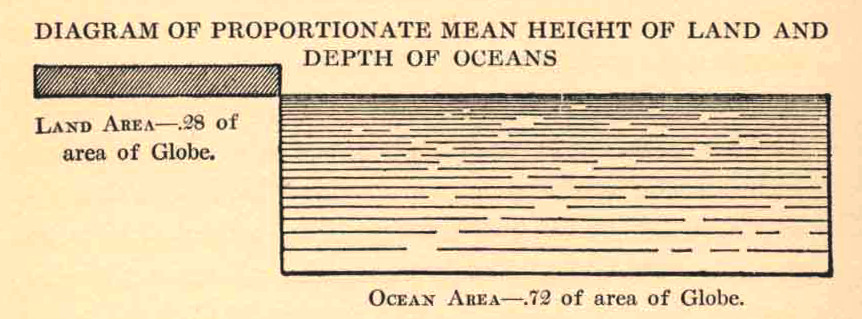
The first circumstance to be considered in relation to the habitability of a planet is its distance from the sun. We know that the heating power of the sun upon our earth is ample for the development of life in an almost infinite variety of forms; and we have a large amount of evidence to show that, were it not for the equalising power of air and water, distributed as they are with us, the heat received from the sun would be sometimes too great and sometimes too little. In some parts of Africa, Australia, and India, the sandy soil becomes so hot that an egg can be cooked by placing it just below the surface. On the other hand, at an elevation of about 12,000 feet in lat. 40° it freezes every night, and throughout the day in all places sheltered from the sun. Now, both these temperatures are adverse to life, and if either of them persisted over a considerable portion of the earth, the development of life would have been impossible. But the heat derived from the sun is inversely as the square of the distance, so that at half the distance we should have four times as much heat, and at twice the distance only one-fourth of the heat. Even at two-thirds of the distance we should receive more than twice as much heat; and, considering the facts as to the [[p. 217]] extreme sensitiveness of protoplasm and the coagulation of albumen, it seems certain that we are situated in what has been termed the temperate zone of the solar system, and that we could not be removed far from our present position without endangering a considerable portion of the life now existing upon the earth, and in all probability rendering the actual development of life through all its phases and gradations, impossible. THE OBLIQUITY OF THE ECLIPTIC The effect of the obliquity of the earth's equator to its path round the sun, upon which depend our varying seasons and the inequality of day and night throughout all the temperate zones, is very generally known. But it is not usually considered that this obliquity is of any great importance as regards the suitability of the earth for the development and maintenance of life; and it seems to have been passed over as an accident hardly worth notice, because almost any other obliquity or none at all would have been equally advantageous. But if we consider what the direction of the earth's axis might possibly have been, we shall find that it is really a matter of great importance from our present point of view. Let us suppose, first, that the earth's axis was, like that of Uranus, almost exactly in the plane of its orbit or directed towards the sun. There can be little doubt that such a position would have rendered our world unfitted for the development of life. For the result would be the most tremendous contrasts of the seasons; at midwinter, on one half the globe, arctic night [[p. 218]] and more than arctic cold would prevail; while on the other half there would be a midsummer of continuous day with a vertical sun and such an amount of heat as nowhere exists with us. At the two equinoxes the whole globe would enjoy equal day and night, all our present tropics and part of the sub-tropical zone having the sun at noon so near to the zenith as to have the essential of a tropical climate. But the change to about a month of constant sunshine or a month of continuous night would be so rapid, that it seems almost impossible that either vegetable or animal life would ever have developed under such terrible conditions. The other extreme direction of the earth's axis, exactly at right angles to the plane of the orbit, would be much more favourable, but would still have its disadvantages. The whole surface from equator to poles would enjoy equal day and night, and every part would receive the same amount of sun-heat all the year round, so that there would be no change of seasons; but the heat received would vary with the latitude. In our latitude the sun's altitude at noon all the year would be less than 40°, the same as now occurs at the equinoxes, and we might therefore have a perpetual spring as regards temperature. But the constancy of the heat in the equatorial and tropical regions and of cold towards the poles would lead to a more constant and more rapid circulation of air, and we should probably experience such continuous northwesterly winds as to render our climate always cold and probably very damp. Near the poles the sun would always be on, or close to, the horizon, and would give so little heat that the sea might be perpetually frozen and the land [[p. 219]] deeply snow-buried; and these conditions would probably extend into the temperate zone, and possibly so far south as to render life impossible in our latitudes, since whatever results arose would be due to permanent causes, and we know how powerful are snow and ice to extend their sway over adjacent areas if not counteracted by summer heat or warm moist winds. On the whole, therefore, it seems probable that this position of the earth's axis would result in a much smaller portion of its surface being capable of supporting a luxuriant and varied vegetable and animal life than is now the case; while the extreme uniformity of conditions everywhere present might be so antagonistic to the great law of rhythm that seems to pervade the universe, and be in other ways so unfavourable, that life-development would probably have taken quite a different course from that which it has taken. It appears almost certain, therefore, that some intermediate position of the axis would be the most favourable; and that which actually exists seems to combine the advantage of change of seasons with good climatical conditions over the largest possible area. We know that during the greater part of the epoch of life-development this area was much greater than at present, since a luxuriant vegetation of deciduous and evergreen trees and shrubs extended up to and within the Arctic Circle, leading to the formation of coal-beds both in palæozoic and tertiary times; the extremely favourable conditions for organic life which then prevailed over so large a portion of the globe's surface, and which persisted down to a comparatively recent epoch, lead to the conclusion that no more favourable degree of obliquity [[p. 220]] was possible than that which we actually possess. A short account of the evidence on this interesting subject will now be given. PERSISTENCE OF MILD CLIMATE THROUGH GEOLOGICAL TIME The whole of the geological evidence goes to show that in remote ages the climate of the earth was generally more uniform, though perhaps not warmer, than it is now, and this can be best explained by a slightly different distribution of sea and land, which allowed the warm waters of the tropical oceans to penetrate into various parts of the continents (which were then more broken up than they are now), and also to extend more freely into the Arctic regions. So soon as we go back into the tertiary period, we find indications of a warmer climate in the north temperate zone; and when we reach the middle of that period, we find abundant indications, both in plant and animal remains, of mild climates near to the Arctic Circle, or actually within it. On the west coast of Greenland, in 70° N. lat., there are found abundance of fossil plants very beautifully preserved, among which are many different species of oaks, beeches, poplars, plane-trees, vines, walnuts, plums, chestnuts, sequoias, and numerous shrubs--137 species in all, indicating a vegetation such as now grows in the north temperate parts of America and Eastern Asia. And even further north, in Spitzbergen, in N. lat. 78° and 79°, a somewhat similar flora is found, not quite so varied, but with oaks, poplars, birches, planes, limes, hazels, pines, and many aquatic plants such as may now be found in West Norway and in Alaska, nearly twenty degrees further south. [[p. 221]] Still more remote, in the Cretaceous period, fossil plants have been found in Greenland, consisting of ferns, cycads, conifers, and such trees and shrubs as poplars, sassafras, andromedas, magnolias, myrtles, and many others, similar in character and often identical in species with fossils of the same period found in Central Europe and the United States, indicating a widespread uniformity of climate, such as would be brought about by the great ocean-currents carrying the warm waters of the tropics into the Arctic seas. Still further back, in the Jurassic period, we have proofs of a mild climate in East Siberia and at Andö in Norway just within the Arctic Circle, in numerous plant remains, and also remains of great reptiles allied to those found in the same strata in all parts of the world. Similar phenomena occur in the still earlier Triassic period; but we will pass on to the much more remote Carboniferous period, during which most of the great coal-beds of the world were formed from a luxuriant vegetation, consisting mostly of ferns, giant horse-tails, and primitive conifers. The luxuriance of these plants, which are often found beautifully preserved and in immense quantities, is supposed to indicate an atmosphere in which carbonic acid gas was much more abundant than now; and this is rendered probable by the small number and low type of terrestrial animals, consisting of a few insects and amphibia. But the interesting point is, that true coal-beds, with similar fossils to those of our own coal-measures, are found at Spitzbergen and at Bear Island in East Siberia, both far within the Arctic Circle, again indicating a great uniformity of climate, [[p. 222]] and probably a denser and more vapour-laden atmosphere, which would act as a blanket over the earth and preserve the heat brought to the Arctic seas by the ocean currents from the warmer regions. The still earlier silurian rocks are also found abundantly in the Arctic regions, but their fossils are entirely of marine animals. Yet they show the same phenomena as regards climate, since the corals and cephalopodous mollusca found in the Arctic beds closely resemble those of all other parts of the earth.1 Many other facts indicate that throughout the enormous periods required for the development of the varied forms of life upon the earth, the great phenomena of nature were but little different from those that prevail in our own times. The slow and gentle processes by which the various vegetable and animal remains were preserved are shown by the perfect state in which many of the fossils exist. Often trunks of trees, cycads, and tree-ferns are found standing erect, with their roots still imbedded in the soil they grew in. Large leaves of poplars, maples, oaks, and other trees are often preserved in as perfect a state as if gathered by a botanist and dried between paper for his herbarium, and the same is especially the case with the beautiful ferns of the Permian and Carboniferous periods. Throughout these and most other formations well-preserved ripple-marks are found in the solidified mud or sand of old seashores, differing in [[p. 223]] no respect from similar marks to be found on almost every coast to-day. Equally interesting are the marks of rain-drops preserved in the rocks of almost all ages, and Sir Charles Lyell has given illustrations of recent impressions of raindrops on the extensive mud-flats of Nova Scotia, and also an illustration of rain-drops on a slab of shale from the carboniferous formation of the same country; and the two are as much alike as the prints of two different showers a few days apart. The general size and form of the drops are almost identical, and imply a great similarity in the general atmospheric conditions. We must not forget that this presence of rain throughout geological time implies, as we have seen in our last chapter, a constant and universal distribution of atmospheric dust. The two chief sources of this dust--the total quantity of which in the atmosphere must be enormous--are volcanoes and deserts, and we are therefore sure that these two great natural phenomena have always been present. Of volcanoes we have ample independent evidence in the presence of lavas and volcanic ashes, as well as actual stumps or cores of old volcanoes, through all geological formations; and we can have little doubt that deserts also were present, though perhaps not always so extensive as they are now. It is a very suggestive fact that these two phenomena, usually held to be blots on the fair face of nature, and even to be opposed to belief in a beneficent Creator, should now be proved to be really essential to the earth's habitability. Notwithstanding this prevalence of warm and uniform conditions, there is also evidence of considerable changes of climate; and at two periods--in the Eocene and in the remote Permian-- [[p. 224]] there are even indications of ice-action, so that some geologists believe that there were then actual glacial epochs. But it seems more probable that they imply only local glaciation, owing to there having been high land and other suitable conditions for the production of glaciers in certain areas. The whole bearing of the geological evidence indicates the wonderful continuity of conditions favourable for life, and for the most part of climatal conditions more favourable than those now prevailing, since a larger extent of land towards the North Pole was available for an abundant vegetation, and in all probability for an equally abundant animal life. We know, too, that there was never any total break in life-development; no epoch of such lowering or raising of temperature as to destroy all life; no such general subsidence as to submerge the whole land-surface. Although the geological record is in parts very imperfect, yet it is, on the whole, wonderfully complete; and it presents to our view a continuous progress, from simple to complex, from lower to higher. Type after type becomes highly specialised in adaptation to local or climatal conditions, and then dies out, giving room for some other type to arise and be specialised in harmony with the changed conditions. The general character of the inorganic change appears to have been from more insular to more continental conditions, accompanied by a change from more uniform to less uniform climates, from an almost sub-tropical warmth and moisture, extending up to the Arctic Circle, to that diversity of tropical, temperate, and cold areas, capable of supporting the greatest possible variety in the forms of life, and which seems especially adapted to stimulate mankind to [[p. 225]] civilisation and social development by means of the necessary struggle against, and utilisation of, the various forces of nature. WATER, ITS AMOUNT AND DISTRIBUTION ON THE EARTH Although it is generally known that the oceans occupy more than two-thirds of the whole surface of the globe, the enormous bulk of the water in proportion to the land that rises above its surface is hardly ever appreciated. But as this is a matter of the greatest importance, both as regards the geological history of the globe and the special subject we are here discussing, it will be necessary to enter into some details in regard to it. According to the best recent estimates, the land area of the globe is 0.28 of the whole surface, and the water area 0.72. But the mean height of the land above the sea-level is found to be 2250 feet, while the mean depth of the seas and oceans is 13,860 feet; so that though the water area is two and a half times that of the land, the mean depth of the water is more than six times the mean height of the land. This is, of course, due to the fact that lowlands occupy most of the land-area, the plateaus and high mountains a comparatively small portion of it; while, though the greatest depths of the oceans about equal the greatest heights of the mountains, yet over enormous areas the oceans are deep enough to submerge all the mountains of Europe and temperate North America, except the extreme summits of one or two of them. Hence it follows that the bulk of the oceans, even omitting all the shallow seas, is more than thirteen times that of the land above sea-level; and if all the land surface and ocean [[p. 226]] floors were reduced to one level, that is, if the solid mass of the globe were a true oblate spheroid, the whole would be covered with water about two miles deep. The diagram here given will render this more intelligible and will serve to illustrate what follows.
In this diagram the lengths of the sections representing land and ocean are proportionate to their areas, while the thickness of each is proportionate to their mean height and mean depth respectively. Hence the two sections are in correct proportion to their cubic contents. A mere inspection of this diagram is sufficient to disprove the old idea, still held by a few geologists and by many biologists, that oceans and continents have repeatedly changed places during geological times, or that the great oceans have again and again been bridged over to facilitate the distribution of beetles or birds, reptiles or mammals. We must remember that although the diagram shows the continents and oceans as a whole, yet it also shows, with quite sufficient accuracy, the proportions of each of the great continents to the oceans which are adjacent to them. It must also be borne in mind that there can be no elevation on a large scale without a corresponding subsidence elsewhere; [[p. 227]] because if there were not, a vast unsupported hollow would be left beneath the rising land or in some part adjacent to it. Now, looking at the diagram and at a chart or globe, try to imagine the ocean bottom rising gradually, to form a continent joining Africa with South America or with Australia (both of which are demanded by many biologists): it is clear that, while such an elevation was going on, either some continental land or some other part of the ocean-bed must sink to a corresponding amount. We shall then see, that if such changes of elevation on a continental scale have taken place again and again at different periods, it would have been almost impossible, on every occasion, to avoid a whole continent being submerged (or even all the continents) in order to equalise subsidence with elevation while new continents were being raised up from the abyssal depths of the ocean. We conclude, therefore, that with the exception of a comparatively narrow belt around the continents, which may be roughly indicated by the thousand fathom line of soundings, the great ocean depths are permanent features of the earth's surface. It is this stability of the general distribution of land and water that has secured the continuity of life upon the earth. Had the great oceanic basins, on the other hand, been unstable, changing places with the land at various periods of geological time, they would, almost certainly, again and again have swallowed up the land in their vast abysses, and have thus destroyed all the organic life of the world. There are many confirmatory proofs of this view (which is now widely accepted by geologists and physicists), and a few of them may be briefly stated. [[p. 228]] 1. None of the continents present us with marine deposits of any one geological age and occupying a large part of the surface of each, as must have been the case had they ever been sunk deep beneath the ocean and again elevated; neither do any of them contain extensive formations corresponding to the deep oceanic clays and oozes, which again they must have done had they been at any time raised up from the ocean depths. 2. All the continents present an almost complete and continuous series of rocks of all geological ages, and in each of the great geological periods there are found fresh water and estuarine deposits, and even old land surfaces, demonstrating continuity of continental or insular conditions. 3. All the great oceans possess, scattered over them, a few or many islands termed "oceanic," and characterised by a volcanic or coraline structure, with no ancient stratified rocks in any one of them; and in none of these is there found a single indigenous land mammal or amphibian. It is incredible that, if these oceans had ever contained extensive continents, and if these oceanic islands are--as even now they are often alleged to be--parts of these now submerged continents, no one fragment of any of the old stratified rocks, which characterise all existing continents, should remain to show their origin. In the Atlantic we find the Azores, Madeira, and St. Helena; in the Indian Ocean, Mauritius, Bourbon, and Kerguelen Island; in the Pacific, the Fiji, Samoan, Society, Sandwich, and Galapagos Islands, all without exception telling us the same tale, that they have been built up from the ocean depths by submarine volcanoes and coralline growths, but have never formed part of continental areas. [[p. 229]] 4. The contours of the floors of all the great oceans, now fairly well known through the soundings of exploring vessels and for submarine telegraph lines, also give confirmatory evidence that they have never been continental land. For if any part of them were a sunken continent, that part must have retained some impress of its origin. Some of the numerous mountain ranges which characterise every continent would have remained. We should find slopes of from 20° to 50° not uncommon, while valleys bordered by rocky precipices, as in Lake Lucerne and a hundred others, or isolated rock-walled mountains like Roraima, or ranges of precipices as in the Ghâts of India or the Fiords of Norway, would frequently be met with. But not a single feature of this kind has ever been found in the ocean abysses. Instead of these we have vast plains which, if the water were removed, would appear almost exactly level, with no abrupt slopes anywhere. When we consider that deposits from the land never reach these remote ocean depths, and that there is no wave action below a few hundred feet, these continental features once submerged would be indestructible; and their total absence is, therefore, itself a demonstration that none of the great oceans are on the sites of submerged continents. HOW OCEAN DEPTHS WERE PRODUCED It is a very difficult problem to determine how the vast basins which are filled by the great oceans, especially that of the Pacific, were first produced. When the earth's surface was still in a molten state, it would necessarily take the form of a true [[p. 230]] oblate spheroid, with a compression at the poles due to its speed of rotation, which is supposed to have been very great. The crust formed by the gradual cooling of such a globe would be of the same general form, and, being thin, would easily be fractured or bent so as to accommodate itself to any unequal stresses from the interior. As the crust thickened and the whole mass slowly cooled and contracted, fissures and crumpling would occur, the former serving as outlets for volcanic activities whose results are found throughout all geological ages; the latter producing mountain chains in which the rocks are almost always curved, folded, or even thrust over each other, indicating the mighty forces due to the adjustments of a solid crust upon a shrinking fluid or semi-fluid interior. But during this whole process there seem to be no forces at work that could lead to the production of such a feature as the Pacific, a vast depression covering nearly one-third of the whole surface of the globe. The Atlantic Ocean, being smaller and nearly opposite to the Pacific, but approximately of equal depth, may be looked upon as a complementary phenomenon which will be probably explained as a result of the same causes as the vaster cavity. So far as I am aware, there is only one suggested cause of the formation of these great oceans that seems adequate; and as that cause is to some extent supported by quite independent astronomical evidence, and also directly bears upon the main subject of the present volume, it must be briefly considered. A few years ago, Professor George Darwin, of Cambridge, arrived at a certain conclusion as to the origin of the moon, which [[p. 231]] is now comparatively well known by Sir Robert Ball's popular account of it in his small volume, Time and Tide. Briefly stated, it is as follows: The tides produce friction on the earth and very slowly increase the length of our day, and also cause the moon to recede further from us. The day is lengthened only by a small fraction of a second in a thousand years, and the moon is receding at an equally imperceptible rate. But as these forces are constant, and have always acted on the earth and moon, as we go back and back into the almost infinite past we come to a time when the rotation of the earth was so rapid that gravity at the equator could hardly retain its outer portion, which was spread out so that the form of the whole mass was something like a cheese with rounded edges. And about the same epoch the distance of the moon is found to have been so small that it was actually touching the earth. All this is the result of mathematical calculation from the known laws of gravitation and tidal effects; and as it is difficult to see how so large a body as the moon could have originated in any other way, it is supposed that at a still earlier period the moon and earth were one, and that the moon separated from the parent mass owing to centrifugal force generated by the earth's rapid rotation. Whether the earth was liquid or solid at this epoch, and exactly how the separation occurred, is not explained either by Professor Darwin or Sir Robert Ball; but it is a very suggestive fact that, quite recently, it has been shown, by means of the spectroscope, that double stars of short period do originate in this way from a single star, as already described in our sixth chapter; but in these cases it seems probable that the parent star is in a gaseous state. [[p. 232]] These investigations of Professor G. Darwin have been made use of by the Rev. Osmond Fisher (in his very interesting and important work, Physics of the Earth's Crust) to account for the basins of the great oceans, the Pacific being the chasm left when the larger portion of the mass of the moon parted from the earth. Adopting, as I do, the theory of the origin of the earth by meteoric accretion of solid matter, we must consider our planet as having been produced from one of those vast rings of meteorites which in great numbers still circulate round the sun, but which at the much earlier period now contemplated were both more numerous and much more extensive. Owing to irregularities of distribution in such a ring and through disturbance by other bodies, aggregations of various sizes would inevitably occur, and the largest of these would in time draw in to itself all the rest, and thus form a planet. During the early stages of this process the particles would be so small, and would come together so gradually, that little heat would be produced, and there would result merely a loose aggregation of cold matter. But as the process went on and the mass of the incipient planet became considerable--perhaps half that of the earth--the rest of the ring would fall in with greater and greater velocity; and this, added to the gravitative compression of the growing mass might, when nearly its present size, have produced sufficient heat to liquefy the outer layers, while the central portion remained solid and to some extent incoherent, with probably large quantities of heavy gases in the interstices. When the amount of the meteoric accretions became so reduced as to be insufficient to keep [[p. 233]] up the heat to the melting-point a crust would form, and might have reached about half or three-fourths of its present thickness when the moon became separated. Let us now try to picture to ourselves what happened. We should have a globe somewhat larger than our earth is now, both because it then contained the material of the moon and also because it was hotter, revolving so rapidly as to be very greatly flattened at the poles; while the equatorial belt bulged out enormously, and would probably have separated in the form of a ring with a very slight increase of the time of rotation, which is supposed to have been about four hours. This globe would have a comparatively thin crust, beneath which there was molten rock to an unknown depth, perhaps a few hundreds, perhaps more than a thousand miles. At this time the attraction of the sun acting on the molten interior produced tides in it, causing the thin crust to rise and fall every two hours, but to so small an extent--only about a foot or so--as not necessarily to fracture it; but it is calculated that this slight rhythmic undulation coincided with the normal period of undulation due to such a large mass of heavy liquid, and so tended to increase the instability due to rapid rotation. The bulk of the moon is about one-fiftieth part that of the earth, and an easy calculation shows us that, taking the area of the Pacific, Atlantic, and Indian Oceans combined as about two-thirds that of the globe, it would require a thickness (or depth) of about forty miles to furnish the material for the moon. We must, of course, assume that there were some inequalities in the thickness of the crust and in its comparative rigidity, so that [[p. 234]] when the critical moment came and the earth could no longer retain its equatorial protuberance against the centrifugal force due to rotation combined with the tidal undulations caused by the sun, instead of a continuous ring slowly detaching itself, the crust gave way in two or more great masses where it was weakest, and as the tidal wave passed under it and a quantity of the liquid substratum rose with it, the whole would break up and collect into a sub-globular mass a short distance from the earth, and continue revolving with it for some time at about the same rate as the surface had rotated. But as tidal action is always equal on opposite sides of a globe, there would be a similar disruption there, forming, it may be supposed, the Atlantic basin, which, as may be seen on a small globe, is almost exactly opposite a part of the Central Pacific. So soon as these two great masses had separated from the earth, the latter would gradually settle down into a state of equilibrium, and the molten matter of the interior, which would now fill the great oceanic basins up to a level of a few miles below the general surface, would soon cool enough to form a thin crust. The larger portion of the nascent moon would gradually attract to itself the one or more smaller portions and form our satellite; and from that time tidal friction by both moon and sun would begin to operate and would gradually lengthen our day and, more rapidly, our month in the way explained in Sir Robert Ball's volume. A very interesting point may now be referred to, because it seems confirmatory of this origin of the great ocean basins. In Mr. Osmond Fisher's work it is explained how the variations in the force of gravity, at numerous points all over the world, have [[p. 235]] been determined by observations with the pendulum, and also how these variations afford a measure of the thickness of the solid crust, which is of less specific gravity than the molten interior on which it rests. By this means a very interesting result was obtained. The observations on numerous oceanic islands proved that the sub-oceanic crust was considerably more dense than the crust under the continents, but also thinner, the result being to bring the average mass of the sub-oceanic crust and oceans to an equality with that of the continental crust, and this causes the whirling earth to be in a state of balance, or equilibrium. Now, both the thinness and the increased density of the crust seem to be well explained by this theory of the origin of the oceanic basins. The new crust would necessarily for a long time be thinner than the older portion, because formed so much later; but it would very soon become cool enough to allow the aqueous vapour of the atmosphere and that given off through fissures from the molten interior to collect in the ocean basins, which would thenceforth be cooled more rapidly and kept at a uniform temperature and also under a uniform pressure, and these conditions would lead to the steady and continuous increase of thickness, with a greater compactness of structure than in the continental areas. It is no doubt to this uniformity of conditions, with a lowering of the bottom temperature throughout the greater part of geological time, till it has become only a few degrees above the freezing-point, that we owe the remarkable persistence of the vast and deep ocean basins on which, as we have seen, the continuity of life on the earth has largely depended. There is one other fact which lends some support to this [[p. 236]] theory of the origin of the ocean basins--their almost complete symmetry with regard to the equator. Both the Atlantic and Pacific basins extend to an equal distance north and south of the equator, an equality which could hardly have been produced by any cause not directly connected with the earth's rotation. The polar seas which are co-terminous with the two great oceans are very much shallower, and cannot, therefore, be considered as forming part of the true oceanic basins. WATER AS AN EQUALISER OF TEMPERATURE The importance of water in regulating the temperature of the earth is so great that, even if we had enough water on the land for all the wants of plants and animals, but had no great oceans, it is almost certain that the earth could not have produced and sustained the various forms of life which it now possesses. The effect of the oceans is twofold. Owing to the great specific heat of water, that is, its property of absorbing heat slowly but to a large amount, and giving it out with equal slowness, the surface-waters of the oceans and seas are heated by the sun so that by the evening of a bright day they have become quite warm to a depth of several feet. But air has much less specific heat than water, a pound of water in cooling one degree being capable of warming four pounds of air one degree; but as air is 770 times as light as water, it follows that the heat from one cubic foot of water will warm more than 3000 cubic feet of air as much as it cools itself. Hence the enormous surface of the seas and oceans, the larger part of which is within the tropics, warms the [[p. 237]] whole of the lower and denser portions of the air, especially during the night, and this warmth is carried to all parts of the earth by the winds, and thus ameliorates the climate. Another quite distinct effect is due to the great ocean currents, like the Gulf Stream and the Japan Current, which carry the warm water of the tropics to temperate and arctic regions, and thus render many countries habitable which would otherwise suffer the rigour of an almost arctic winter. These currents are, however, directly due to the winds, and properly belong to the section on the atmosphere. The other equalising action, due primarily to the great area of the seas and oceans, is a result of the vast evaporating surface from which the land derives almost all its water in the form of rain and rivers; and it is quite evident that if there were not sufficient water-surface to produce an ample supply of vapour for this purpose, arid districts would occupy more and more of the earth's surface. How much water-surface is necessary for life we do not know; but if the proportions of water and land-surfaces were reversed, it seems probable that the larger proportion of the earth might be uninhabitable. The vapour thus produced has also a very great effect in equalising temperature; but this also is a point which will come better under our next chapter on the atmosphere. There are, however, some matters connected with the water-supply of the earth, and its relation to the development of life, that call for a few remarks here. What has determined the total quantity of water on the earth or on other planets does [[p. 238]] not appear to be known; but presumably it would depend, partially or wholly, on the mass of the planet being sufficient to enable it to retain by its gravitative force the oxygen and hydrogen of which water is composed. As the two gases are so easily combined to form water, but can only be separated under special conditions, its quantity would be dependent on the supply of hydrogen, which is but rarely found on the earth in a free state. The important fact, however, is, that we do possess so great a quantity of water, that if the whole surface of the globe was as regularly contoured as are the continents, and merely wrinkled with mountain chains, then the existing water would cover the whole globe nearly two miles deep, leaving only the tops of high mountains above its surface as rows of small islands, with a few larger islands formed by what are now the high plateaus of Tibet and the Southern Andes. Now there seems no reason why this distribution of the water should not have occurred--in fact it seems probable that it would have occurred, had it not been for the fortunate coincidence of the formation of enormously deep ocean basins. So far as I am aware, no sufficient explanation of the formation of these basins has been given but that of Mr. Osmond Fisher, as here described, and that depends upon three unique circumstances: (1) the formation of a satellite at a very late period of the planet's development when there was already a rather thick crust; (2) the satellite being far larger in proportion to its primary than any other in the solar system; and (3) its having been produced by fission from its primary on account of extremely rapid rotation, combined with solar tides in its molten [[p. 239]] interior, and a rate of oscillation of that molten interior coinciding with the tidal period.2 Whether this very remarkable theory of the origin of our moon is the true one, and if so, whether the explanation it seems to afford of the great oceanic basins is correct, I am not mathematician enough to judge. The tidal theory of the origin of the moon, as worked out mathematically by Professor G. H. Darwin, has been supported by Sir Robert Ball and accepted by many other astronomers; while the researches of the Rev. Osmond Fisher into the Physics of the Earth's Crust, together with his mathematical abilities and his practical work as a geologist, entitle his opinion on the question of the mode of origin of the ocean basins to the highest respect. And, as we have seen, the existence of these vast and deep ocean basins, produced by the agency of a series of events so remarkable as to be quite unique in the solar system, played an important part in rendering the earth fit for the development of the higher forms of animal life, while without them it seems not improbable that the conditions would have been such as to render any varied forms of terrestrial life hardly possible.
1. For a fuller account of this Arctic fauna and flora see the works of Sir C. Lyell, Sir A. Geikie, and other geologists. A full summary of it is also given in the author's Island Life. [[on p. 222]] 2. Professor G. H. Darwin states that it is nearly certain that no other satellite nor any of the planets originated in the same way as the moon. [[on p. 239]] _________________________
THE EARTH IN RELATION TO LIFE: ATMOSPHERIC CONDITIONS We have seen in our tenth chapter that the physical basis of life--protoplasm--consists of the four elements--oxygen, nitrogen, hydrogen, and carbon, and that both plants and animals depend largely upon the free oxygen in the air to carry on their vital processes; while the carbonic acid and ammonia in the atmosphere seem to be absolutely essential to plants. Whether life could have arisen and have been highly developed with an atmosphere composed of different elements from ours it is, of course, impossible to say; but there are certain physical conditions which seem absolutely essential whatever may be the elements which compose it. The first of these essentials is an atmosphere which shall be of such density at the surface of the planet, and of so great a bulk as to be not too rare to fulfil its various functions at all altitudes where there is a considerable area of land. What determines the total quantity of gaseous matter on the surface of a planet will be, mainly, its mass, together with the average temperature of its surface. The molecules of gases are in a state of rapid motion in all directions, and the lighter gases have the most rapid motions. The average speed of the motion of the molecules has been [[p. 241]] roughly determined under varying conditions of pressure and temperature, and also the probable maximum and minimum rates, and from these data, and certain known facts as to planetary atmospheres, Mr. G. Johnstone Stoney, F. R. S., has calculated what gases will escape from the atmospheres of the earth and the other planets. He finds that all the gases which are constituents of air have such comparatively low molecular rates of motion that the force of gravity at the upper limits of the earth's atmosphere is amply sufficient to retain them; hence the stability of its composition. But there are two other gases, hydrogen and helium, which are both known to enter the atmosphere, but never accumulate so as to form any measurable portion of it, and these are found to have sufficient molecular motion to escape from it. With regard to hydrogen, if the earth were much larger and more massive than it is, so as to retain the hydrogen, disastrous consequences might ensue, because, whenever a sufficient quantity of this gas accumulated, it would form an explosive mixture with the oxygen of the atmosphere, and a flash of lightning or even the smallest flame would lead to explosions so violent and destructive as perhaps to render such a planet unsuited for the development of life. We appear, therefore, to be just at the major limit of mass to secure habitability, except in such planets as may have no continuous supply of free hydrogen. Perhaps the most important mechanical functions of the atmosphere dependent on its density are: (1) the production of winds, which in many ways bring about an equalisation of temperature, and which also produce surface-currents on the ocean; [[p. 242]] and (2) the distribution of moisture over the earth by means of clouds which also have other important functions. Winds depend primarily on the local distribution of heat in the air, especially on the great amount of heat constantly present in the equatorial zone, due to the sun being always nearly vertical at noon, and to its being similarly vertical at each tropic once a year, with a longer day, leading to even higher temperatures than at the equator, and producing also that continuous belt of arid lands or deserts which almost encircle the globe in the region of the tropics. Heated air being lighter, the colder air from the temperate zones continually flows towards it, lifting it up and causing it to flow over, as it were, to the north and south. But as the inflow comes from an area of less rapid to one of more rapid rotation, the course of the air is diverted, and produces the northeast and southeast trades; while the overflow from the equator going to an area of less rapid rotation turns westward and produces the southwest winds so prevalent over the north Atlantic and north temperate zone generally, and the northwest in the southern hemisphere. It is outside the zone of the equable trade-winds, and in a region a few degrees on each side of the tropics, that destructive hurricanes and typhoons prevail. These are really enormous whirlwinds due to the intensely heated atmosphere over the arid regions already mentioned, causing an inrush of cool air from various directions, thus setting up a rotatory motion which increases in rapidity till equilibrium is restored. The hurricanes of the West Indies and Mauritius, and the typhoons of the Eastern seas, are thus caused. Some of these storms are so [[p. 243]] violent that no human structures can resist them, while the largest and most vigorous trees are torn to pieces or overturned by them. But if our atmosphere were much denser than it is, its increased weight would give it still greater destructive force; and if to this were added a somewhat greater amount of sun-heat--which might be due either to our greater proximity to the sun or to the sun's greater size or greater heat-intensity, these tempests might be so increased in violence and frequency as to render considerable portions of the earth uninhabitable. The constant and equable trade-winds have a very important function in initiating those far-reaching ocean-currents which are of the greatest importance in equalising temperature. The well-known Gulf Stream is to us the most important of these currents, because it plays the chief part in giving us the mild climate we enjoy in common with the whole of Western Europe, a mildness which is felt to a considerable distance within the Arctic Circle; and, in conjunction with the Japan Current, which does the same for the whole of the temperate regions of the North Pacific, renders a large portion of the globe better adapted for life than it would be without these beneficial influences. These equalising currents, however, are almost entirely due to the form and position of the continents, and especially to the fact that they are so situated as to leave vast expanses of ocean along the equatorial zone, and extending north and south to the Arctic and Antarctic regions. If with the same amount of land the continents had been so grouped as to occupy a considerable portion of the equatorial oceans--such as would have been the case had Africa been turned so as to join South America, and [[p. 244]] Asia been brought to the southeast so as to take the place of part of the equatorial Pacific, then the great ocean-currents would have been but feeble or have hardly existed. Without these currents much of the north and south temperate lands would have been buried in ice, while the largest portion of the continents would have been so intensely heated as perhaps to be unsuited for the development of the higher forms of animal life, since we have shown (in Chapters X and XI) how delicate is the balance and how narrow the limits of temperature which are required. There seems to be no reason whatever why some such distribution of the sea and land should not have existed, had it not been for the admittedly exceptional conditions which led to the production of our satellite, thus necessarily forming vast chasms along the region of the equator where centrifugal force as well as the internal solar tides were most powerful, and where the thin crust was thus compelled to give way. And as the highest authorities declare that there are no indications of such an origin of satellites in the case of any other planet, the whole series of conditions favourable to life on the earth become all the more remarkable. CLOUDS; THEIR IMPORTANCE AND THEIR CAUSES Few persons have any adequate conception of the real nature of clouds and of the important part they take in rendering our world a habitable and an enjoyable one. On the average, the rainfall over the oceans is much less than over the land, the whole region of the trade-winds having usually [[p. 245]] a cloudless sky and very little rain; but in the intervening belt of calms, near to the equator, a cloudy sky and heavy rains are frequent. This arises from the fact that the warm, moist air over the ocean is raised upwards, by the cold and heavy air from north and south, into a cooler region where it cannot hold so much aqueous vapour, which is there condensed and falls as rain. Generally, wherever the winds blow over extensive areas of water on to the land, especially if there are mountains or elevated plateaus which cause the moisture-laden air to rise to heights where the temperature is lower, clouds are formed and more or less rain falls. But if the land is of an arid nature and much heated by the sun, the air becomes capable of holding still more aqueous vapour, and even dense rain-clouds disperse without producing any rainfall. From these simple causes, with the large area of sea as compared with the land upon our earth, by far the larger portion of the surface is well supplied with rain, which, falling most abundantly in the elevated and therefore cooler regions, percolates the soil, and gives rise to those innumerable springs and rivulets which moisten and beautify the earth, and which, uniting together, form streams and rivers, which return to the seas and oceans whence they were originally derived. CLOUDS AND RAIN DEPEND UPON ATMOSPHERIC DUST The beautiful system of aqueous circulation by means of the atmosphere as sketched above was long thought to explain the whole process, and to require no further elucidation; but about a quarter of a century back a curious experiment was made which [[p. 246]] indicated that there was another factor in the process which had been entirely overlooked. If a small jet of steam is sent into two large glass receivers, one filled with ordinary air, the other with air which has been filtered by passing through a thick layer of cotton wool so as to keep back all particles of solid matter, the first vessel will be instantly filled with condensed, cloudy-looking vapour, while in the other vessel the air and vapour will remain perfectly transparent and invisible. Another experiment was then made to imitate more nearly what occurs in nature. The two vessels were prepared as before, but a small quantity of water was placed in each vessel and allowed to evaporate till the air was nearly saturated with vapour, which remained invisible in both. Both vessels were then slightly cooled, when instantly a dense cloud was formed in that filled with unfiltered air, while the other remained quite clear. These experiments proved that the mere cooling of air below the dew point will not cause the aqueous vapour in it to condense into drops so as to form mist, fog, or cloud, unless small particles of solid or liquid matter are present to act as nuclei upon which condensation begins. The density of a cloud will therefore depend not only on the quantity of vapour in the air, but on the presence of an abundance of minute dust-particles on which condensation can begin. That such dust exists everywhere in the air, even up to great heights, is not a supposition but a proved fact. By exposing glass plates covered with glycerine in different places and at different altitudes the number of these particles in each cubic foot of air has been determined; and it is found that not only are they present everywhere at low levels, but that there are a considerable [[p. 247]] number even at the tops of the highest mountains. These solid particles also act in another way. By radiation in the higher atmosphere they become very cold, and thus condense the vapour by contact, just as the points of grass-blades condense it to form dew. When steam is escaping from an engine we see a mass of dense white vapour, a miniature cloud; and if we are near it in cold, damp weather, we feel little drops of rain produced from it. But on a fine, warm day it rises quickly and soon melts away, and entirely disappears. Exactly the same thing happens on a larger scale in nature. In fine weather we may have abundant clouds continually passing high overhead, but they never produce rain, because as the minute globules of water slowly fall towards the earth, the warm, dry air again turns them into invisible vapour. Again, in fine weather, we often see a small cloud on a mountain top which remains there a considerable time, even though a brisk wind is blowing. The mountain top is colder than the surrounding air, and the invisible vapour becomes condensed into cloud by passing over it, but the moment these cloud particles are carried past the summit into the warmer and drier air they are again evaporated and disappear. On Table Mountain, near Cape Town, this phenomenon occurs on a large scale, and is termed the table-cloth, the mass of white fleecy cloud seeming to hang over the flat mountain top to some distance down, where it remains for several months, while all around there is bright sunshine. Another phenomenon that indicates the universal presence of dust to enormous heights in the atmosphere is the blue colour of [[p. 248]] the sky. This is caused by the presence of such excessively minute particles of dust through an enormous thickness of the higher atmosphere--probably up to a height of twenty or thirty miles, or more--that they reflect only the light of short wave-lengths from the blue end of the spectrum. This also has been proved by experiment. If a glass cylinder, several feet long, is filled with pure air from which all solid particles have been removed by filtering and passing over red-hot platinum wires, and a ray of electric light is passed through it, the interior, when viewed laterally, appears quite dark, the light passing through in a straight line and not illuminating the air. But if a little more air is passed through the filter, but so rapidly as to allow the minutest particles of dust to enter with it, the vessel becomes gradually filled with a blue haze, which gradually deepens into a beautiful blue, comparable with that of the sky. If now some of the unfiltered air is admitted, the blue fades away into the ordinary tint of daylight. Since it has been known that liquid oxygen is blue, many people have concluded that this explains the blue colour of the sky. But it has really nothing to do with the point at issue. The blue of the liquid oxygen becomes so excessively faint in the gas, further attenuated as it is by the colourless nitrogen, that it would have no perceptible colour in the whole thickness of our atmosphere. Again, if it had a perceptible blue tint we could not see it against the blackness of space behind it; but white objects seen through it, such as the moon and clouds, should all appear blue, which they do not do. The blue we see is from the whole sky, and is therefore reflected light; and as pure air is [[p. 249]] quite transparent, there must be solid or liquid particles so minute as to reflect blue light only. In the lower atmosphere the rain-producing particles are larger, and reflect all the rays, thus diluting the blue colour near the horizon, and, by refraction and reflection combined, producing the various beautiful hues of sunrise and sunset. This production of exquisite colours by the dust in the atmosphere, though adding greatly to the enjoyment of life, cannot be considered essential to it; but there is another circumstance connected with atmospheric dust which, though little appreciated, might have effects which can hardly be calculated. If there were no dust in the atmosphere, the sky would appear black even at noon, except in the actual direction of the sun; and the stars would be visible in the day as well as at night. This would follow because air does not reflect light, and is not visible. We should therefore receive no light from the sky itself as we do now, and the north side of every hill, house, and other solid objects, would be totally dark, unless there were any surfaces in that direction to reflect the light. The surface of the ground at a little distance would be in sunshine, and this would be the only source of light wherever direct sunlight was cut off. To get a good amount of pleasant light in houses it would be necessary to have them built on nearly level ground, or on ground rising to the north, and with walls of glass all round and down to the floor line, to receive as much as possible of the reflected light from the ground. What effect this kind of light would have on vegetation it is difficult to say, but trees and shrubs would probably grow laterally towards the south, east, and west, so as to get [[p. 250]] as much direct sunshine as possible. A more important result would be that, as sunshine would be perpetual during the day, so much evaporation would take place that the soil would become arid and almost bare in places that are now covered with vegetation, and plants like the cactuses of Arizona and the euphorbias of South Africa would occupy a large portion of the surface. Returning now from this collateral subject of light and colour to the more important aspect of the question--the absence of cloud and rain--we have to consider what would happen, and in what way the enormous quantity of water which would be evaporated under continual sunshine would be returned to the earth. The first and most obvious means would be by abnormally abundant dews, which would be deposited almost every night on every form of leafy vegetation. Not only would all grass and herbage, but all the outer leaves of shrubs and trees, condense so much moisture as to take the place of rain so far as the needs of such vegetation were concerned. But without arrangements for irrigation cultivation would be almost impossible, because the bare soil would become intensely heated during the day, and would retain so much of its heat through the night as to prevent any dew forming upon it. Some more effective mode, therefore, of returning the aqueous vapour of the atmosphere to the earth and ocean, would be required, and this, I believe, would be done by means of hills and mountains of sufficient height to become decidedly colder than the lowlands. The air from over the oceans would be constantly [[p. 251]] loaded with moisture, and whenever the winds blew on to the land the air would be carried up the slopes of the hills into the colder regions, and there be rapidly condensed upon the vegetation, and also on the bare earth and rocks of northern slopes, and wherever they cooled sufficiently during the afternoon or night to be below the temperature of the air. The quantity of vapour thus condensed would reduce the atmospheric pressure, which would lead to an inrush of air from below, bringing with it more vapour, and this might give rise to perpetual torrents, especially on northern and eastern slopes. But as the evaporation would be much greater than at the present time, owing to perpetual sunshine, so the water returned to the earth would be greater, and as it would not be so uniformly distributed over the land as it is now, the result would perhaps be that extensive mountain sides would become devastated by violent torrents, rendering permanent vegetation almost impossible; while other and more extensive areas, in the absence of rain, would become arid wastes that would support only the few peculiar types of vegetation that are characteristic of such regions. Whether such conditions as here supposed would prevent the development of the higher forms of life it is impossible to say, but it is certain that they would be very unfavourable, and might have much more disastrous consequences than any we have here suggested. We can hardly suppose that, with winds and rock-formations at all like what they are now, any world could be wholly free from atmospheric dust. If, however, the atmosphere itself were much less dense than it is, say one-half, which might very easily have been the case, then the winds would have less [[p. 252]] carrying power, and at the elevations at which clouds are usually formed there would not be enough dust-particles to assist in their formation. Hence fogs close to the earth's surface would largely take the place of clouds floating far above it, and these would certainly be less favourable to human life and to that of many of the higher animals than existing conditions. The world-wide distribution of atmospheric dust is a remarkable phenomenon. As the blue colour of the sky is universal, the whole of the higher atmosphere must be pervaded by myriads of ultra-microscopical particles, which by reflecting the blue rays only give us not only the azure vault of heaven, but in combination with the coarser dust of lower altitudes, diffused daylight, the grand forms and motions of the fleecy clouds, and the "gentle rain from heaven" to refresh the parched earth and make it beautiful with foliage and flowers. Over every part of the vast Pacific Ocean, whose islands must produce a minimum of dust, the sky is always blue, and its thousand isles do not suffer for want of rain. Over the great forest-plain of the Amazon valley, where the production of dust must be very small, there is yet abundance of rain-clouds and of rain. This is due primarily to the two great natural sources of dust--the active volcanoes, together with the deserts and more arid regions of the world; and, in the second place, to the density and wonderful mobility of the atmosphere, which not only carries the finest dust-particles to an enormous height, but distributes them through its whole extent with such wonderful uniformity. Every dust particle is of course much heavier than air, and in a comparatively short time, if the atmosphere were still, would [[p. 253]] fall to the ground. Tyndall found that the air of a cellar under the Royal Institution in Albemarle Street, which had not been opened for several months, was so pure that the path of a beam of electric light sent through it was quite invisible. But careful experiments show that not only is the air in continual motion, but the motion is excessively irregular, being hardly ever quite horizontal, but upwards and downwards and in every intermediate direction, as well as in countless whirls and eddies; and this complexity of motion must extend to a vast height, probably to fifty miles or more, in order to provide a sufficient thickness of those minutest particles which produce the blue of the sky. All this complexity of motion is due to the action of the sun in heating the surface of the earth, and the extreme irregularity of that surface both as regards contour and its capacity for heat-absorption. In one area we have sand or rock or bare clay, which, when exposed to bright sunshine, becomes scorching hot; in another area we have dense vegetation, which, owing to evaporation caused by the sunshine, remains comparatively cool, and also the still cooler surfaces of rivers and Alpine lakes. But if the air were much less dense than it is, these movements would be less energetic, while all the dust that was raised to any considerable height would, by its own weight, fall back again to the earth much more rapidly than it does now. There would thus be much less dust permanently in the atmosphere, and this would inevitably lead to diminished rainfall and, partially, to the other injurious effects already described. [[p. 254]] ATMOSPHERIC ELECTRICITY We have already seen that vegetable organisms obtain the chief part of the nitrogen in their tissues from ammonia produced in the atmosphere and carried into the earth by rain. This substance can only be thus produced by the agency of electrical discharges, or lightning, which cause the combination of the hydrogen in the aqueous vapour with the free oxygen of the air. But clouds are important agents in the accumulation of electricity in sufficient amount to produce the violent discharges we know as lightning, and it is doubtful whether without them there would be any discharges through the atmosphere capable of decomposing the aqueous vapour in it. Not only are clouds beneficial in the production of rain, and also in moderating the intensity of continuous sun-heat, but they are also requisite for the formation of chemical compounds in vegetables which are of the highest importance to the whole animal kingdom. So far as we know, animal life could not exist on the earth's surface without this source of nitrogen, and therefore without clouds and lightning; and these, we have just seen, depend primarily on a due proportion of dust in the atmosphere. But this due proportion of dust is mainly supplied by volcanoes and deserts, and its distribution and constant presence in the air depend upon the density of the atmosphere. This again depends on two other factors: the force of gravity due to the mass of the planet, and the absolute quantity of the free gases constituting the atmosphere. We thus find that the vast, invisible ocean of air in which we [[p. 255]] live, and which is so important to us that deprivation of it for a few minutes is destructive of life, produces also many other beneficial effects of which we usually take little account, except at times when storm or tempest, or excessive heat or cold, remind us how delicate is the balance of conditions on which our comfort, and even our lives, depend. But the sketch I have here attempted to give of its varied functions shows us that it is really a most complex structure, a wonderful piece of machinery, as it were, which in its various component gases, its actions and reactions upon the water and the land, its production of electrical discharges, and its furnishing the elements from which the whole fabric of organic life is composed and perpetually renewed, may be truly considered to be the very source and foundation of life itself. This is seen, not only in the fact of our absolute dependence upon it every minute of our lives, but in the terrible effects produced by even a slight degree of impurity in this vital element. Yet it is among those nations that claim to be the most civilised, those that profess to be guided by a knowledge of the laws of nature, those that most glory in the advance of science, that we find the greatest apathy, the greatest recklessness, in continually rendering impure this all-important necessary of life, to such a degree that the health of the larger portion of their populations is injured and their vitality lowered, by conditions which compel them to breathe more or less foul and impure air for the greater part of their lives. The huge and ever-increasing cities, the vast manufacturing towns belching forth smoke and poisonous gases, with the crowded dwellings, where millions are forced to live under the [[p. 256]] most terrible insanitary conditions, are the witnesses to this criminal apathy, this incredible recklessness and inhumanity. For the last fifty years and more the inevitable results of such conditions have been fully known; yet to this day nothing of importance has been done, nothing is being done. In this beautiful land there is ample space and a superabundance of pure air for every individual. Yet our wealthy and our learned classes, our rulers and law-makers, our religious teachers and our men of science, all alike devote their lives and energies to anything or everything but this. Yet this is the one great and primary essential of a people's health and well-being, to which everything should, for the time, be subordinate. Till this is done, and done thoroughly and completely, our civilisation is naught, our science is naught, our religion is naught, and our politics are less than naught--are utterly despicable; are below contempt. It has been the consideration of our wonderful atmosphere in its various relations to human life, and to all life, which has compelled me to this cry for the children and for outraged humanity. Will no body of humane men and women band themselves together, and take no rest till this crying evil is abolished, and with it nine-tenths of all the other evils that now afflict us? Let everything give way to this. As in a war of conquest or aggression nothing is allowed to stand in the way of victory, and all private rights are subordinated to the alleged public weal, so, in this war against filth, disease, and misery let nothing stand in the way--neither private interests nor vested rights--and we shall certainly conquer. This is the gospel that should be preached, in season and out of season, till the nation listens and is convinced. [[p. 257]] Let this be our claim: Pure air and pure water for every inhabitant of the British Isles. Vote for no one who says "It can't be done." Vote only for those who declare "It shall be done." It may take five or ten or twenty years, but all petty ameliorations, all piecemeal reforms, must wait till this fundamental reform is effected. Then, when we have enabled our people to breathe pure air, and drink pure water, and live upon simple food, and work and play and rest under healthy conditions, they will be in a position to decide (for the first time) what other reforms are really needed. Remember! We claim to be a people of high civilisation, of advanced science, of great humanity, of enormous wealth! For very shame do not let us say "We cannot arrange matters so that our people may all breathe unpolluted, unpoisoned air!"
THE EARTH IS THE ONLY HABITABLE PLANET
Having shown in the last three chapters how numerous and how complex are the conditions which alone render life possible on our earth, how nicely balanced are opposing forces, and how curious and delicate are the means by which the essential combinations of the elements are brought about, it will be a comparatively easy task to show how totally unfitted are all the other planets either to develop or to preserve the higher forms of life, and, in most cases, any forms above the lowest and most rudimentary. In order to make this clear we will take the most important of the conditions in order, and see how the various planets fulfil them. MASS OF A PLANET AND ITS ATMOSPHERE The height and density of the atmosphere of a planet is important as regards life in several ways. On its density depends its power of carrying moisture; of holding a sufficient supply of dust-particles for the formation of clouds; of carrying ultra-microscopic particles to such a height and in such quantity as to diffuse the light of the sun by reflection from the whole sky; of raising waves in the ocean and thus aërating its waters, and [[p. 259]] of producing the ocean currents which so greatly equalise temperature. Now this density depends on two factors: the mass of the planet and the quantity of the atmospheric gases. But there is good reason to think that the latter depends directly upon the former, because it is only when a certain mass is attained that any of the lighter permanent gases can be held on the surface of a planet. Thus, according to Dr. G. Johnstone Stoney, who has specially studied this subject, the moon cannot retain even such a heavy gas as carbonic acid, or the still heavier carbon disulphide; while no particle of oxygen, nitrogen, or water-vapour can possibly remain on it, owing to the fact of its mass being only about one eightieth that of the earth. It is believed that there are considerable quantities of gases in the stellar spaces, and probably also within the solar system, but perhaps in the liquid or solid form. In that state they might be attracted by any small mass such as the moon, but the heat of its surface when exposed to the solar rays would quickly restore them to the gaseous condition, when they would at once escape. It is only when a planet attains a mass at least a quarter that of the earth that it is capable of retaining water-vapour, one of the most essential of the gases; but with so small a mass as this its whole atmosphere would probably be so limited in amount and so rare at the planet's surface that it would be quite unable to fulfil the various purposes for which an atmosphere is required in order to support life. For their adequate fulfilment the mass of a planet cannot be much less than that of the earth. Here we come to one of those nice adjustments of which so many have [[p. 260]] been already pointed out. Dr. Johnstone Stoney arrives at the conclusion that hydrogen escapes from the earth. It is continually produced in small quantities by submarine volcanoes, by fissures in volcanic regions, from decaying vegetation, and from some other sources; yet, though sometimes found in minute quantities, it forms no regular constituent of our atmosphere.1 The quantity of hydrogen combined with oxygen to form the mass of water in our vast and deep oceans is enormous. Yet if it had been only one-tenth more than it actually is the present land surface would have been almost all submerged. How the adjustments occurred so that there was exactly enough hydrogen to fill the vast ocean basins with water to such a depth as to leave enough land surface for the ample development of vegetable and animal life, and yet not so much as to be injurious to climate, it is difficult to imagine. Yet the adjustment stares us in the face. First we have a satellite unique in size as compared with its primary, and apparently in lateness of origin; then we have a mode of origin for that satellite said to be certainly unique in the solar system; as a consequence of this origin, it is believed, we have enormously deep ocean basins symmetrically placed with regard to the equator--an arrangement which is very important for ocean circulation; then we must have had the right quantity of hydrogen, obtained in some unknown way, which formed water enough to fill these chasms, so as to leave an ample area of dry [[p. 261]] land, but which one-tenth more water would have ingulfed; and, lastly, we have oxygen enough left to form an atmosphere of sufficient density for all the requirements of life. It could not be that the surplus hydrogen escaped when the water had been produced, because it escapes very slowly, and it combines so easily with free oxygen by means of even a spark, as to make it certain that all the available hydrogen was used up in the oceanic waters, and that the supply from the earth's interior has been since comparatively small in amount. There is yet one more adjustment to be noticed. All the facts now referred to show that the earth's mass is sufficient to bring about the conditions favourable for life. But if our globe had been a little larger, and proportionately denser, in all probability no life would have been possible. Between a planet of 8000 and one of 9500 miles diameter is not a large difference, when compared with the enormous range of size of the other planets. Yet this slight increase in diameter would give two-thirds increase in bulk, and, with a corresponding increase of density due to the greater gravitative force, the mass would be about double what it is. But with double the mass the quantity of gases of all sorts attracted and retained by gravity would probably have been double; and in that case there would have been double the quantity of water produced, as no hydrogen could then escape. But the surface of the globe would only be one-half greater than at present, in which case the water would have sufficed to cover the whole surface several miles deep. [[p. 262]] HABITABILITY OF OTHER PLANETS When we look to the other planets of our system we see everywhere illustrations of the relation of size and mass to habitability. The smaller planets, Mercury and Mars, have not sufficient mass to retain water-vapour, and without it they cannot be habitable. All the larger planets can have very little solid matter, as indicated by their very low density, notwithstanding their enormous mass. There is, therefore, very good reason for the belief that the adaptability of a planet for a full development of life is primarily dependent, within very narrow limits, on its size and, more directly, on its mass. But if the earth owes its specially constituted atmosphere and its nicely adjusted quantity of water to such general causes as here indicated, and the same causes apply to the other planets of the solar system, then the only planet on which life can be possible is Venus. As, however, it may be urged that exceptional causes may have given other planets an equal advantage in the matter of air and water, we will briefly consider some of the other conditions which we have found to be essential in the case of the earth, but which it is almost impossible to conceive as existing, to the required extent, on any other planet of the solar system. A SMALL AND DEFINITE RANGE OF TEMPERATURE We have already seen within what narrow limits the temperature on a planet's surface must be maintained in order to develop and support life. We have also seen how numerous and how delicate [[p. 263]] are the conditions, such as density of atmosphere, extent and permanence of oceans, and distribution of sea and land, which are requisite, even with us, in order to render possible the continuous preservation of a sufficiently uniform temperature. Slight alterations one way or another might render the earth almost uninhabitable, through its being liable to alternations of too great heat or excessive cold. How then can we suppose that any other of the planets, which have either very much more or very much less sun-heat than we receive, could, by any possible modification of conditions, be rendered capable of producing and supporting a full and varied life-development? Mars receives less than half the amount of sun-heat per unit of surface that we do. And as it is almost certain that it contains no water (its polar snows being caused by carbonic acid or some other heavy gas) it follows that, although it may produce vegetable life of some low kinds, it must be quite unsuited for that of the higher animals. Its small size and mass, the latter only one-ninth that of the earth, may probably allow it to possess a very rare atmosphere of oxygen and nitrogen, if those gases exist there, and this lack of density would render it unable to retain during the night the very moderate amount of heat it might absorb during the day. This conclusion is supported by its low reflecting power, showing that it has hardly any clouds in its scanty atmosphere. During the greater part of the twenty-four hours, therefore, its surface-temperature would probably be much below the freezing point of water; and this, taken in conjunction with the total absence of aqueous [[p. 264]] vapour or liquid water, would add still further to its unsuitability for animal life. In Venus the conditions are equally adverse in the other direction. It receives from the sun almost double the amount of heat that we receive, and this alone would render necessary some extraordinary combination of modifying agencies in order to reduce and render uniform the excessively high temperature. But it is now known that Venus has one peculiarity which is in itself almost prohibitive of animal life, and probably of even the lowest forms of vegetable life. This peculiarity is, that through tidal action caused by the sun, its day has been made to coincide with its year, or, more properly, that it rotates on its axis in the same time that it revolves round the sun. Hence it always presents the same face to the sun; and while one-half has a perpetual day, the other half has perpetual night, with perpetual twilight through refraction in a narrow belt adjoining the illuminated half. But the side that never receives the direct rays of the sun must be intensely cold, approximating, in the central portions, to the zero of temperature, while the half exposed to perpetual sunshine of double intensity to ours, must almost certainly rise to a temperature far too great for the existence of protoplasm, and probably, therefore, of any form of animal life. Venus appears to have a dense atmosphere, and its brilliancy suggests that we see the upper surface of a cloud-canopy, and this would no doubt greatly reduce the excessive solar heat. Its mass, being a little more than three-fourths that of the earth, would enable it to retain the same gases as we possess. But [[p. 265]] under the extraordinary conditions that prevail on the surface of this planet, it is hardly possible that the temperature of the illuminated side can be preserved in a sufficient state of uniformity for the development of life in any of its higher forms. Mercury possesses the same peculiarity of keeping one face always toward the sun, and as it is so much smaller and so much nearer the sun its contrasts of heat and cold must be still more excessive, and we need hardly discuss the possibility of this planet being habitable. Its mass being only one-thirtieth that of the earth, water-vapour will certainly escape from it, and, most probably, nitrogen and oxygen also, so that it can possess very little atmosphere; and this is indicated by its low reflecting power, no less than 83 per cent. of the sun's light being absorbed, and only 17 per cent. reflected, whereas clouds reflect 72 per cent. This planet is therefore intensely heated on one side and frozen on the other; it has no water and hardly any atmosphere, and is therefore, from every point of view, totally unfitted for supporting living organisms. Even if it is supposed that, in the case of Venus, its perpetual cloud-canopy may keep down the surface temperature within the limits necessary for animal life, the extraordinary turmoil in its atmosphere caused by the excessively contrasted temperatures of its dark and light hemispheres must be extremely inimical to life, if not absolutely prohibitive of it. For on the greater part of the hemisphere that never receives a ray of light or heat from the sun all the water and aqueous vapour must be turned into ice or snow, and it seems almost impossible that [[p. 266]] the air itself can escape congelation. It could only do so by a very rapid circulation of the whole atmosphere, and this would certainly be produced by the enormous and permanent difference of temperature between the two hemispheres. Indications of refraction by a dense atmosphere are visible during the planet's transit over the sun's disc, and also when it is in conjunction with the sun, and the refraction is so great that Venus is believed to have an atmosphere much higher than ours. But during the rapid circulation of such an atmosphere heated on one-half the planet and cooled on the other, most of the aqueous vapour must be taken out of it on the dark side as fast as it is produced on the heated side, though sufficient may remain to produce a canopy of very lofty clouds analogous to our cirri. The occasional visibility of the dark side of Venus may be caused by an electrical glow due to the friction of the perpetually overflowing and inflowing atmosphere, this being increased by reflection from a vast surface of perpetual snow. If we consider all the exceptional features of this planet, it appears certain that the conditions as regards climate cannot now be such as to maintain a temperature within the narrow limits essential for life, while there is little probability that at any earlier period it can have possessed and maintained the necessary stability during the long epochs which are requisite for its development. Before considering the condition of the larger planets, it will be well to refer to an argument which has been supposed to minimise the difficulties already stated as to those planets which approach nearest to the earth in size and distance from the sun. [[p. 267]] THE ARGUMENT FROM
EXTREME In reply to the evidence showing how nice are the adaptations required for life-development, it is often objected that life does now exist under very extreme conditions--under tropic heat and arctic snows; in the burnt-up desert as well as in the moist tropical forest; in the air as well as in the water; on lofty mountains as well as on the level lowlands. This is no doubt true, but it does not prove that life could have been developed in a world where any of these extremes of climate characterised the whole surface. The deserts are inhabited because there are oases where water is attainable, as well as in the surrounding fertile areas. The arctic regions are inhabited because there is a summer, and during that summer there is vegetation. If the surface of the ground were always frozen, there would be no vegetation and no animal life. The late Mr. R. A. Proctor put this argument of the diversity of conditions under which life actually does exist on the earth as well probably as it can be put. He says: "When we consider the various conditions under which life is found to prevail, that no difference of climatic relations, or of elevation, of land, or of air, or of water, of soil in land, of freshness or saltness in water, of density in air, appears (so far as our researches have extended) to render life impossible, we are compelled to infer that the power of supporting life is a quality which has an exceedingly wide range in nature." This is true, but with certain reservations. The only species of animal which does really exist under the most varied conditions of [[p. 268]] climate is man, and he does so because his intellect renders him to some extent the ruler of nature. None of the lower animals have such a wide range, and the diversity of conditions is not really so great as it appears to be. The strict limits are nowhere permanently overpassed, and there is always the change from winter to summer, and the possibility of migration to less inhospitable areas. THE GREAT PLANETS ALL UNINHABITABLE Having already shown that the condition of Mars, both as regards water, atmosphere, and temperature, is quite unfitted to maintain life, a view in which both general principles and telescopic examination perfectly agree, we may pass on to the outer planets, which, however, have long been given up as adapted for life even by the most ardent advocates for "life in other worlds." Their remoteness from the sun--even Jupiter being five times as far as the earth, and therefore receiving only one twenty-fifth of the light and heat that we receive per unit of surface--renders it almost impossible, even if other conditions were favourable, that they should possess surface-temperatures adequate to the necessities of organic life. But their very low densities, combined with very large size, renders it certain that they none of them have a solidified surface, or even the elements from which such a surface could be formed. It is supposed that Jupiter and Saturn, as well as Uranus and Neptune, retain a considerable amount of internal heat, but certainly not sufficient to keep the metallic and other elements of [[p. 269]] which the sun and earth consist in a state of vapour, for if so they would be planetary stars and would shine by their own light. And if any considerable portion of their bulk consisted of these elements, whether in a solid or a liquid state, their densities would necessarily be much greater than that of the earth instead of very much less--Jupiter is under one-fourth the density of the earth, Saturn under an eighth, while Uranus and Neptune are of intermediate densities, though much less in bulk even than Saturn. It thus appears that the solar system consists of two groups of planets which differ widely from each other. The outer group of four very large planets are almost wholly gaseous, and probably consist of the permanent gases--those which can only be liquefied or solidified at a very low temperature. In no other way can their small density combined with enormous bulk be accounted for. The inner group also of four planets are totally unlike the preceding. They are all of small size, the earth being the largest. They are all of a density roughly proportionate to their bulk. The earth is both the largest and the densest of the group; not only is it situated at that distance from the sun which, through solar heat alone, allows water to remain in the liquid state over almost the whole of its surface, but it possesses numerous characteristics which secure a very equable temperature, and which have secured to it very nearly the same temperature during those enormous geological periods in which terrestrial life has existed. We have already shown that no other planet possesses these characteristics now, and it is almost equally [[p. 270]] certain that they never have possessed them in the past, and never will possess them in the future. A LAST ARGUMENT FOR HABITABILITY OF THE PLANETS Although it has been admitted by the late Mr. Proctor and some other astronomers that most of the planets are not now habitable, yet, it is often urged, they may have been so in the past or may become so in the future. Some are now too hot, others are now too cold; some have now no water, others have too much; but all go through their appointed series of stages, and during some of these stages life may be or may have been possible. This argument, although vague, will appeal to some readers, and it may, therefore, be necessary to reply to it. This is the more necessary as it is still made use of by astronomers. In a criticism of my article in the Fortnightly Review, M. Camille Flammarion, of the Paris Observatory, dramatically remarks: "Yes, life is universal, and eternal, for time is one of its factors. Yesterday the moon, to-day the earth, to-morrow Jupiter. In space there are both cradles and tombs."2 It is thus suggested that the moon was once inhabited, and that Jupiter will be inhabited in some remote future; but no attempt is made to deal with the essential physical conditions of these very diverse objects, rendering them not only now, but always, unfitted to develop and to maintain terrestrial or aërial life. This vague supposition--it can hardly be termed an argument--as regards past or future adaptability for life, of all the planets and some of the satellites in the solar system, is, [[p. 271]] however, rendered invalid by an equally general objection to which its upholders appear never to have given a moment's consideration; and as it is an objection which still further enforces the view as to the unique position of the earth in the solar system, it will be well to submit it to the judgment of our readers. LIMITATION OF THE SUN'S HEAT It is well known that there is, and has been for nearly half a century, a profound difference of opinion between geologists and physicists as to the actual or possible duration in years of life upon the earth. The geologists, being greatly impressed with the vast results produced by the slow processes of the wearing away of the rocks and the deposit of the material in seas or lakes, to be again upheaved to form dry land, and to be again carved out by rain and wind, by heat and cold, by snow and ice, into hills and valleys and grand mountain ranges; and further, by the fact that the highest mountains in every part of the globe very often exhibit on their loftiest summits stratified rocks which contain marine organisms, and were therefore originally laid down beneath the sea; and, yet again, by the fact that the loftiest mountains are often the most recent, and that these grand features of the earth's surface are but the latest examples of the action of forces that have been at work throughout all geological time--studying all their lives the detailed evidences of all these changes, have come to the conclusion that they imply enormous periods only to be measured by scores or hundreds of millions of years. [[p. 272]] And the collateral study of fossil remains in the long series of rock-formations enforces this view. In the whole epoch of human history, and far back into prehistoric times during which man existed on the earth, although several animals have become extinct, yet there is no proof that any new one has been developed. But this human era, so far as yet known, going back certainly to the glacial epoch and almost certainly to pre-glacial times, cannot be estimated at less than a million, some think even several million years; and as there have certainly been some considerable alterations of level, excavation of valleys, deposits of great beds of gravel, and other superficial changes during this period, some kind of a scale of measurement of geological time has been obtained, by comparison with the very minute changes that have occurred during the historical period. This scale is admittedly a very imperfect one, but it is better than none at all; and it is by comparing these small changes with the far greater ones which have occurred during every successive step backward in geological history that these estimates of geological time have been arrived at. They are also supported by the palæontologists, to whom the vast panorama of successive forms of life is an ever-present reality. Directly they pass into the latest stage of the Tertiary period--the Pliocene of Sir Charles Lyell--all over the world new forms of life appear which are evidently the forerunners of many of our still existing species; and as they go a little further back, into the Miocene, there are indications of a warmer climate in Europe, and large numbers of mammals resembling those which now inhabit the tropics, but of quite distinct species and often of distinct genera and families. And [[p. 273]] here, though we have only reached to about the middle of the Tertiary period, the changes in the forms of life, in the climate, and in the land-surfaces are so great when compared with the very minute changes during the human epoch, as to require us to multiply the time elapsed many times over. Yet the whole of the Tertiary period, during which all the great groups of the higher animals were developed from a comparatively few generalised ancestral forms, is yet the shortest by far of the three great geological periods--the Mesozoic or Secondary, having been much longer, with still vaster changes both in the earth's crust and in the forms of life; while the Palæozoic or Primary, which carries us back to the earliest forms of life as represented by fossilised remains, is always estimated by geologists to be at least as long as the other two combined and probably very much longer. From these various considerations most geologists who have made any estimates of geological time from the period of the earliest fossiliferous rocks, have arrived at the conclusion that about 200 millions of years are required. But from the variety of the forms of life at this early period it is concluded that a very much greater duration is needed for the whole epoch of life. Speaking of the varied marine fauna of the Cambrian period, the late Professor Ramsay says: "In this earliest known varied life we find no evidence of its having lived near the beginning of the zoölogical series. In a broad sense, compared with what must have gone before, both biologically and physically, all the phenomena connected with this old period seem, to my mind, to be of quite a recent description; and the climates of seas and lands [[p. 274]] were of the very same kind as those the world enjoys at the present day." And Professor Huxley held very similar views when he declared: "If the very small differences which are observable between the crocodiles of the older Secondary formations and those of the present day furnish any sort of an approximation towards an estimate of the average rate of change among reptiles, it is almost appalling to reflect how far back in Palæozoic times we must go before we can hope to arrive at that common stock from which the crocodiles, lizards, Ornithoscelida, and Plesiosauria, which had attained so great a development in the Triassic epoch, must have been derived." Now, in opposition to these demands of the geologists, in which they are almost unanimous, the most celebrated physicists, after full consideration of all possible sources of the heat of the sun, and knowing the rate at which it is now expending heat, declare, with complete conviction, that our sun cannot have existed as a heat-giving body for so long a period, and they would therefore reduce the time during which life can possibly have existed on the earth to about one-fourth of that demanded by geologists. In one of his latest articles, Lord Kelvin says: "Now we have irrefragable dynamics proving that the whole life of our sun as a luminary is a very moderate number of million years, probably less than 50 million, possibly between 50 and 100" (Phil. Mag., vol ii., Sixth Ser., p. 175, Aug., 1901). In my Island Life (Chapter X) I have myself given reasons for thinking that both the stratigraphical and biological changes may have gone on more quickly than has been supposed, and that geological time (meaning thereby the time during which the development [[p. 275]] of life upon the earth has been going on) may be reduced so as possibly to be brought within the maximum period allowed by physicists; but there will certainly be no time to spare, and any planets dependent on our sun, whose period of habitability is either past, or to come, cannot possibly have, or have had, sufficient time for the necessarily slow evolution of the higher life-forms. Again, all physicists hold that the sun is now cooling, and that its future life will be much less than its past. In a lecture at the Royal Institution (published in Nature Series, in 1889), Lord Kelvin says: "It would, I think, be exceedingly rash to assume as probable anything more than twenty million years of the sun's light in the past history of the earth, or to reckon more than five or six million years of sunlight for time to come." These extracts serve to show that, unless either geologists or physicists are very far from any approach to accuracy in their estimates of past or future age of the sun, there is very great difficulty in bringing them into harmony or in accounting for the actual facts of the geological history of the earth and of the whole course of life-development upon it. We are, therefore, again brought to the conclusion that there has been, and is, no time to spare; that the whole of the available past life-period of the sun has been utilised for life-development on the earth, and that the future will be not much more than may be needed for the completion of the grand drama of human history, and the development of the full possibilities of the mental and moral nature of man. We have here, then, a very powerful argument, from a [[p. 276]] different point of view than any previously considered, for the conclusion that man's place in the solar system is altogether unique, and that no other planet either has developed or can develop such a full and complete life-series as that which the earth has actually developed. Even if the conditions had been more favourable than they are seen to be on other planets, Mercury, Venus, and Mars could not possibly have preserved equability of conditions long enough for life-development, since for unknown ages they must have been passing slowly towards their present wholly unsuitable conditions; while Jupiter and the planets beyond him, whose epoch of life-development is supposed to be in the remote future when they shall have slowly cooled down to habitability, will then be still more faintly illuminated and scantily warmed by a rapidly cooling sun, and may thus become, at the best, globes of solid ice. This is the teaching of science--of the best science of the twentieth century. Yet we find even astronomers who, more than any other exponents of science, should give heed to the teachings of the sister sciences to which they owe so much, indulging in such rhapsodies as the following: "In our solar system, this little earth has not obtained any special privileges from Nature, and it is strange to wish to confine life within the circle of terrestrial chemistry." And again: "Infinity encompasses us on all sides, life asserts itself, universal and eternal, our existence is but a fleeting moment, the vibration of an atom in a ray of the sun, and our planet is but an island floating in the celestial archipelago, to which no thought will ever place any bounds."3 In place of such "wild and whirling words," I have [[p. 277]] endeavoured to state the sober conclusions of the best workers and thinkers as to the nature and origin of the world in which we live, and of the universe which on all sides surrounds us. I leave it to my readers to decide which is the most trustworthy guide.
1. Transactions of Royal Dublin Society, vol. vi. (ser. ii.), part xiii. "Of Atmospheres upon Planets and Satellites." By G. Johnstone Stoney, F. R. S., etc., etc. [[on p. 260]] 2. Knowledge, June, 1903. [[on p. 270]] 3. M. Camille Flammarion, in Knowledge, June, 1903. [[on p. 276]] _________________________
THE STARS--HAVE THEY PLANETARY SYSTEMS?
Most of the writers on the Plurality of Worlds, from Fontenelle to Proctor, taking into consideration the enormous number of the stars and their apparent uselessness to our world, have assumed that many of them must have systems of planets circling round them, and that some of these planets, at all events, must possess inhabitants, some, perhaps, lower, but others no doubt higher than ourselves. One of our well-known modern astronomers, writing only ten years ago, adopts the same view. He says: "The suns which we call stars were clearly not created for our benefit. They are of very little practical use to the earth's inhabitants. They give us very little light; an additional small satellite--one considerably smaller than the moon--would have been much more useful in this respect than the millions of stars revealed by the telescope. They must therefore have been formed for some other purpose. . . . We may therefore conclude, with a high degree of probability, that the stars--at least those with spectra of the solar type--form centres of planetary systems somewhat similar to our own."1 The author then discusses the conditions necessary for life analogous to that of our [[p. 279]] earth, as regards temperature, rotation, mass, atmosphere, water, etc., and he is the only writer I have met with who has considered these conditions; but he touches on them very briefly, and he arrives at the conclusion that, in the case of the stars of solar type, it is probable that one planet, situated at a proper distance, would be fitted to support life. He estimates roughly that there are about ten million stars of this type, that is, closely resembling our sun, and that if only one in ten of these has a planet at the proper distance and properly constituted in other respects, there will be one million worlds fitted for the support of animal life. He therefore concludes that there are probably many stars having life-bearing planets revolving round them. There are, however, many considerations not taken account of by this writer which tend to reduce very considerably the above estimate. It is now known that immense numbers of the stars of smaller magnitudes are nearer to us than are the majority of the stars of the first and second magnitudes, so that it is probable that these, as well as a considerable proportion of the very faint telescopic stars, are really of small dimensions. We have evidence that many of the brightest stars are much larger than our sun, but there are probably ten times as many that are much smaller. We have seen that the whole of the past light and heat giving duration of our sun has, according to the best authorities, been only just sufficient for the development of life upon the earth. But the duration of a sun's heat-giving power will depend mainly upon its mass, together with its constituent elements. Suns which are much smaller than ours are, therefore, from that cause alone, unsuited to give adequate light and heat [[p. 280]] for a sufficient time, and with sufficient uniformity, for life-development on planets, even if they possess any at the right distance, and with the extensive series of nicely adjusted conditions which I have shown to be necessary. Again, we must, probably, rule out as unfitted for life-development the whole region of the Milky Way, on account of the excessive forces there in action, as shown by the immense size of many of the stars, their enormous heat-giving power, the crowding of stars and nebulous matter, the great number of star-clusters, and, especially, because it is the region of "new stars," which imply collisions of masses of matter sufficiently large to become visible from the immense distance we are from them, but yet excessively small as compared with suns the duration of whose light is to be measured by millions of years. Hence the Milky Way is the theatre of extreme activity and motion; it is comparatively crowded with matter undergoing continual change, and is therefore not sufficiently stable for long periods to be at all likely to possess habitable worlds. We must, therefore, limit our possible planetary systems suitable for life-development, to stars situated inside the circle of the Milky Way and far removed from it--that is, to those composing the solar cluster. These have been variously estimated to consist of a few hundred or many thousand stars--at all events to a very small number as compared with the "hundreds of millions" in the whole stellar universe. But even here we find that only a portion are probably suitable. Professor Newcomb arrives at the conclusion--as have some other astronomers--that the stars in general have a much smaller mass in proportion to [[p. 281]] the light they give than our sun has; and, after an elaborate discussion, he finally concludes that the brighter stars are, on the average, much less dense than our sun. In all probability, therefore, they cannot give light and heat for so long a period, and as this period in the case of our sun has only been just sufficient, the number of suns of the solar type and of a sufficient mass may be very limited. Yet further, even among stars having a similar physical constitution to our sun, and of an equal or greater mass, only a portion of their period of luminosity would be suitable for the support of planetary life. While they are in process of formation by accretions of solid or gaseous masses, they would be subject to such fluctuations of temperature, and to such catastrophic outbursts when any larger mass than usual was drawn towards them, that the whole of this period--perhaps by far the longest portion of their existence--must be left out of the account of planet-producing suns. Yet all these are to us stars of various degrees of brilliancy. It is almost certain that it is only when the growth of a sun is nearly completed, and its heat has attained a maximum, that the epoch of life-development is likely to begin upon any planets it may possess at the most suitable distance, and upon which all the requisite conditions should be present. It may be said that there are great numbers of stars beyond our solar cluster and yet within the circle of the Milky Way, as well as others towards the poles of the Milky Way, which I have not here referred to. But of these regions very little is known, because it is impossible to tell whether stars in these directions are situated in the outer portion of the solar cluster, or in the [[p. 282]] regions beyond it. Some astronomers appear to think that these regions may be nearly empty of stars, and I have endeavoured to represent what seems to be the general view on this very difficult subject in the two diagrams of the stellar universe at p. 296. The regions beyond our cluster and above or below the plane of the Milky Way are those where the small irresolvable nebulæ abound, and these may indicate that sun-formation is not yet active in those regions. The two charts of Nebulæ and Clusters at the end of the volume illustrate, and perhaps tend to support this view. DOUBLE AND MULTIPLE STAR SYSTEMS We have already seen, in our sixth chapter, how rapid and extraordinary has been the discovery of what are termed spectroscopic binaries--pairs of stars so close together as to appear like a single star in the most powerful telescopes. The systematic search for such stars has only been carried on for a few years, yet so many have been already found, and their numbers are increasing so rapidly, as to quite startle astronomers. One of the chief workers in this field, Professor Campbell of the Lick Observatory, has stated his opinion that, as accuracy of measurement increases, these discoveries will go on till--"the star that is not a spectroscopic binary will prove to be the rare exception,"--and other astronomers of eminence have expressed similar views. But these close revolving star-systems are generally admitted to be out of the category of life-producing suns. The tidal disturbances mutually produced must be enormous, and this must be inimical to the development of planets, unless they [[p. 283]] were very close to each sun, and thus in the most unfavourable position for life. We thus see that the result of the most recent researches among the stars is entirely opposed to the old idea that the countless myriads of stars all had planets circulating round them, and that the ultimate purpose of their existence was, that they should be supporters of life, as our sun is the supporter of life upon the earth. So far is this from being the case, that vast numbers of stars have to be put aside as wholly unfitted for such a purpose; and when by successive eliminations of this nature we have reduced the numbers which may possibly be available to a few millions, or even to a few thousands, there comes the last startling discovery, that the entire host of stars is found to contain binary systems in such rapidly increasing numbers, as to lead some of the very first astronomers of the day to the conclusion that single stars may some day be found to be the rare exception! But this tremendous generalisation would, at one stroke, sweep away a large proportion of the stars which other successive disqualifications had spared, and thus leave our sun, which is certainly single, and perhaps two or three companion orbs, alone among the starry host as possible supporters of life on some one of the planets which circulate around them. But we do not really know that any such suns exist. If they exist we do not know that they possess planets. If any do possess planets these may not be at the proper distance, or be of the proper mass, to render life possible. If these primary conditions should be fulfilled, and if there should possibly be not only one or two, but a dozen or more that so far fulfil the first few [[p. 284]] conditions which are essential, what probability is there that all the other conditions, all the other nice adaptations, all the delicate balance of opposing forces that we have found to prevail upon the earth, and whose combination here is due to exceptional conditions which exist in the case of no other known planet--should all be again combined in some of the possible planets of these possibly existing suns? I submit that the probability is now all the other way. So long as we could assume that all the stars might be, in all essentials, like our sun, it seemed almost ludicrous to suppose that our sun alone should be in a position to support life. But when we find that enormous classes like the gaseous stars of small density, the solar stars while increasing in size and temperature, the stars which are much smaller than our sun, the nebulous stars, probably all the stars of the Milky Way, and lastly, that enormous class of spectroscopic doubles--veritable Aaron's rods which threaten to swallow up all the rest--that all these are for various reasons unlikely to have attendant planets adapted to develop life, then the probabilities seem to be enormously against there being any considerable number of suns possessing attendant habitable earths. Just as the habitability of all the planets and larger satellites, once assumed as so extremely probable as to amount almost to a certainty, is now generally given up, so that in speculating on life in stellar systems Mr. Gore assumes that only one planet to each sun can be habitable; in like manner it may, and I believe will, turn out, that of all the myriad stars, the more we learn about them, the smaller and smaller will become the scanty residue which, with any probability, we can suppose [[p. 285]] to illuminate and vivify habitable earths. And when with this scanty probability we combine the still scantier probability that any such planet will possess simultaneously, and for a sufficiently long period, all the highly complex and delicately balanced conditions known to be essential for a full life-development, the conception that on this earth alone has such development been completed will not seem so wildly improbable a conjecture as it has hitherto been held to be. ARE THE STARS BENEFICIAL TO US? When I suggested in my first publication on this subject that some emanations from the stars might be beneficial or injurious, and that a central position might be essential in order to render these emanations equable, one of my astronomical critics laughed the idea to scorn, and declared that "we might wander into outer space without losing anything more serious than we lose when the night is cloudy and we cannot see the stars."2 How my critic knows that this is so he does not tell us. He states it positively, with no qualification, as if it were an established fact. It may be as well to inquire, therefore, if there is any evidence bearing upon the point at issue. Astronomers are so fully occupied with the vast number and variety of the phenomena presented by the stellar universe and the various difficult problems arising therefrom, that many lesser but still interesting inquiries have necessarily received little attention. Such a minor problem is the determination of how much [[p. 286]] heat or other active radiation we receive from the stars; yet a few observations have been made with results that are of considerable interest. In the years 1900 and 1901 Mr. E. F. Nichols of the Yerkes Observatory made a series of experiments with a radiometer of special construction, to determine the heat emitted by certain stars. The result arrived at was, that Vega gave about 1/200,000,000 of the heat of a candle at one metre distance, and Arcturus about 2.2 times as much.
In 1895 and 1896 Mr. G. M. Minchin made a series of experiments on the Electrical Measurement of Starlight, by means of a photo-electric cell of peculiar construction which is sensitive to the whole of the rays in the spectrum, and also to some of the ultra-red and ultra-violet rays. Combined with this was a very [[p. 287]] delicate electrometer. The telescope employed to concentrate the light was a reflector of two feet aperture. Mr. Minchin was assisted in the experiments by the late Professor G. F. Fitzgerald, F. R. S., of Trinity College, Dublin, which may be considered a guarantee of the accuracy of the observations. The foregoing are the chief results obtained. The sensitive surface on which the light of the stars was concentrated was 1/20 inch in diameter. We must therefore diminish the amount of candle light in this table in the proportion of the square of the diameter of the mirror (in 1/20ths of an inch) to one, or 1/230,400. If we make the necessary reduction in the case of Vega, and also equalise the distance at which the candle was placed, we find the following result: Observer Star Candle power at 10 ft. This enormous difference in the result is no doubt largely due to the fact that Mr. Nichols's apparatus measured heat alone, whereas Mr. Minchin's cell measured almost all the rays. And this is further shown by the fact that, whereas Mr. Nichols found Arcturus a red star, hotter than Vega a white one, Mr. Minchin, measuring also the light-giving and some of the chemical rays, found Vega considerably more energetic than Arcturus. These comparisons also suggest that other modes of measurement might give yet higher results, but it will no doubt be urged that such minute effects must necessarily be quite inoperative upon the organic world. [[p. 288]] There are, however, some considerations which tend the other way. Mr. Minchin remarks on the unexpected fact that Betelguese produces more than double the electrical energy of Procyon, a much brighter star. This indicates that many of the stars of smaller visual magnitudes may give out a large amount of energy, and it is this energy, which we now know can take many strange and varied forms, that would be likely to influence organic life. And as to the quantity being too minute to have any effect, we know that the excessively minute amount of light from the very smallest telescopic stars produces such chemical changes on a photographic plate as to form distinct images, with comparatively small lenses or reflectors and with an exposure of two or three hours. And if it were not that the diffused light of the surrounding sky also acts upon the plate and blurs the faint images, much smaller stars could be photographed. We know that not all the rays but a portion only are capable of producing these effects; we know also that there are many kinds of radiation from the stars, and probably some yet undiscovered comparable with the X-rays and other new forms of radiation. We must also remember the endless variety and the extreme instability of the protoplasmic products in the living organism, many of which are perhaps as sensitive to special rays as is the photographic plate. And we are not here limited to action for a few minutes or a few hours, but throughout the whole night and day, and continued whenever the sky is clear for months or years. Thus the cumulative effect of these very weak radiations may become important. It is probable that their action would be most influential on plants, and here we find [[p. 289]] all the conditions requisite for its accumulation and utilisation in the large amount of leaf-surface exposed to it. A large tree must present some hundreds of superficial feet of receptive surface, while even shrubs and herbs often have a leaf-area of greater superficial extent than the object-glasses of our largest telescopes. Some of the highly complex chemical processes that go on in plants may be helped by these radiations, and their action would be increased by the fact that, coming from every direction over the whole surface of the heavens, the rays from the stars would be able to reach and act upon every leaf of the densest masses of foliage. The large amount of growth that takes place at night may be in part due to this agency. Of course all this is highly speculative; but I submit, in view of the fact that the light of the very faintest stars does produce distinct chemical changes, that even the very minute heat-effects are measurable, as well as the electro-motive forces caused by them; and further, that when we consider the millions, perhaps hundreds of millions of stars, all acting simultaneously on any organism which may be sensitive to them, the supposition that they do produce some effect, and possibly a very important effect, is not one to be summarily rejected as altogether absurd and not worth inquiring into. It is not, however, these possible direct actions of the stars upon living organisms to which I attach much weight as regards our central position in the stellar universe. Further consideration of the subject has convinced me that the fundamental importance of that position is a physical one, as has already been suggested by Sir Norman Lockyer and some other astronomers. [[p. 290]] Briefly, the central position appears to be the only one where suns can be sufficiently stable and long-lived to be capable of maintaining the long process of life-development in any of the planets they may possess. This point will be further developed in the next and concluding chapter.
1. The Worlds of Space, by J. E. Gore, chapter iii. [[on p. 278]] 2. The Fortnightly Review, April, 1903, p. 60. [[on p. 285]] _________________________
STABILITY OF THE STAR-SYSTEM: IMPORTANCE OF OUR CENTRAL POSITION: SUMMARY AND CONCLUSION One of the greatest difficulties with regard to the vast system of stars around us is the question of its permanence and stability, if not absolutely and indefinitely, yet for periods sufficiently long to allow for the many millions of years that have certainly been required for our terrestrial life-development. This period, in the case of the earth, as I have sufficiently shown, has been characterised throughout by extreme uniformity, while a continuance of that uniformity for a few millions of years in the future is almost equally certain. But our mathematical astronomers can find no indications of such stability of the stellar universe as a whole, if subject to the law of gravitation alone. In reply to some questions on this point, my friend Professor George Darwin writes as follows: "A symmetrical annular system of bodies might revolve in a circle with or without a central body. Such a system would be unstable. If the bodies are of unequal masses and not symmetrically disposed, the break-up of the system would probably be more rapid than in the ideal case of symmetry." This would imply that the great annular system of the Milky Way is unstable. But if so, its existence at all is a greater [[p. 292]] mystery than ever. Although in detail its structure is very irregular, as a whole it is wonderfully symmetrical; and it seems quite impossible that its generally circular ring-like form can be the result of the chance aggregation of matter from any pre-existing different form. Star-clusters are equally unstable, or, rather, nothing is known or can be predicated about their stability or instability, according to Professors Newcomb and Darwin. Mr. E. T. Whittaker (Secretary to the Royal Astronomical Society), to whom Professor G. Darwin sent my questions, writes: "I doubt whether the principal phenomena of the stellar universe are consequences of the law of gravitation at all. I have been working myself at spiral nebulæ, and have got a first approximation to an explanation--but it is electro-dynamical and not gravitational. In fact, it may be questioned whether, for bodies of such tremendous extent as the Milky Way or nebulæ, the effect which we call gravitation is given by Newton's law; just as the ordinary formulæ of electrostatic attraction break down when we consider charges moving with very great velocities." Accepting these statements and opinions of two mathematicians who have paid special attention to similar problems, we need not limit ourselves to the laws of gravitation as having determined the present form of the stellar universe; and this is the more important because we may thus escape from a conclusion which many astronomers seem to think inevitable, viz., that the observed proper motions of the stars cannot be explained by the gravitative forces of the system itself. In Chapter VIII of this work I have quoted Professor Newcomb's calculation as to the [[p. 293]] effect of gravitation in a universe of 100 million stars, each five times the mass of our sun, and spread over a sphere which it would take light 30,000 years to cross; then, a body falling from its outer limits to the centre could at the utmost acquire a velocity of twenty-five miles a second; and therefore, any body in any part of such a universe having a greater velocity would pass away into infinite space. Now, as several stars have, it is believed, much more than this velocity, it follows not only that they will inevitably escape from our universe, but that they do not belong to it, as their great velocity must have been acquired elsewhere. This seems to have been the idea of the astronomer who stated that, even at the very moderate speed of our sun, we should in five million years be deep in the actual stream of the Milky Way. To this I have already sufficiently replied; but I now wish to bring before my readers an excellent illustration of the importance of the late Professor Huxley's remark, that the results you got out of the "mathematical mill" depend entirely on what you put into it. In the Philosophical Magazine (January, 1902) is a remarkable article by Lord Kelvin, in which he discusses the very same problem as that which Professor Newcomb had discussed at a much earlier date, but, starting from different assumptions, equally based on ascertained facts and probabilities deduced from them, brings out a very different result. Lord Kelvin postulates a sphere of such a radius that a star at its confines would have a parallax of one-thousandth part of a second (0".001), equivalent to 3215 light-years. Uniformly distributed through this sphere there is matter equal in mass to [[p. 294]] 1000 million suns like ours. If this matter becomes subject to gravitation, it all begins to move at first with almost infinite slowness, especially near its centre; but nevertheless, in twenty-five million years many of these suns would have acquired velocities of from twelve to twenty miles a second, while some would have less and some probably more than seventy miles a second. Now such velocities as these agree generally with the measured velocities of the stars, hence Lord Kelvin thinks there may be as much matter as 1000 million suns within the above-named distance. He then states that if we suppose there to be 10,000 million suns within the same sphere, velocities would be produced very much greater than the known star-velocities; hence it is probable that there is very much less matter than 10,000 million times the sun's mass. He also states that if the matter were not uniformly distributed within the sphere, then, whatever was the irregularity, the acquired motions would be greater; again indicating that the 1000 million suns would be ample to produce the observed effects of stellar motion. He then calculates the average distance apart of each of the 1000 million stars, which he finds to be about 300 millions of millions of miles. Now the nearest star to our sun is about twenty-six million million of miles distant, and, as the evidence shows, is situated in the denser part of the solar cluster. This gives ample allowance for the comparative emptiness of the space between our cluster and the Milky Way, as well as of the whole region towards the poles of the Milky Way (as shown by the diagrams in Chapter IV), while the comparative density of extensive portions of the Galaxy itself may serve to make up the average. [[p. 295]] Now, previous writers have come to a different conclusion from the same general line of argument, because they have started with different assumptions. Professor Newcomb, whose statement made some years back is usually followed, assumed 100 million stars each five times as large as our sun, equal to 500 million suns in all, and he distributed them equally throughout a sphere 30,000 light-years in diameter. Thus he has half the amount of matter assumed by Lord Kelvin, but nearly five times the extent, the result being that gravity could only produce a maximum speed of twenty-five miles a second; whereas on Lord Kelvin's assumption a maximum speed of seventy miles a second would be produced, or even more. By this latter calculation we find no insuperable difficulty in the speed of any of the stars being beyond the power of gravitation to produce, because the rates here given are the direct results of gravitation acting on bodies almost uniformly distributed through space. Irregular distribution, such as we see everywhere in the universe, might lead to both greater and less velocities; and if we further take account of collisions and near approaches of large masses resulting in explosive disruptions, we might have almost any amount of motion as the result, but as this motion would be produced by gravitation within the system, it could equally well be controlled by gravitation. In order that my readers may better understand the calculations of Lord Kelvin, and also the general conclusions of astronomers as to the form and dimensions of the stellar universe, I have drawn two diagrams, one showing a plan on the central plane of the Milky Way, the other a section through its poles. Both [[p. 296]]
are on the same scale, and they show the total diameter across the Milky Way as being 3600 light-years, or about half that [[p. 297]] postulated by Lord Kelvin for his hypothetical universe. I do this because the dimensions given by him are those which are sufficient to lead to motions near the centre such as the stars now
possess in a minimum period of twenty-five million years after the initial arrangement he supposes, at which later epoch which we are now supposed to have reached, the whole system would of course be greatly reduced in extent by aggregations towards [[p. 298]] and near the centre. These dimensions also seem to accord sufficiently with the actual distances of stars as yet measured. The smallest parallax which has been determined with any certainty, according to Professor Newcomb's list, is that of Gamma Cassiopeiæ, which is one-hundredth of a second (0".01), while Lord Kelvin gives none smaller than 0".02, and these will all be included within the solar cluster as I have shown it. It must be clearly understood that these two illustrations are merely diagrams to show the main features of the stellar universe according to the best information available, with the proportionate dimensions of these features, so far as the facts of the distribution of the stars and the views of those astronomers who have paid most attention to the subject can be harmonised. Of course it is not suggested that the whole arrangement is so regular as here shown, but an attempt has been made by means of the dotted shading to represent the comparative densities of the different portions of space around us, and a few remarks on this point may be needed. The solar cluster is shown very dense at the central portion, occupying one-tenth of its diameter, and it is near the outside of this dense centre that our sun is supposed to be situated. Beyond this there seems to be almost a vacuity, beyond which again is the outer portion of the cluster consisting of comparatively thinly scattered stars, thus forming a kind of ring-cluster, resembling in shape the beautiful ring-nebula in Lyra, as has been suggested by several astronomers. There is some direct evidence for this ring-form. Professor Newcomb in his recent book on The Stars gives a list of all stars of which the parallax [[p. 299]] is fairly well known. These are sixty-nine in number; and on arranging them in the order of the amount of their parallax, I find that no less than thirty-five of them have parallaxes between 0".1 and 0".4 of a second, thus showing that they constitute part of the dense central mass; while three others, from 0".4 to 0".75, indicate those which are our closest companions at the present time, but still at an enormous distance. Those which have parallaxes of less than the tenth and down to one-hundredth of a second are only thirty-one in all; but as they are spread over a sphere ten times the diameter, and therefore a thousand times the cubic content of the sphere containing those above one-tenth of a second, they ought to be immensely more numerous even if very much more thinly scattered. The interesting point, however, is, that till we get down to a parallax of 0".06, there are only three stars as yet measured, whereas those between 0".2 and 0".6, an equal range of parallax, are twenty-six in number, and as these are scattered in all directions they indicate an almost vacant space followed by a moderately dense outer ring. In the enormous space between our cluster and the Milky Way, and also above and below its plane to the poles of the Galaxy, stars appear to be very thinly scattered, perhaps more densely in the plane of the Milky Way than above and below it where the irresolvable nebulæ are so numerous; and there may not improbably be an almost vacant space beyond our cluster for a considerable distance, as has been supposed, but this cannot be known till some means are discovered of measuring parallaxes of from one-hundredth to one five-hundredth of a second. These diagrams also serve to indicate another point of [[p. 300]] considerable importance to the view here advocated. By placing the solar system towards the outer margin of the dense central portion of the solar cluster (which may very possibly include a large proportion of dark stars and thus be much more dense towards the centre than it appears to us), it may very well be supposed to revolve, with the other stars composing it, around the centre of gravity of the cluster, as the force of gravity towards that centre might be perhaps twenty or a hundred times greater than towards the very much less dense and more remote outer portions of the cluster. The sun, as indicated on the diagrams, is about thirty light-years from that centre, corresponding to a parallax of a little more than one-tenth of a second, and an actual distance of 190 millions of millions of miles, equal to about 70,000 times the distance of the sun from Neptune. Yet we see that this position is so little removed from the exact centre of the whole stellar universe, that if any beneficial influences are due to that central position in regard to the Galaxy, it will receive them perhaps to as full an extent as if situated at the actual centre. But if it is situated as here shown, there is no further question as to its proper motion carrying it from one side to the other of the Milky Way in less time than has been required for the development of life upon the earth. And if the solar cluster is really sub-globular, and sufficiently condensed to serve as a centre of gravity for the whole of the stars of the cluster to revolve around, all the component stars which are not situated in the plane of its equator (and that of the Milky Way) must revolve obliquely at various angles up to an angle of 90°. These numerous diverging motions, together with the motions [[p. 301]] of the nearer stars outside the cluster, some of which may revolve round other centres of gravity made up largely of dark bodies, would perhaps sufficiently account for the apparent random motions of so many of the stars. UNIFORM HEAT-SUPPLY DUE TO CENTRAL POSITION We now come to a point of the greatest interest as regards the problem we are investigating. We have seen how great is the difference in the estimates of geologists and those of physicists as to the time that has elapsed during the whole development of life. But the position we have now found for the sun, in the outer portion of the central star-cluster may afford a clue to this problem. What we require is, some mode of keeping up the sun's heat during the enormous geological periods in which we have evidence of a wonderful uniformity in the earth's temperature, and therefore in the sun's heat-emission. The great central ring-cluster with its condensed central mass, which presumably has been forming for a much longer period than our sun has been giving heat to the earth, must during all this time have been exerting a powerful attraction on the diffused matter in the spaces around it, now apparently almost void as compared with what they may have been. Some scanty remnants of that matter we see in the numerous meteoric swarms which have been drawn into our system. A position towards the outside of this central aggregation of suns would evidently be very favorable for the growth by accretion of any considerable mass. The enormous distance apart of the outer components (the outer ring) of the [[p. 302]] cluster would allow a large amount of the inflowing meteoritic matter to escape them, and the larger suns situated near the surface of the inner dense cluster would draw to themselves the greater part of this matter.1 The various planets of our system were no doubt built up from a portion of the matter that flowed in near the plane of the ecliptic, but much of that which came from all other directions would be drawn towards the sun itself or to its neighbouring suns. Some of this would fall directly into it; other masses coming from different directions and colliding with each other would have their motion checked, and thus again fall into the sun; and so long as the matter falling in were not in too large masses, the slow additions to the sun's bulk and increase of its heat would be sufficiently gradual to be in no way prejudicial to a planet at the earth's distance. The main point I wish to suggest here is, that by far the greater portion of the matter of the whole stellar universe has, either through gravitation or in combination with electrical forces, as suggested by Mr. Whittaker, become drawn together into the vast ring-formed system of the Milky Way, which is, presumably, slowly revolving, and has thus been checked in its original inflow towards the centre of mass of the stellar universe. [[p. 303]] It has also probably drawn towards itself the adjacent portions of the scattered material in the spaces around it in all directions. Had the vast mass of matter postulated by Lord Kelvin acquired no motion of revolution, but have fallen continuously towards the centre of mass, the motions developed when the more distant bodies approached that centre would have been extremely rapid; while, as they must have fallen in from every direction, they would have become more and more densely aggregated, and collisions of the most catastrophic nature would frequently have occurred, and this would have rendered the central portion of the universe the least stable and the least fitted to develop life. But, under the conditions that actually prevail, the very reverse is the case. The quantity of matter remaining between our cluster and the Milky Way being comparatively small, the aggregation into suns has gone on more regularly and more slowly. The motions acquired by our sun and its neighbours have been rendered moderate by two causes: (1) their nearness to the centre of the very slowly aggregating cluster where the motion due to gravitation is least in amount; and (2) the slight differential attraction away from the centre by the Milky Way on the side nearest to us. Again, this protective action of the Milky Way has been repeated, on a smaller scale, by the formation of the outer ring of the solar cluster, which has thus preserved the inner central cluster itself from a too abundant direct inflow of large masses of matter. But although the matter composing the outer portion of the [[p. 304]] original universe has been to a large extent aggregated into the vast system of the Milky Way, it seems probable, perhaps even certain, that some portion would escape its attractive forces and would pass through its numerous open spaces--indicated by the dark rifts, channels, and patches, as already described--and thus flow on unchecked towards the centre of mass of the whole system. The quantity of matter thus reaching the central cluster from the enormously remote spaces beyond the Milky Way might be very small in comparison with what was retained to build up that wonderful star-system; but it might yet be so large in total amount as to play an important part in the formation of the central group of suns. It would probably flow inwards almost continuously, and when it ultimately reached the solar cluster, it would have attained a very high velocity. If, therefore, it were widely diffused, and consisted of masses of small or moderate size as compared with planets or stars, it would furnish the energy requisite for bringing these slowly aggregating stars to the required intensity of heat for forming luminous suns. Here, then, I think, we have found an adequate explanation of the very long-continued light- and heat-emitting capacity of our sun, and probably of many others in about the same position in the solar cluster. These would at first gradually aggregate into considerable masses from the slowly moving diffused matter of the central portions of the original universe; but at a later period they would be reinforced by a constant and steady inrush of matter from its very outer regions, and therefore possessing such high velocities as materially to aid in producing and [[p. 305]] maintaining the requisite temperature of a sun such as ours, during the long periods demanded for continuous life-development. The enormous extension and mass of the original universe of diffused matter (as postulated by Lord Kelvin) is thus seen to be of the greatest importance as regards this ultimate product of evolution, because, without it the comparatively slow-moving and cool central regions might not have been able to produce and maintain the requisite energy in the form of heat; while the aggregation of by far the larger portion of its matter in the great revolving ring of the Galaxy was equally important, in order to prevent the too great and too rapid inflow of matter to these favoured regions. It appears, then, that if we admit as probable some such process of development as I have here indicated, we can dimly see the bearing of all the great features of the stellar universe upon the successful development of life. These are, its vast dimensions; the form it has acquired in the mighty ring of the Milky Way; and our position near to, but not exactly in, its centre. We know that the star-system has acquired these forms, presumably from some simple and more diffused condition. We know that we are situated near the centre of this vast system. We know that our sun has emitted light and heat, almost uniformly, for periods incompatible with rapid aggregation and the equally rapid cooling which physicists consider inevitable. I have here suggested a mode of development which would lead to a very slow but continuous growth of the more central suns; to an excessively long period of nearly stationary heat-giving power; and lastly, an equally long period of very gradual cooling [[p. 306]] --a period the commencement of which our sun may have just entered upon. Descending now to terrestrial physics, I have shown that, owing to the highly complex nature of the adjustments required to render a world habitable and to retain its habitability during the æons of time requisite for life-development, it is in the highest degree improbable that the required conditions and adaptations should have occurred in any other planets of any other suns, which might occupy an equally favourable position as our own, and which were of the requisite size and heat-giving power. Lastly, I submit that the whole of the evidence I have here brought together leads to the conclusion that our earth is almost certainly the only inhabited planet in our solar system; and, further, that there is no inconceivability--no improbability even--in the conception that, in order to produce a world that should be precisely adapted in every detail for the orderly development of organic life culminating in man, such a vast and complex universe as that which we know exists around us, may have been absolutely required. SUMMARY OF THE ARGUMENT As the last ten chapters of this volume embody a connected argument leading to the conclusion above stated, it may be useful to my readers to summarise rather fully the successive steps of this argument, the facts on which it rests, and the various subsidiary conclusions arrived at. (1) One of the most important results of modern astronomy [[p. 307]] is to have established the unity of the vast stellar universe which we see around us. This rests upon a great variety of observations, which demonstrate the wonderful complexity in detail of the arrangement and distribution of stars and nebulæ, combined with a no less remarkable general symmetry, indicating throughout a single inter-dependent system, not a number of totally distinct systems so far apart as to have no physical relations with each other, as was once supposed. (2) This view is supported by numerous converging lines of evidence, all tending to show that the stars are not infinite in number, as was once generally believed, and which view is even now advocated by some astronomers. The very remarkable calculations of Lord Kelvin, referred to in the early part of this chapter, give a further support to this view, since they show that if the stars extended much beyond those we see or can obtain direct knowledge of, and with no very great change in their average distance apart, then the force of gravitation towards the centre would have produced on the average more rapid motions than the stars generally possess. (3) An overwhelming consensus of opinion among the best astronomers establishes the fact of our nearly central position in the stellar universe. They all agree that the Milky Way is nearly circular in form. They all agree that our sun is situated almost exactly in its medial plane. They all agree that our sun, although not situated at the exact centre of the galactic circle, is yet not very far from it, because there are no unmistakable signs of our being nearer to it at any one point and farther away from the opposite point. Thus the nearly central [[p. 308]] position of our sun in the great star-system is almost universally admitted. On the question of the solar-cluster there is more difference of opinion; though here, again, all are agreed that there is such a cluster. Its size, form, density, and exact position are somewhat uncertain, but I have, as far as possible, been guided by the best available evidence. If we adopt Lord Kelvin's general idea of the gradual condensation of an enormous diffused mass of matter towards its common centre of gravity, that centre would be approximately the centre of this cluster. Also, as gravitational force at and near this centre would be comparatively small, the motions produced there would be slow, and collisions being due only to differential motions, when they did occur would be very gentle. We might therefore expect many dark aggregations of matter here, which may explain why we do not find any special crowding of visible stars in the direction of this centre; while, as no star has a sensible disc, the dark stars if at great distances would hardly ever be seen to occult the bright ones. Thus, it seems to me, the controlling force may be explained which has retained our sun in approximately the same orbit around the centre of gravity of this central cluster during the whole period of its existence as a sun and our existence as a planet; and has thus saved us from the possibility--perhaps even the certainty--of disastrous collisions or disruptive approaches to which suns, in or near the Milky Way, and to a less extent elsewhere, are or have been exposed. It seems quite probable that in that region of more rapid and less controlled motions and more crowded masses of matter, no star can remain in a nearly [[p. 309]] stable condition as regards temperature for sufficiently long periods to allow of a complete system of life-development on any planet it may possess. (4) The various proofs are next stated that assure us of the almost complete uniformity of matter, and of material physical and chemical laws, throughout our universe. This I believe no one seriously disputes; and it is a point of the greatest importance when we come to consider the conditions required for the development and maintenance of life, since it assures us that very similar, if not identical, conditions must prevail wherever organic life is or can be developed. (5) This leads us on to the consideration of the essential characteristics of the living organism, consisting as it does of some of the most abundant and most widely distributed of these material elements, and being always subject to the general laws of matter. The best authorities in physiology are quoted, as to the extreme complexity of the chemical compounds which constitute the physical basis for the manifestation of life; as to their great instability; their wonderful mobility combined with permanence of form and structure; and the altogether marvellous powers they possess of bringing about unique chemical transformations and of building up the most complicated structures from simple elements. I have endeavoured to put the broad phenomena of vegetable and animal life in a way that will enable my readers to form some faint conception of the intricacy, the delicacy, and the mystery of the myriad living forms they see everywhere around them. Such a conception will enable them to realise how supremely [[p. 310]] grand is organic life, and to appreciate better, perhaps, the absolute necessity for the numerous, complex and delicate adaptations of inorganic nature, without which it is impossible for life either to exist now, or to have been developed during the immeasurable past. (6) The general conditions which are absolutely essential for life thus manifested on our planet are then discussed, such as, solar light and heat; water universally distributed on the planet's surface and in the atmosphere; an atmosphere of sufficient density, and composed of the several gases from which alone protoplasm can be formed; some alternations of light and darkness, and a few others. (7) Having treated these conditions broadly, and explained why they are important and even indispensable for life, we next proceed to show how they are fulfilled upon the earth, and how numerous, how complex, and often how exact are the adjustments needed to bring them about, and maintain them almost unchanged throughout the vast æons of time occupied in the development of life. Two chapters are evoted to this subject; and it is believed that they contain facts that will be new to many of my readers. The combinations of causes which lead to this result are so varied, and in several cases dependent on such exceptional peculiarities of physical constitution, that it seems in the highest degree improbable that they can all be found again combined either in the solar system or even in the stellar universe. It will be well here just to enumerate these coditions, which are all essential within more or less narrow limits:
Many of these act and react on each other, and lead to results of great complexity. (8) Passing on to other planets of the solar system, it is shown that none of them combine all the complex conditions which are found to work harmoniously together on the earth; while in most cases there is some one defect which alone removes them from the category of possible life-producing and life-supporting planets. Among these are the small size and mass of Mars, being such that it cannot retain aqueous vapour; and the fact that Venus rotates on its axis in the same time as it takes to revolve round the sun. Neither of these facts was known when Proctor wrote upon the question of the habitability of the planets. All the other planets are now given up--and were given up by Proctor himself--as possible life-bearers in their present stage; but he and others have held that, if not suitable now, they may have been the scene of life-development in the past, while others will be so in the future. In order to show the futility of this supposition, the problem [[p. 312]] of the duration of the sun as a stable heat-giver is discussed; and it is shown that it is only by reducing the periods claimed by geologists and biologists for life-development upon the earth, and by extending the time allowed by physicists to its utmost limits, that the two claims can be harmonised. It follows that the whole period of the sun's duration as a light- and heat-giver has been required for the development of life upon the earth; and that it is only upon planets whose phases of development synchronise with that of the earth that the evolution of life is possible. For those whose material evolution has gone on quicker or slower, there has not been, or will not be, time enough for the development of life. (9) The problem of the stars as possibly having life-supporting planets is next dealt with, and reasons are given why in only a minute portion of the whole is this possible. Even in that minute portion, reduced probably to a few of the component suns of the solar cluster, a large proportion seems likely to be ruled out by being close binary systems, and another large portion by being in process of aggregation. In those remaining, whether they may be reckoned by tens or by hundreds we cannot say, the chances against the same complex combination of conditions as those which we find on the earth occurring on any planet of any other sun are enormously great. (10) I then refer, briefly, to some recent measurements of star-radiation, and suggest that they may thus possibly have important effects on the development of vegetable and animal life; and, finally, I discuss the problem of the stability of the stellar universe and the special advantage we derive from our [[p. 313]] central position, suggested by some of the latest researches of our great mathematician and physicist--Lord Kelvin. CONCLUSIONS Having thus brought together the whole of the available evidence bearing upon the questions treated in this volume, I claim that certain definite conclusions have been reached and proved, and that certain other conclusions have enormous probabilities in their favour. The conclusions reached by modern astronomers are: (1) That the stellar universe forms one connected whole; and, though of enormous extent, is yet finite, and its extent determinable. (2) That the solar system is situated in the plane of the Milky Way, and not far removed from the centre of that plane. The earth is therefore nearly in the centre of the stellar universe. (3) That this universe consists throughout of the same kinds of matter, and is subjected to the same physical and chemical laws. The conclusions which I claim to have shown to have enormous probabilities in their favour are-- (4) That no other planet in the solar system than our earth is inhabited or habitable. (5) That the probabilities are almost as great against any other sun possessing inhabited planets. (6) That the nearly central position of our sun is probably a permanent one, and has been specially favourable, perhaps absolutely essential, to life-development on the earth. [[p. 314]] These latter conclusions depend upon the combination of a large number of special conditions, each of which must be in definite relation to many of the others, and must all have persisted simultaneously during enormous periods of time. The weight to be given to this kind of reasoning depends upon a full and fair consideration of the whole evidence as I have endeavoured to present it in the last seven chapters of this book. To this evidence I appeal. This completes my work as a connected argument, founded wholly on the facts and principles accumulated by modern science; and it leads, if my facts are substantially correct and my reasoning sound, to one great and definite conclusion--that man, the culmination of conscious organic life, has been developed here only in the whole vast material universe we see around us. I claim that this is the logical outcome of the evidence, if we consider and weigh this evidence without any prepossessions whatever. I maintain that it is a question as to which we have no right to form a priori opinions not founded upon evidence. And evidence opposed to this conclusion, or even as to its improbability, we have absolutely none whatever. But, if we admit the conclusion, nothing that need alarm either the scientific or the religious mind necessarily follows, because it can be explained or accounted for in either of two distinct ways. One considerable body, including probably the majority of men of science, will admit that the evidence does apparently lead to this conclusion, but will explain it as due to a fortunate coincidence. There might have been a hundred or a thousand life- [[p. 315]] bearing planets, had the course of evolution of the universe been a little different, or there might have been none at all. They would probably add, that, as life and man have been produced, that shows that their production was possible; and therefore, if not now then at some other time, if not here then in some other planet of some other sun, we should be sure to have come into existence; or if not precisely the same as we are, then something a little better or a little worse. The other body, and probably much the larger, would be represented by those who, holding that mind is essentially superior to matter and distinct from it, cannot believe that life, consciousness, mind, are products of matter. They hold that the marvellous complexity of forces which appear to control matter, if not actually to constitute it, are and must be mind-products; and when they see life and mind apparently rising out of matter and giving to its myriad forms an added complexity and unfathomable mystery, they see in this development an additional proof of the supremacy of mind. Such persons would be inclined to the belief of the great eighteenth-century scholar, Dr. Bentley, that the soul of one virtuous man is of greater worth and excellency than the sun and all his planets and all the stars in the heavens; and when they are shown that there are strong reasons for thinking that man is the unique and supreme product of this vast universe, they will see no difficulty in going a little further, and believing that the universe was actually brought into existence for this very purpose. With infinite space around us and infinite time before and behind us, there is no incongruity in this conception. A universe [[p. 316]] as large as ours for the purpose of bringing into existence many myriads of living, intellectual, moral, and spiritual beings, with unlimited possibilities of life and happiness, is surely not more out of proportion than is the complex machinery, the lifelong labour, the ingenuity and invention which we have bestowed upon the production of the humble, the trivial, pin. Neither is the apparent waste of energy so great in such a universe, comparatively, as the millions of acorns, produced during its life by an oak, every one of which might grow to be a tree, but of which only one does actually, after several hundred years, produce the one tree which is to replace the parent. And if it is said that the acorns are food for bird and beast, yet the spores of ferns and the seeds of orchids are not so, and countless millions of these go to waste for every one which reproduces the parent form. And all through the animal world, especially among the lower types, the same thing is seen. For the great majority of these entities we can see no use whatever, either of the enormous variety of the species, or the vast hordes of individuals. Of beetles alone there are at least a hundred thousand distinct species now living, while in some parts of sub-arctic America mosquitoes are sometimes so excessively abundant that they obscure the sun. And when we think of the myriads that have existed through the vast ages of geological time, the mind reels under the immensity of, to us, apparently useless life. All nature tells us the same strange, mysterious story, of the exuberance of life, of endless variety, of unimaginable quantity. All this life upon our earth has led up to and culminated in that of man. It has been, I believe, a common and not unpopular [[p. 317]] idea that during the whole process of the rise and growth and extinction of past forms, the earth has been preparing for the ultimate--Man. Much of the wealth and luxuriance of living things, the infinite variety of form and structure, the exquisite grace and beauty in bird and insect, in foliage and flower, may have been mere by-products of the grand mechanism we call nature--the one and only method of developing humanity. And is it not in perfect harmony with this grandeur of design (if it be design), this vastness of scale, this marvellous process of development through all the ages, that the material universe needed to produce this cradle of organic life, and of a being destined to a higher and a permanent existence, should be on a corresponding scale of vastness, of complexity, of beauty? Even if there were no such evidence as I have here adduced for the unique position and the exceptional characteristics which distinguish the earth, the old idea that all the planets were inhabited, and that all the stars existed for the sake of other planets, which planets existed to develop life, would, in the light of our present knowledge, seem utterly improbable and incredible. It would introduce monotony into a universe whose grand character and teaching is endless diversity. It would imply that to produce the living soul in the marvellous and glorious body of man--man with his faculties, his aspirations, his powers for good and evil--that this was an easy matter which could be brought about anywhere, in any world. It would imply that man is an animal and nothing more, is of no importance in the universe, needed no great preparations for his advent, only, perhaps, a second-rate demon, and a third or fourth-rate earth. Looking [[p. 318]] at the long and slow and complex growth of nature that preceded his appearance, the immensity of the stellar universe with its thousand million suns, and the vast æons of time during which it has been developing--all these seem only the appropriate and harmonious surroundings, the necessary supply of material, the sufficiently spacious workshop for the production of that planet which was to produce, first, the organic world, and then, Man. In one of his finest passages our great world-poet gives us his conception of the grandeur of human nature--"What a piece of work is man! How noble in reason! How infinite in faculty! In form and moving, how express and admirable! In action how like an angel! In apprehension how like a god!" And for the development of such a being what is a universe such as ours? However vast it may seem to our faculties, it is as a mere nothing in the ocean of the infinite. In infinite space there may be infinite universes, but I hardly think they would be all universes of matter. That would indeed be a low conception of infinite power! Here, on earth, we see millions of distinct species of animals, millions of different species of plants, and each and every species consisting often of many millions of individuals, no two individuals exactly alike; and when we turn to the heavens, no two planets, no two satellites alike; and outside our system we see the same law prevailing--no two stars, no two clusters, no two nebulæ alike. Why then should there be other universes of the same matter and subject to the same laws--as is implied by the conception that the stars are infinite in number, and extend through infinite space? Of course there may be, and probably are, other universes, [[p. 319]] perhaps of other kinds of matter and subject to other laws, perhaps more like our conceptions of the ether, perhaps wholly non-material, and what we can only conceive of as spiritual. But, unless these universes, even though each of them were a million times vaster than our stellar universe, were also infinite in number, they could not fill infinite space, which would extend on all sides beyond them, so that even a million million such universes would shrink to imperceptibility when compared with the vast beyond! Of infinity in any of its aspects we can really know nothing, but that it exists and is inconceivable. It is a thought that oppresses and overwhelms. Yet many speak of it glibly as if they knew what it contains, and even use that assumed knowledge as an argument against views that are unacceptable to themselves. To me its existence is absolute but unthinkable--that way madness lies.
I will conclude with one of the finest passages relating to the infinite that I am acquainted with, from the pen of the late R. A. Proctor: "Inconceivable, doubtless, are these infinities of time and space, of matter, of motion, and of life. Inconceivable that the whole universe can be for all time the scene of the operation of infinite power, omnipresent, all-knowing. Utterly incomprehensible how Infinite Purpose can be associated with endless material evolution. But it is no new thought, no modern discovery, that [[p. 320]] we are thus utterly powerless to conceive or comprehend the idea of an Infinite Being, Almighty, All-knowing, Omnipresent, and Eternal, of whose inscrutable purpose the material universe is the unexplained manifestation. Science is in presence of the old, old mystery; the old, old questions are asked of her--'Canst thou by searching find out God? Canst thou find out the Almighty unto perfection? It is as high as heaven; what canst thou do? deeper than hell; what canst thou know?' And science answers these questions as they were answered of old--'As touching the Almighty we cannot find Him out.'" The following beautiful lines--among the latest products of Tennyson's genius--so completely harmonise with the subject-matter of the present volume, that no apology is needed for quoting them here.
1. Since writing this chapter I have seen a paper by Luigi d'Auria dealing mathematically with "Stellar Motion," etc., and am pleased to see that, from quite different considerations, he has found it necessary to place the solar system at a distance from the centre not very much more remote than the position I have given it. He says: "We have good reasons to suppose that the solar system is rather near the centre of the Milky Way, and as this centre would, according to our hypothesis, coincide with the centre of the Universe, the distance of 159 light years assumed is not too great, nor can it be very much smaller."--Journal of the Franklin Institute, March, 1903. [[on p. 302]] _________________________
INDEX Adrianus Tollius on stone axes, 201.
[[RETURN TO TITLE PAGE OF BOOK, and TABLE OF CONTENTS]] _________________________ |