|
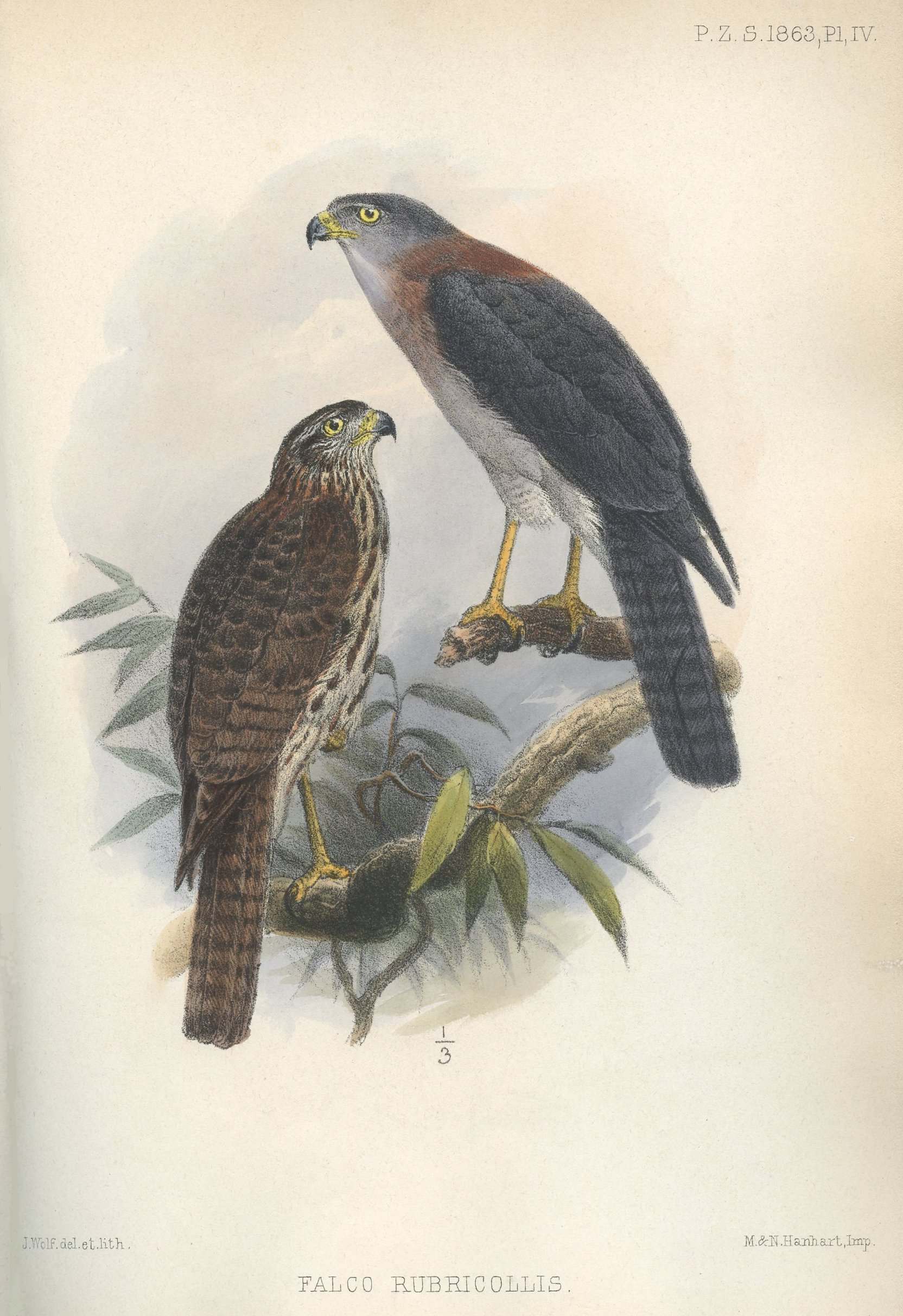
Russel Wallace : Alfred Russell Wallace (sic) (One of the Moluccas), with Descriptions of the New Species (S72: 1863) This collection of birds was made by myself during two months of the year 1861. It consists of sixty-six species, among which were no less than seventeen new ones. Of these, three were found about the same time in the Island of Sula, and, with a new Pitta, have already been described in the Society's 'Proceedings,' leaving thirteen to be described in the present paper. In my paper "On the Birds of the Sula Islands," read before the Society at their last Meeting, I pointed out that the large proportion of purely Celebes forms found there forced us to the conclusion that a closer connexion had once existed between those islands and Celebes, and required us to class them as forming a single zoological group. The Island of Bouru must, on the contrary, be classed with the Moluccas; for, leaving out about twenty species of rather wide distribution, the remaining forty-six are all either identical with, or most nearly allied to, Moluccan species. Not a single characteristic Celebes form is found in Bouru; and there are only three birds in the island whose affinities seem rather with the Indian than the Australian region, viz. Alcedo moluccensis, Hirundo javanica, and Treron aromatica. Bouru is therefore the western limit of the Moluccan fauna, and is the poorest portion of it, having several very remarkable deficiencies. Lorius, found in every other island of the Moluccas and New Guinea, is absent; Cacatua, found in every island of the Australian region, is also absent; and, stranger still, Buceros and Corvus, found in almost every large island of the archipelago, are both wanting. [[p. 19]] With these exceptions, most of the Moluccan types are represented either by identical or allied species. The following is a list of the new species now described, and of a few others which seem confined to Bouru:-- Tanygnathus affinis, n.s., Bouru and Ceram. All but the two first species in this list are confined to Bouru only, and they are mostly representative species of Moluccan forms. Besides these, the three species of Pachycephala are also, as far as the Moluccas are concerned, peculiar to Bouru; for though they are found also in Sula, they have evidently emigrated there, the Celebes group, to which Sula belongs, not possessing any species of the genus. The Island of Bouru may therefore be considered to have added seventeen new species, but not any new forms or genera, to the Moluccan avifauna. GEOFFROIUS PERSONATUS. Psittacus personatus, Shaw. Hab. Bouru, Amboyna, Ceram, Goram, Ké and Aru Islands. ECLECTUS MAGNUS. Psittacus magnus, Gm. S. N. i. p. 344. Hab. Bouru and the other islands of the Moluccas and New Guinea. ECLECTUS PUNICEUS. Psittacus puniceus, Gm. ? (et auct.) Pl. Enl. 518. Hab. Bouru, Amboyna, and Ceram. TANYGNATHUS AFFINIS. Viridis, subtus flavescens; capite saturate viridi; dorsi plumis cæruleo marginatis; crisso cæruleo; tectricibus alarum minoribus et mediis obscure viridibus, flavo marginatis, versus marginem et flexuram alarum viridi-cæruleis; majoribus cæruleo-viridibus, flavo-viridi marginatis; cauda subtus lutescente; culmine rostri versus basin biangulato. Near T. macrorhynchus, Wagl.; but the under surface, and especially the sides of the breast and belly, have much less yellow; the shoulders and wing-coverts are dull greenish and blue instead of deep black, and only a few of the lesser wing-coverts are of a greenish black; the greater wing-coverts nearest the body are all green, and the yellow margins are much less conspicuous than in the allied species; the outer webs of the primaries and of the greater and middle wing-coverts are green, instead of blue as in T. macrorhynchus. The bill also differs, the culmen being much flattened in its basal half, with distinct angular edges, whereas in the allied species it is regularly rounded. Bill deep red; feet dusky olive; iris olive-yellow, with an outer ring nearly white. Total length 17 inches; wing 9 1/2 inches; bill, to base, 2 1/8 inches, 1 7/8 inch. TRICHOGLOSSUS CYANOGRAMMUS. T. cyanogrammus, Wagl. Mon. Psitt. p. 554. Hab. Bouru, Ceram, and all the Papuan Islands. [[p. 21]] EOS RUBRA, var. Psittacus borneus, L. Hab. Bouru, Amboyna, Ceram, and Matabello Islands. HALIASTUR LEUCOSTERNUS. Haliastur leucosternus, Gould, B. of Austr. i. pl. 4. Hab. Bouru and the countries eastward. BAZA REINWARDTII. Lophotes reinwardtii, Schleg. & Müll. Verh. Ned. t. 5. Hab. Bouru, the Moluccas, and Timor. ACCIPITER RUBRICOLLIS. (Pl. IV.) Supra nigro-plumbeus, subtus albo-cinereus; nucha et colli lateribus late et intense rufis; genis cinereo-plumbeis; gula ventreque albescentibus; remigibus rectricibusque obscure fasciatis. Above slaty black; beneath very pale ash, shading into nearly pure white on the throat, belly, and under tail-coverts. Back and sides of the neck extending between the shoulders deep red-brown, a lighter shade of which covers the sides of the breast; the wings and tail are crossed by obscure black bands, which on the lighter undersides of the feathers become distinct blackish bands, less visible on the outer tail-feathers. The under wing-coverts and the base and margins of all the quills beneath are of a light rufous-buff. Bill black, at the base plumbeous; cere, orbits, and feet yellow; iris golden yellow. Length 14 inches; wing 8 1/4 inches; tail 6 1/4 inches; tarsus 2 1/8 inches; middle toe and
claw 2 1/8 inches. [[p. 22]] ACCIPITER CRUENTUS. Astur cruentus, Gould, Birds of Austr. i. pl. 18. Hab. Bouru and Timor. ATHENE HANTU. Rufa, supra rufo-brunnea; gula pallidiore; fronte genisque albescentibus; corpore subtus, cum cauda, rufescente et albescente indistinctissime fasciato; tectricibus alarum inferioribus rufis; remigibus fuscis, pogonio externo rufo; digitis tarsisque setulosis. Above dark, beneath bright rufous; tail with very indistinct, narrow, paler bars; forehead, cheeks, and chin whitish; under surface indistinctly banded with narrow fasciæ of darker and lighter rufous or whitish; the under tail-coverts barred with rufous and whitish; quills not barred, except close to their bases; under wing-coverts rufous, not barred; third, fourth, and fifth quills equal; tarsi and toes densely clothed with bristles; bill whitish horn-colour; iris yellow; feet (in the living bird) white. Length 12 inches; wing 8 3/4 inches; tail 5 inches. SCOPS LEUCOSPILUS. Ephialtes leucospila, G. R. Gray, P. Z. S. 1860, p. 344. Hab. Bouru and Gilolo. CAPRIMULGUS MACROURUS. C. macrourus, Horsf. Linn. Trans. xiii. p. 142. Hab. Bouru and the whole archipelago. DENDROCHELIDON MYSTACEUS. Cypselus mystaceus, Less. Voy. Coquille, Ois. t. 22. Hab. Bouru, Moluccas, and New Guinea. CACOMANTIS ASSIMILIS. Cuculus assimilis, G. R. Gray, P. Z. S. 1858, p. 184. Hab. Bouru. EUDYNAMIS RANSOMI. E. ransomi, Bp. Consp. Gen. Av. p. 101. Mas ad. nigro-violaceo nitens; rostro pallide viridi-olivaceo; pedibus plumbeis. The female and young male were described by Bonaparte. The adult male is, like others of the genus, entirely shining blue-black; iris crimson. Total length 18-19 inches; wing 8-8 1/2 inches; bill, to front, 1 1/8 inch. CENTROPUS MEDIUS. C. medius, Bp. Consp. Gen. Av. p. 108. Bill black; feet blackish lead; iris olive-brown. In the immature bird the plumage above is pale rufous, banded and spotted with black; the tail bronzy black, with about sixteen rufous bands; the under surface yellowish, with small dark spots; the thighs and vent dusky; and the bill pale horn. Length 18-19 inches; wing 7 1/2-8 inches; bill, from gape, 1 1/2 inch. TODIRAMPHUS COLLARIS. Alcedo collaris. Scop.; Sw. Zool. Ill. t. 57. Hab. Bouru and the whole archipelago. TODIRAMPHUS SANCTUS. Halcyon sancta, Vig. & Horsf.; Gould, Birds of Austr. ii. pl. 21. Hab. Bouru and the islands eastward. TANYSIPTERA ACIS. Supra nigra, subtus albo-rufescens, plumis tenuiter nigro marginatis; plumis pilei cæruleo marginatis, superciliis et corona occipitali magis cæruleis; tectricibus alarum minoribus cæruleis; uropygio albo; tectricibus caudæ superioribus albis, rufo tinctis et nigro marginatis; rectricibus mediis elongatis cæruleis, ad basin fusco et albo maculatis, spatulis albis cæruleo marginatis; aliis albis, externe fusco-cæruleo marginatis, interne albo et nigro maculatis; gula albescente; tectricibus caudæ inferioribus albis. Forehead and crown black, with the feathers blue-margined; a band over the eyes and round the nape brighter blue; ear-coverts, back, and wings deep black, with the lesser wing-coverts blue-margined, margin of the wing blue-tinged; primaries with the outer webs pale-edged towards the tips; under surface of the body pale [[p. 24]] buff, nearly white on the throat; the feathers of the breast and flanks with blackish lateral edges; rump white, feathers black-edged, the black increasing to the tail-coverts, the last of which have the outer web black; middle tail-feathers blue, with the bases irregularly white-striped, and the spatulate ends white, with bluish margins; lateral tail-feathers white, with blue margins to the outer webs, and irregular dusky markings on the inner webs. Bill orange-red; feet olive; iris dark. Total length 14 1/2 inches; wing 4 inches. Nine species of the genus have now been described; and a careful examination of the fine series of specimens in my collection having convinced me that they can all be clearly characterized, I will add a table of the species.
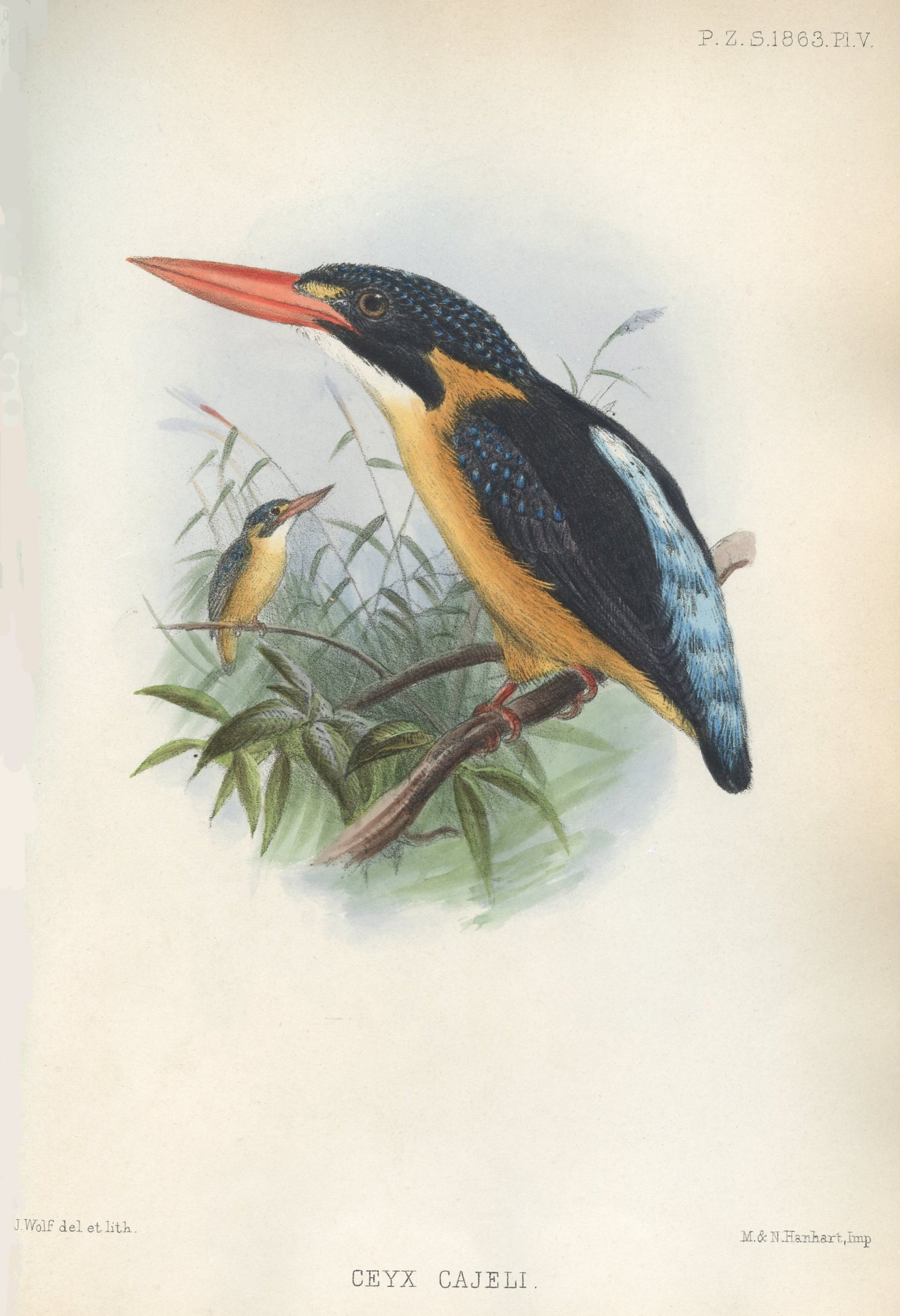
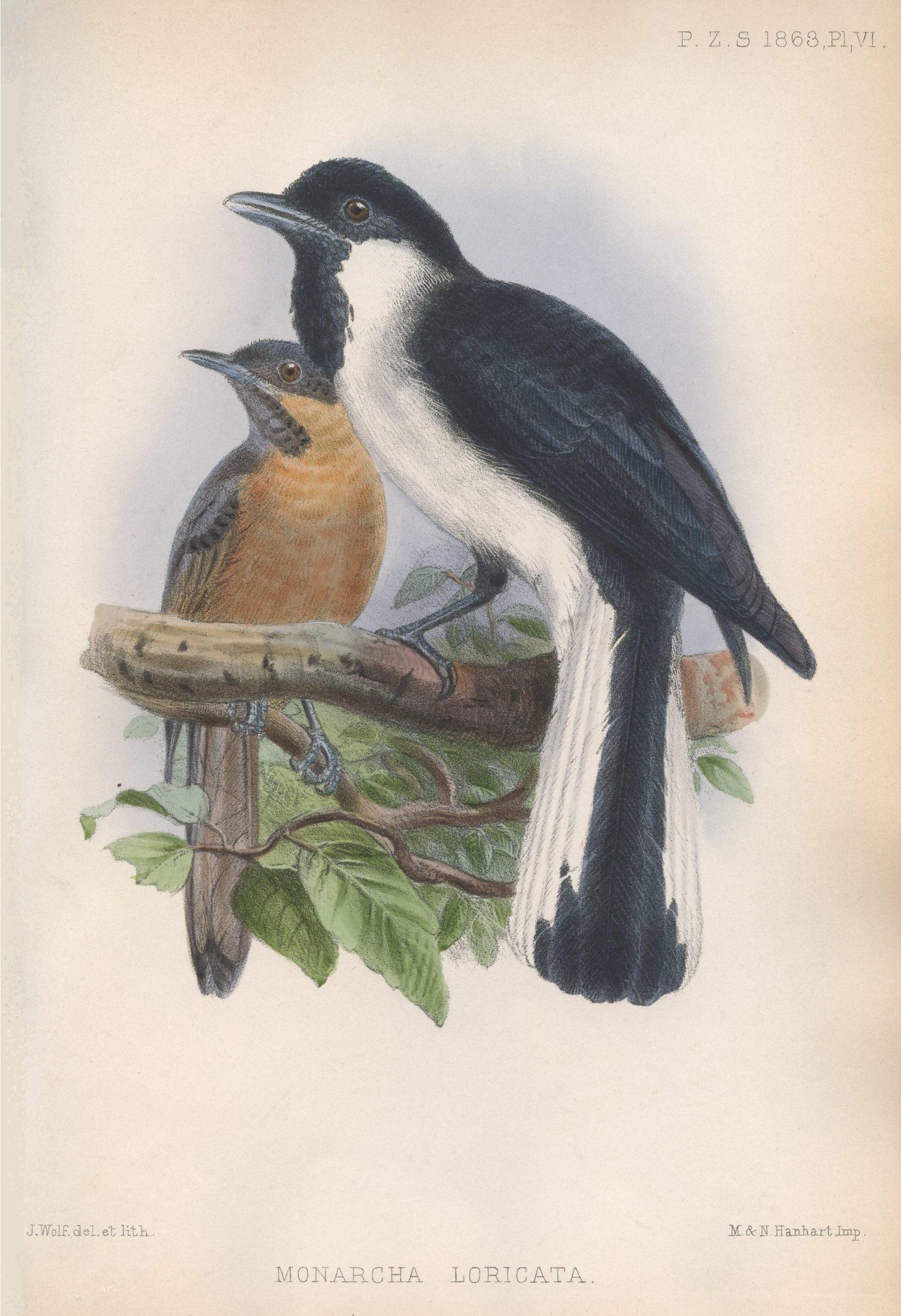
In this table I have altogether left out the Linnæan Alcedo dea, because it is possible we may yet obtain certain evidence as to which species it was applied to. The figure in the 'Planches Enluminées' and the careful description of Brisson agree best with T. sabrina, G. R. Gray; and I should have little hesitation in placing that name under T. dea as a synonym, but that specimens may yet arrive from Ternate--the locality given by the old authors. It is to be remarked, however, that Kaioa Islands, where I obtained T. sabrina, is the southernmost of a chain of islets extending up to Ternate, and nowhere more than eight or nine miles apart; so that it is very improbable there should be another species in that island. There can be [[p. 25]] therefore, I think, but little doubt that T. sabrina is but an individual or local variety of the true Alcedo dea. ALCEDO MOLUCCENSIS. Alcedo moluccensis, Blyth, Journ. As. Soc. Bengal, 1847. Hab. Bouru, Celebes, and Gilolo. CEYX CAJELI. (Pl. V.) Nigra, subtus rufo-lutea; capite et tectricibus alarum punctis parvis cæruleis ornatis; dorso et caudæ tectricibus pallide cæruleis; gula late alba; genis nigris aut tenuiter cæruleo striatis; flexura et margine alarum, colli et frontis maculis lateralibus rufis; rostro pedibusque dilute corallinis. Above black; beneath rufous yellow; each feather on the head marked with a very small, subtriangular, light-blue spot; on the back and upper tail-coverts the outer half of each feather is whitish blue; chin and throat pure white; a frontal spot over each nostril, a patch behind the ears, and the bend and margin of the wing rufous; ear-coverts black, and the space below them either black or very finely striated with blue; bill and feet pale coral-red; iris dark. Length 6 inches; wing 2 3/8 inches; bill, from front, 1 3/8 inch. EURYSTOMUS PACIFICUS. Coracias pacifica, Lath. Hab. Bouru and the islands eastward. PITTA RUBRINUCHA. Pitta rubrinucha, Wallace, P. Z. S. 1862, p. 187. Hab. Bouru. ACROCEPHALUS AUSTRALIS. Acrocephalus australis, Gould, Birds of Austr. iii. t. 38. Hab. Bouru. CISTICOLA RUSTICA. Luteo-rufa; supra plumis medialiter nigris; subtus gula et abdomine medio albescentibus; rectricibus subtus rufo terminatis, macula subapicali nigra. Rufous yellow; feathers of the head with a black stripe, of the [[p. 26]] back and wing-coverts black with a rufous margin; quills dusky, the primaries narrowly, the secondaries and tertiaries more broadly rufous-margined; tail pale, rufous-tipped; the two middle feathers rufous, with the central part and towards the apex blackish, the rest black; beneath with the sides of the neck, the breast, the flanks, and the under wing-coverts and tail-coverts pale chestnut, becoming nearly pure white on the throat and the middle of the belly; quills beneath brownish black, narrowly margined with pale rufous towards the base; tail beneath dusky, the feathers with narrow margins and broader tips of pale rufous, and each with a large suhapical black spot; bill dusky above, pale beneath; feet and claws pale yellowish; iris pale olive. Total length 4 inches; wing l 7/10 inch; tarsus 5/8 inch. MIMETA BOURUENSIS. Philedon bouruensis, Quoy & Gaimard, Voy. de l'Astrol. t. 8. f. 2. Cinereo-brunnea, subtus pallidior; facie et auriculis fusco-nigris; capite et gula substriatis; torque nuchali indistincto fulvo-cinereo. Earthy brown; beneath whitish brown; head a little paler, the feathers marked with a central blackish stripe, and on the nape a narrow paler rufescent band; ear-coverts dusky black; lores and cheeks blackish, mixed with whitish; chin and sides of the throat with a dusky stripe on each feather; primaries outwardly edged with pale rufous; under wing-coverts and margins of all the quills beneath towards the base pale rufous or buff; under tail-coverts with a tinge of buff; rectrices, all but the middle pair, tipped on the inner web with the same colour; bill horny black; feet lead-colour; iris dull red. Length 9 inches; wing 5 5/8 inches; tail 4 3/4 inches; bill, to front, 1 1/2 inch. Returning now to Mimeta and Tropidorhynchus, we have to observe that the former is a smaller, weaker, less active, less noisy, and less pugnacious bird; the feet have a less powerful grasp, and the bill is less acute. The latter has a great variety of loud and piercing notes, which bring its companions to the rescue in time of danger; and I have observed them drive away crows and even hawks which had ventured to perch on a tree where two or three of them were feeding. The Tropidorhynchus knows how to take care of himself, and make himself both respected and feared; it would therefore evidently be to the advantage of the more defenceless Mimeta to be mistaken for him. In this instance, as in most others, the imitation is far closer in the living bird than in the dead specimens, and it is a far more satisfactory case of mimicry than any of those which I have alluded to as occurring among birds, and which are more or less general resemblances to another group; while here we have two species, each confined to a single island, and each accurately imitated by a bird of a distinct family, with which it has no direct affinities. I therefore cannot doubt that this is a true case of mimicry, exactly analogous to that so common among insects, and which my friend Mr. Bates has the honour of having first brought under the same general laws which have regulated all variation in the organic world. CRINIGER MYSTICALIS. Viridi-olivaceus; subtus flavo-virens; gula crissoque flavescentibus; mento, loris et palpebris flavis; remigum pogonio interno fusco-nigro; cauda immaculata. Entirely olive-green, more yellow-tinged beneath, especially on the throat and under tail-coverts; the lores, chin, and eyelids are pure yellow, and also the basal half of the gape-bristles; bill horny black; feet lead-colour; iris red. Total length 9 inches; wing 4 1/4; bill to gape 1 inch. ARTAMUS LEUCOGASTER. Lanius leucogaster, Val. Ann. Mus. H. Nat. iv. t. 7. f. 2. Hab. Bouru and the whole archipelago, from Sumatra to New Guinea. HIRUNDO JAVANICA. Hirundo javanica, Lath., Temm. Pl. Col. 83. f. 2. Hab. Bouru and the islands westward. MYIAGRA GALEATA. Myiagra galeata, G. R. Gray, P. Z. S. 1860, p. 352. Hab. Bouru and the Moluccas. MONARCHA LORICATA. (Pl. VI.) Nigro-chalybea, subtus alba; mento gulaque squamatis, nigro-chalybeis; cauda alba, rectricibus mediis nigris, duabus utrinque juxta medium nigro terminatis; rostro pedibusque cæruleo-plumbeis. Blue-black; beneath pure white, except the throat, which is covered with scaly feathers of a rich metallic blue-black; this colour meets the black of the upper parts at the angle of the mouth, and extends in an oval shield to the bottom of the neck; under wing-coverts white; tail with the three lateral feathers on each side entirely white, the next two black-tipped, and the middle pair entirely black, with occasionally some white touches on the outer webs; bill and feet lead-blue; iris dark. The sexes are alike; in the young bird the white is replaced by pale reddish brown, and the black by fuscous brown. Total length 7 inches; wing 3 1/2 inches. RHIPIDURA TRICOLOR. Musicapa tricolor, Vieill. N. Dict. Hist. Nat. xvi. p. 490. Hab. Bouru, Moluccas, and New Guinea. RHIPIDURA BOURUENSIS. Fusco-plumbea; capite nigro, ventre pallide rufo, alis caudaque fuscis; gula albescente, pectoris maculis elongatis albis; stria supraoculari occulta, alba; tectricibus majoribus pallide terminatis, remigibus ultimis pallide marginatis; rectricum duarum externarum pogonio externo rufo-albo. Dusky lead-colour, deepening on the head to black; wings and [[p. 30]] tail dusky brown; feathers of the throat somewhat decomposed, with the outer half white; those of the breast with an elongate oval white spot on each feather; middle of the belly, the vent, and under tail-coverts pale rufous; over the eye is a silvery-white mark, only visible when the feathers are raised; the under wing-coverts are tipped with pale rufous, the outer row with white; the greater wing-coverts above have the extreme apex whitish, the tertiary quills have a very narrow pale-rufous edging; the tail is immaculate, with the exception of the two outer quills, which have their outer web for its whole length rusty white; bill black; feet dusky; iris dark. Length 7 inches; wing 3 3/8 inches; tail 3 1/2 inches; bill, to front, 1/2 inch. PACHYCEPHALA LINEOLATA. Pachycephala lineolata, Wallace, P. Z. S. 1862, p. 341. Hab. Bouru and Sula Islands. PACHYCEPHALA RUFESCENS. Pachycephala rufescens, Wallace, P. Z. S. 1862, p. 341. Hab. Bouru and Sula Islands. PACHYCEPHALA CLIO. Pachycephala clio, Wallace, P. Z. S. 1862, p. 341. Hab. Bouru and the Sula Islands. [[p. 31]] DICRURUS AMBOINENSIS. Dicrurus amboinensis, G. R. Gray, P. Z. S. 1860, p. 354. Hab. Bouru. CAMPEPHAGA MARGINATA. Supra plumbea, subtus albo-cinerea; loris fusco-nigris; tectricibus caudæ et alarum inferioribus albis; remigibus et tectricibus alarum majoribus nigris, albo marginatis; rectricibus extimis utrinque tribus albo terminatis. Bluish lead-colour above, ashy white beneath; base of wings beneath and under tail-coverts white; wings and tail black; primaries white-margined on the inner web near the base; secondaries, tertiaries, and greater wing-coverts white-margined towards the points; middle tail-feathers ashy, with a black tip, outer ones with the outer margin and tip ashy, the next two with diminishing ashy tips; bill and feet black; iris dark. Total length 8 1/2 inches; wing 4 1/4 inches. Hab. Bouru.Remarks.--This species somewhat resembles C. plumbea, but is smaller and paler beneath, and the bill is more slender. TROPIDORHYNCHUS BOURUENSIS. Cinereo-brunneus, subtus pallide cinereus; gula et capitis lateribus plumis subrigidis subsericeis; alis caudaque subtus fuscis; rectricum lateralium utrinque duarum apicibus tenuiter fulvescentibus; facie nuda nigra; protuberantia ad basin rostri nulla. Above ashy brown; head somewhat paler, with lanceolate feathers, the stems of which are black; beneath pale ashy; the plumes of the throat and upper part of the breast and the marginal feathers of the head and face somewhat rigid, of a silky lustre, and with darker stems; quills dusky, with the inner margins of a paler fulvous tinge; tail uniform dusky, the two outer feathers on each side with the apex on the inner side of paler fulvous colour; orbits and cheeks bare, black; bill black, without any protuberance at the base; feet pale lead-colour; iris light olive. Length 14 1/2 inches; wing 6 inches; tail 5 1/2 inches; bill, to front, 1 3/4 inch. ZOSTEROPS CHLORIS. Zosterops chloris, Bp. Consp. Gen. Av. p. 398. Hab. Bouru, Ternate, and Banda. [[p. 32]] DICÆUM ERYTHROTHORAX Diceum erythrothorax, Less. Voy. Coquille, Ois. t. 30. f. 1, 2. Hab. Bouru. NECTARINIA PROSERPINA. Purpureo-nigra velutina; capite viridi-chalybeo; gula purpureo-violacea metallica; crisso, tectricibus caudæ superioribus et alarum minoribus purpureo-cyaneis; remigibus fusco-nigris; cauda elongata, rectricibus duabus mediis purpureo marginatis. ♀. Supra olivaceo-viridis, subtus flavescens; capite pectoreque cinereis; cauda fuscescenti-nigra, apice pallida. Rich velvety purple-black; crown greenish steel-blue; throat richly scaled with violet-purple; wings, with the lesser coverts only, the rump, and upper tail-coverts metallic-blue; two middle tail-feathers margined on both sides with purple; wings and tail fuscous black. Female.--Above olive-green; the crown and nape dark ash, each feather having a central dusky spot; beneath pale olive-yellow, the throat and breast light ash; quills dusky, with an outer margin of olive-yellow; tail purplish-black, the feathers margined on the outer web with olive-green, and a whitish spot on the inner web at the apex, increasing in size from the middle to the outer feathers. Length 5 inches; wing 2 1/3 inches; tail 1 1/2 inch; bill, from front, 3/4 inch. NECTARINIA ZENOBIA. Cinnyris zenobia, Less. Voy. Coq. Hab. Bouru, Amboyna, Ceram, and Ké Islands. CALORNIS OBSCURA. Lamprotornis obscura, Bp. (ex Forsten) Consp. Gen. Av. 417. Hab. Bouru and the other Moluccas. [[p. 33]] MUNIA MOLUCCA. Loxia molucca, L.; Pl. Enl. 139. 2. Hab. Bouru and the Moluccas. TRERON AROMATICA. Columba aromatica, Gm. Bill, cere, and eyelids pale dull blue, tip of the bill becoming yellow in dry specimens; iris white; feet dusky purple. Total length 11 1/2 inches; wing 6 inches. Remarks.--Brisson's description of this species is most accurate, and, with the bird before one, cannot be mistaken. The figure in the 'Planches Enluminées' is abominable, but no doubt applies only to this bird. Gmelin copies Brisson; but makes an error which would prevent one recognizing the bird, in saying that "the upper tail-coverts are sordid white," instead of the lower. This bird is the true Treron aromatica (as being an inhabitant of the Spice Islands), a name which has been applied to birds of distinct species from India, Sumatra, and the Philippine Islands. It is easily distinguished from all its allies by having the top of the head ashy blue, not reaching below or even to the eyes, by the broad yellow bands on the wings, and by the under tail-coverts being nearly pure white in both sexes. CARPOPHAGA MELANURA. Carpophaga melanura ?, G. R. Gray, P. Z. S. 1860, p. 361. Hab. Bouru and all the Moluccas. CARPOPHAGA PERSPICILLATA, var. Columba perspicillata, Temm. Pl. Col. 246. Hab. Bouru, Batchian, Gilolo, and Waigiou Islands. [[p. 34]] PTILONOPUS PRASINORRHOUS. Ptilonopus prasinorrhous, G. R. Gray, P. Z. S. 1858, p. 185. Bill and its base, as far as the eye, gamboge-yellow; iris orange-brown, with an inner ring of yellow; feet dull purple. Length 9 1/2 inches; wing 4 3/4 inches. PTILONOPUS VIRIDIS. Columba viridis, L., Pl. Enl. 142. Bill yellow, the base red; iris yellowish red; orbits yellow; feet red. Total length 9 inches. The male and female are alike. MACROPYGIA AMBOINENSIS. Columba amboinensis, L., Bp. Consp. Gen. Av. ii. p. 56. Hab. Bouru and the other Moluccas. CHALCOPHAPS MOLUCCENSIS. Chalcophaps moluccensis, G. R. Gray, P. Z. S. 1862, p. 345. Hab. Bouru, Sula Islands, and the Moluccas. MEGAPODIUS WALLACII. Megapodius wallacei, G. R. Gray, P. Z. S. 1860, p. 362, pl. 171. This species differs somewhat in its habits from the other members of the family found in the Malay Islands. It resides generally in the hilly districts of the interior, like Megacephalon maleo, and, like that species, comes down to the beach to deposit its eggs; but instead of scratching a hole for them and covering it up again, the bird burrows into the sand to the depth of 3 or 4 feet obliquely downwards, and deposits its egg at the bottom. It then loosely covers up the mouth of its hole; and is said by the natives to obliterate and disguise, by innumerable tracks and scratches, its own footmarks leading to the hole. Its offspring is then left to make its way into the world as it best can. The only specimen I obtained here was caught on the beach, at the mouth of its burrow, early one morning. Its wing was broken and wounded at the outer joint, as if it had been attacked by some small animal when in its burrow, probably a rat. Hab. Bouru, Gilolo, and Ternate. MEGAPODIUS FORSTENI. Megapodius forsteni, Gray & Mitch. Gen. of Birds, iii. pl. 124. Hab. Bouru, Amboyna, and Ceram. GLAREOLA GRALLARIA. Glareola grallaria, Temm. Hab. Bouru and Australia. ESACUS MAGNIROSTRIS. Charadrius magnirostris, Lath., Temm. Pl. Col. 387. Hab. Bouru, Celebes, and New Guinea. NUMENIUS UROPYGIALIS. Numenius uropygialis, Gould, B. of Austr. vi. pl. 43. Hab. Bouru, the Moluccas, and New Guinea. BUTORIDES JAVANICUS. Ardea javanica, Horsf. Linn. Trans, xiii. p. 190. Hab. Bouru and the whole archipelago. ARDETTA FLAVICOLLIS. Ardea flavicollis, Lath. Ind. Orn. ii. p. 701. Hab. Bouru, and from India to Australia. NYCTICORAX CALEDONICUS. Ardea caledonica, Gm.: Gould, B. of Austr. 6. t. 63. Hab. Bouru, Moluccas, and Australia. GALLINULA FRONTATA. Fusco-plumbeo-nigra; dorso alisque olivascentibus; cauda nigra; tectricibus caudæ inferioribus lateralibus albis, mediis nigris; rostro rubro, apice abrupte luteo; clypeo frontali magno, dilatato, supercilia attingente; pedibus rubris, fusco articulatis, tibiis subtus olivaceis. Very near G. tenebrosa, Gould, but distinguishable from that species by the differently-coloured back and wings, which are olivaceous brown instead of black, the rather slenderer bill, the very large frontal plate, and the more uniform-coloured legs, the joints of the tibiæ and tarsi being dusky olive, the median line of the tibiæ beneath olive-green, the tarsi beneath dusky lead-colour; the lateral under tail-coverts pure white, the middle ones black; the rest of the plumage of a dusky lead-colour, deepening on the top of the head and neck to nearly black, and on the breast tinged with brown; wings brownish olive; tail black. Total length 13 inches; wing 7 inches; bill, from back of frontal plate, 2 inches. [[p. 36]] RALLINA PHILIPPENSIS. Rallus philippensis, L. Hab. Bouru and the islands eastward. DENDROCYGNA GUTTULATA. Anas guttulata, Temm. Hab. Bouru, Ceram, and Celebes. TADORNA RADJAH. Anas radjah. Less. & Garn. Voy. Coq. Zool. pl. 49. Eyelids yellow; iris milk-white; bill and feet white; claws dusky white; nostrils blackish. Total length 21 inches. PODICEPS TRICOLOR. Podiceps tricolor, G. R. Gray, P. Z. S. 1860, p. 366. Bill black; base of the lower mandible lemon-yellow, which extends up towards the eye. Hab. Bouru and the Moluccas.
1. Since reading this paper, I have seen Professor Schlegel's 'Catalogue of the Birds in the Leyden Museum,' part 1, in which (Astures, p. 39) he describes this bird under the name of Nisus cirrhocephalus ceramensis, which seems to be equivalent to making it a variety of N. cirrhocephalus. Considering, however, the [[p. 22]] bird to be a very good species, I should at once have adopted Professor Schlegel's name ceramensis, had I not obtained the bird in other localities than Ceram. The Raptores having so generally an extensive range renders the application of territorial specific names less advisable in their case than in that of the Passeres. My own rule is only to apply the name of a country as specific name when the surrounding districts are known to possess their peculiar representative species, in which case it amounts almost to a certainty that the new bird is similarly restricted in range. [[on pp. 21-22]] 2. PACHYCEPHALA MENTALIS, n. s. P. flavo-olivacea; capite, genis mentoque nigris; gula late alba;
lunula pectorali nigra; subtus cum torque nuchali vivide flava; cauda ejusque tectricibus superioribus
nigris; remigibus fusco-nigris, primariis olivaceo limbatis, aliis tectricibusque alarum flavo-olivaceo
marginatis; rostro nigro, pedibus fusco-olivaceis. 3. DICÆUM VULNERATUM.
|
||||||||||||||||||||||||||||||||||||||||||||||||||||