Some Biogeographers, Evolutionists and Ecologists:
Chrono-Biographical Sketches
Wynne-Edwards, Vero Copner (England-Scotland
1906-1997)
ecology, ornithology
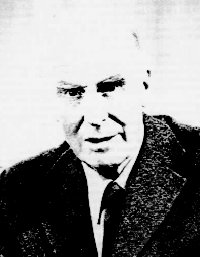 from Wikipedia.org |
Wynne-Edwards was one of the century's leading behavioral ecologists. The key element of his point of view was his elucidation of the hypothesis of group selection, an idea which, though frequently discussed, continues to attract only limited acceptance among evolutionary biologists. Early in his career Wynne-Edwards worked especially on fishes and birds, concurrently developing an interest in marine biology. In one of the more creative research projects he was able to get the Cunard Line to let him make a number of free voyages across the North Atlantic in their ships to examine the changing movements and migration patterns of seabirds. A resulting report, published in 1935, won him a Walker Prize from the Boston Natural History Society. During his tenure at McGill he concentrated on studies of freshwater fishes and far-northern plants and birds; these efforts later won him another Walker Prize. On returning to Britain he made use of his earlier investigations into the breeding behavior and population structure of birds by developing the group selection idea, which posed that populations, rather than individuals, are the focus of selective forces; specifically, it is those populations that develop means of exploiting their resources sustainably that will tend to succeed at the expense of those who are less successful at doing so. This thinking was spelled out in full in 1962 in one of the century's leading ecology titles, Animal Dispersion in Relation to Social Behaviour. |
Life Chronology
--born in Leeds, England, on 4 July 1906.
--1927: B.A. in zoology, Oxford University
--1930: M.A., Oxford University
--1930-1944: assistant professor in zoology, McGill University
--1935: publishes "On the Habits and Distribution of Birds on the North
Atlantic" in the Proceedings of the Boston Society of Natural History
--1937, 1944, 1945, 1950: fieldwork in northern Canada
--1944-1946: associate professor, zoology, McGill University
--1946-1974: holds Regius chair in zoology at the University of Aberdeen
--1950: elected to the Royal Society of Edinburgh
--1962: publishes his Animal Dispersion in Relation to Social Behaviour
--1962: visits New Zealand on fellowship
--1963-1968: joint editor, Journal of Applied Ecology
--1965-1970: president, British Ornithologists' Union
--1968-1971: chairman, Natural Environment Research Council
--1970: elected to the Royal Society of London
--1977: honorary LL.D., University of Aberdeen
--1977: receives the Godman-Salvin medal of the British Ornithologists'
Union
--1977: receives the Neill Prize of the Royal Society of Edinburgh
--1980: receives the Frink Medal of the Zoological Society of London
--dies near Aberdeen, Scotland, on 5 January 1997.
For Additional Information, See:
--The
Auk,
Vol. 116(3) (1999): 815-816.
--Ibis, Vol. 139(2) (1997): 415-418.
--Biographical Memoirs
of Fellows of the Royal Society, Vol. 44 (1998): 472-484.
--Perspectives in Biology and Medicine, Vol 47(1) (2004): 15-31.
*
*
*
*
*
Copyright 2005 by Charles H. Smith. All rights
reserved.
http://people.wku.edu/charles.smith/chronob/WYNN1906.htm
Return to Home/Alphabetical Listing by Name
Return to Listing by Country
Return to Listing by Discipline